Boeing To Buy Spirit Aero For $4.7 Billion In Stock Deal
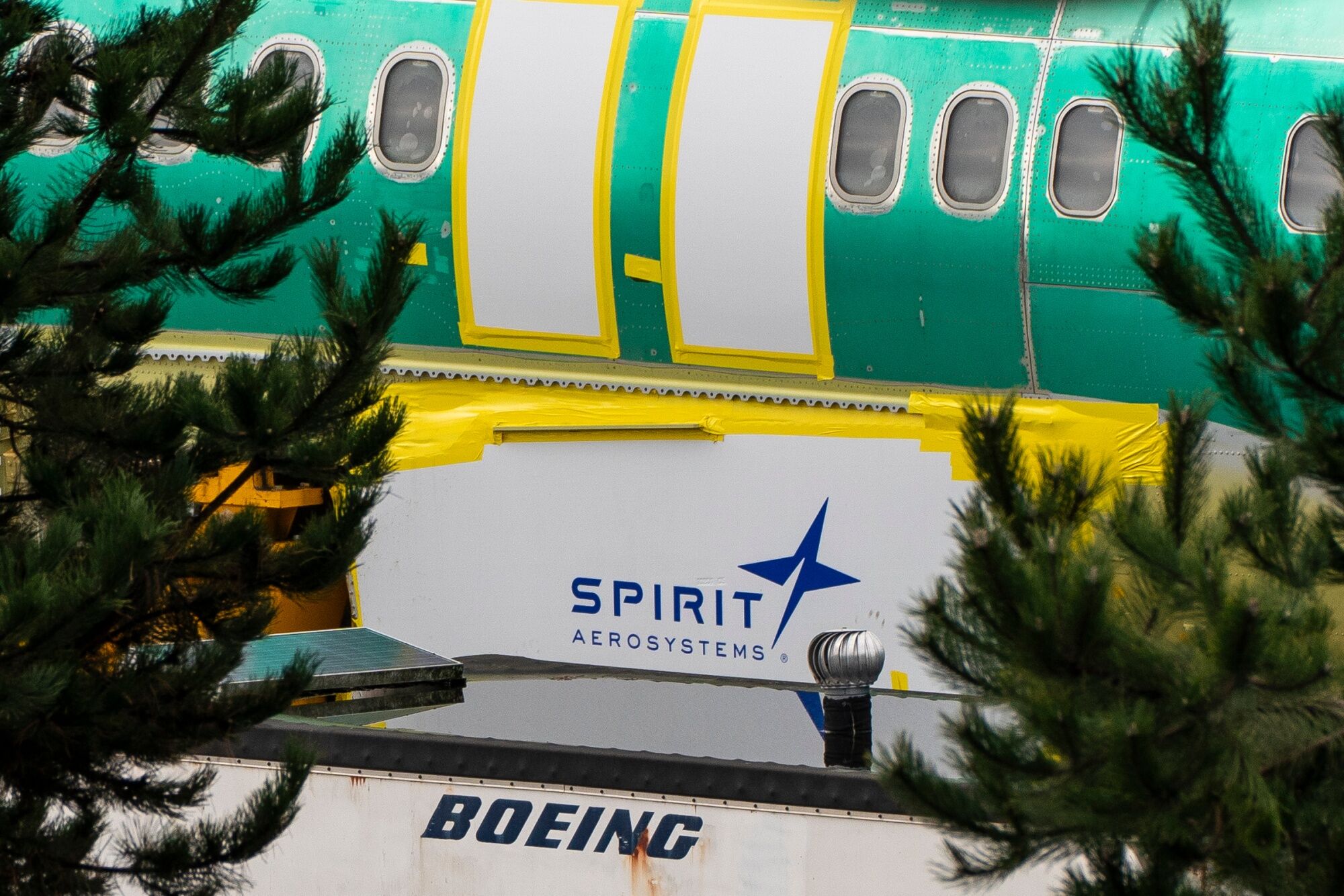
(Bloomberg) -- Boeing Co. agreed to buy back Spirit AeroSystems Holdings Inc. for $37.25 a share in an all-stock deal that values the supplier at $4.7 billion, unwinding a two-decade separation as the embattled US planemaker tries to fix is manufacturing defects.
The total transaction value is about $8.3 billion, including Spirit's last reported net debt, according to a statement early on Monday. Rival Airbus SE will also take over parts of Spirit that make parts for its operations, and the European planemaker will pay a nominal price of $1 for the assets, while receiving $559 million in compensation, according to a separate release.
“We believe this deal is in the best interest of the flying public, our airline customers, the employees of Spirit and Boeing, our shareholders and the country more broadly,” Boeing Chief Executive Officer Dave Calhoun said in the statement.

The complex, three-way transaction reunites Boeing with an operation that it spun off in 2005 as part of a broader push to trim costs and outsource assets. The move to take Spirit back in-house came in the wake of the near catastrophic accident on Jan. 5 in which a fuselage that had been assembled by Spirit lost a door-shaped panel during flight. That mishap triggered a chain reaction at Boeing, which has seen a wholesale management shakeup, federal investigations, to scrutiny of to federal investigations.
The price that Boeing is paying is 30% above Spirit's closing stock price on February 29, the day before the companies confirmed they were in merger talks.
Airbus said it entered a “binding term sheet agreement” with Spirit that will see the planemaker take on facilities that make A350 fuselage sections in Kinston, North Carolina, and St. Nazaire in France. It will also seek to buy the A220 wing and mid-fuselage production in Belfast, Northern Ireland, and Casablanca, Morocco, as well as A220 pylon manufacturing at Spirit's headquarters, it said.
The transaction is set to close in the middle of next year. Boeing said it's taking over “substantially all Boeing-related commercial operations,” as well as additional commercial, defense and aftermarket operations.
The deal struck after months of negotiations comes as Boeing approaches another milestone, a settlement with the US Justice Department that would potentially involve pleading guilty to criminal fraud in relation to two crashes involving the 737 Max aircraft that occurred in rapid succession in 2018 and 2019.
The US government plans to charge Boeing, leaving the planemaker to choose between pleading guilty or taking the risk of going to trial, according to people familiar with the matter said on Sunday.

The effort to buy back Spirit will likely be welcomed by US aviation regulators concerned about manufacturing quality lapses as the companies deal with massive worker turnover following the pandemic. But the tie-up and dissolution of Spirit would also need to be approved by Pentagon and US antitrust regulators increasingly concerned about consolidating aerospace and defense manufacturing.
The Boeing transaction, once completed, will reunite assets that for decades once sat under one roof, bringing together thousands of workers and decades of shared expertise. It also brings a longtime former Boeing leader back to the company as directors hunt for a new leader, with Calhoun set to step down at the end of the year.
Spirit Aero CEO Pat Shanahan was a longtime Boeing executive steeped in factory operations, known for helping turn around the 787 Dreamliner after a troubled start. He's considered a potential contender to succeed Calhoun in Boeing's top role.
Spirit has faced growing financial pressure and scrutiny alongside Boeing after the door-shaped panel on a 737 Max 9 model blew out minutes after takeoff. Shipments of 737 fuselages have plummeted as Boeing steps up its inspections in Kansas and back at home near Seattle, and declined to accept aircraft structures with missing components or incomplete work.
For Boeing, the deal brings a key supplier for the 737, 787 Dreamliner and other commercial jets back in-house at a time when the company is feeling the financial strain from the slowed-down output. Boeing lost about $4 billion in cash in the first quarter and is set to bleed a similar amount in the current three months of the year. The company's credit rating is hovering one level above speculative grade, and management is keen to avoid slipping into junk territory.
PJT Partners was the financial adviser to Boeing, with Goldman Sachs Group Inc. and Consello acting as additional advisers.
--With assistance from Siddharth Philip and Allyson Versprille.
(Updates with financial details from second paragraph.)
More stories like this are available on bloomberg.com
©2024 Bloomberg L.P.

-
Talking Points This Week: Tech Nerves, FII Buying, And A Faraway Banking Shock

The global markets are not shining this Diwali. The exception in the large markets is, India.
-
Midterm Rally Lasted A Day. The Hard Reality Of A Divided US May Last Two Years | Opinion
Between a contested AI boom, a debt ceiling that arrives in 2027 and a president with every incentive to act alone, the next two years may prove more volatile than the first day's rally suggests.
-
Blue Wave Will Derail the AI Trade but Won't Dismantle the AI Era | Unhedged Position
The Democrats' sweep of the US Congress will see politics collide with economic forces both over the long and short term.
-
It's Time To Take The GST Council's Bet On Trust Global
Payment records can prove India's services exports, and clear, proportionate rules can bring foreign digital sellers into the tax net.
-
Opinion | India at 38: From Innovation Overperformer to Innovation Powerhouse
India now has 453 VC-backed deep science startups, 18 of them late-stage, after 117 percent growth since 2020. Laurus Labs, at USD 9.3 billion, is the most valuable deep science company in any middle-income economy outside China.
-
Navigating Energy Crossroads: S Jaishankar's Call For Diversified Supply Chains At G20 Ministerial Meeting
As geopolitical fault lines continue to test maritime trade routes and commodity flows, Jaishankar's message remains pertinent: true economic resilience requires open markets, protected transit lines, and a genuine commitment to multilateral cooperation rather than coercion.
-
Indians Are Travelling, But Not Every Journey Is A Holiday | The Week In Whys
Pilgrims, patients and working women are the real travellers, and the system hasn't quite caught up with them.
-
Getting To Work Costs Women More | The Reason Why
It is not just about women paying more than men. It is about women paying much more in cities than in villages.
-
AI Bias In Investing Cannot Be Eliminated, But It Can Be Governed
Framing is a particularly important example as identical financial information presented in terms of gains rather than losses can lead an LLM to reach a different assessment.









