Blackstone, KKR Defy Global Private Debt Slump With Bets On Asia
(Bloomberg) -- Direct-lending behemoths from Blackstone Inc. to KKR & Co. are looking to expand in Asia's fledgling private-debt sector, targeting firms shut out of volatile public markets but healthy enough to survive surging inflation and a potential recession.
Bucking an industry-wide slowdown, some of these alternative-asset powerhouses are building up their presence in the region at a brisk pace. Blackstone is targeting a tenfold increase in private credit assets to at least $5 billion “in the near term” while Apollo Global Management and KKR both recently launched their first Asia-oriented private credit funds worth $1.25 billion and $1.1 billion, respectively.
“There are a lot of growing sectors in Asia where we see increasing demand for financing, including tech, software and life science, especially at a time of market volatility and uncertainty,” said Roger Zhang, a managing director at Blackstone.

Private lenders globally have been shifting more toward prioritizing risk control, as they steer away from companies willing to accept higher borrowing costs but more vulnerable to an economic slowdown. This is also happening at a time when increased currency volatility is adding to the long-standing challenge in some Asian countries of curbs on foreign investment, factors that have threatened to temper the market's momentum in the region.
“We are focused on giving capital to winners and businesses that are going to thrive but that are unable to access the capital markets for more technical reasons,” such as a lack of liquidity in public bond markets, said SJ Lim, a managing director at KKR.
KKR has made more than 15 credit investments totaling about $2.7 billion since 2019 in the Asia Pacific region, according to a KKR spokesperson.
Positioned between equity and cheaper public debt, private credit involves businesses getting money directly from a fund, which often offers more contractual flexibility than getting a loan from a bank or even borrowing from a shadow lender.
But bank lending remains the mainstay in Asia, given the institutional knowledge lenders have built up on the various regulations and legal standards across countries.
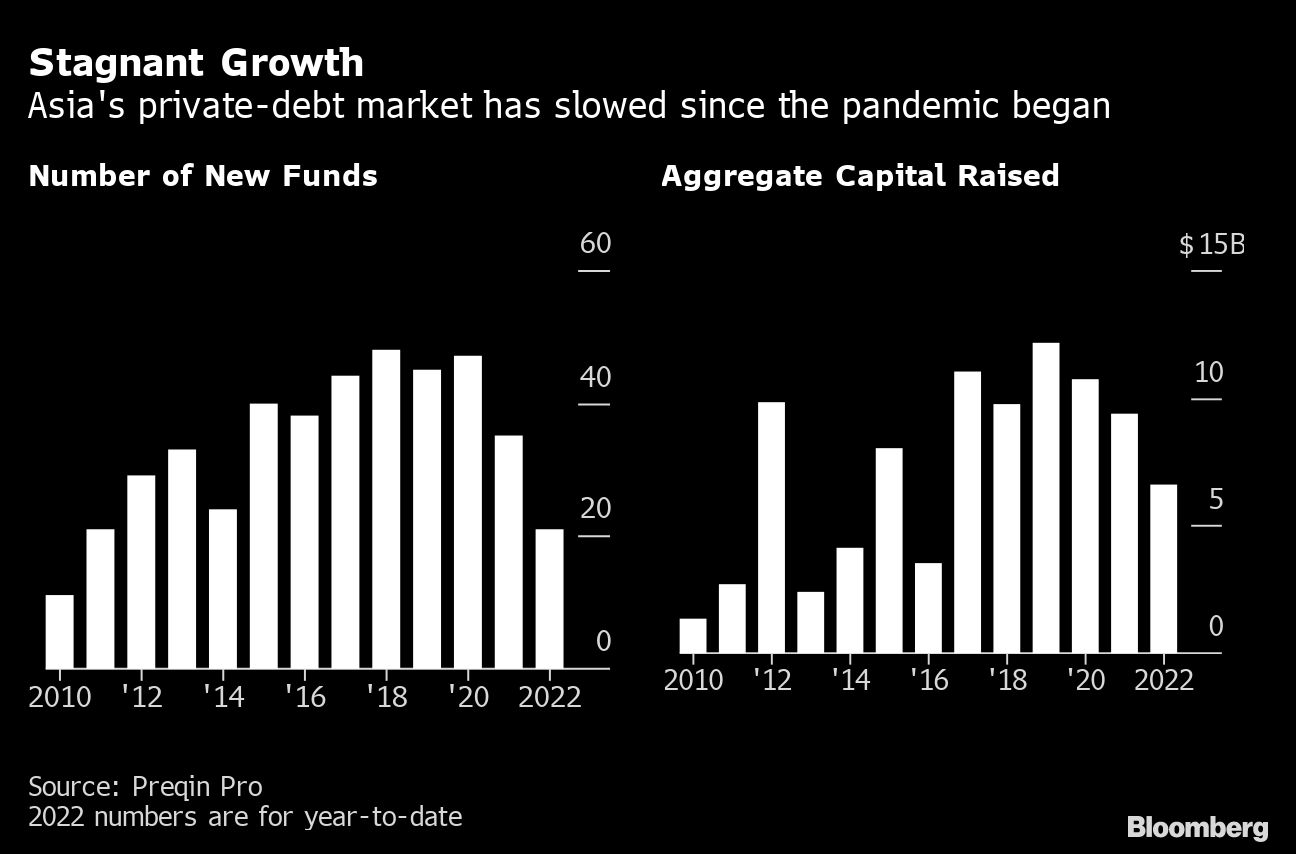
The number of new private-debt funds, as well the total amount of money they've all raised, has dropped since the pandemic began. That's partly contributed to the average fund size rising to $346 million this year, up 18% from last year, according to data provider Preqin.
“There's more appetite from investors to allocate to these funds as the latter have become more competitive in sectors where banks used to lend,” said Angela Lai, an analyst at Preqin. “Having a bigger fund would allow fund managers to lend in larger ticket size.”
More stories like this are available on bloomberg.com
©2022 Bloomberg L.P.

-
Love, Sex Aur Dhokha: The Audacious Plot To Spy On Jensen Huang

A Taipei dinner, a Singapore chip buyer and a suspected Chinese asset: inside the alleged spy operation that got close to NVIDIA's Jensen Huang.
-
Ten Things I Learnt This Samvat
Patience can be a trap. Cheap stocks can stay cheap. Leverage can wipe you out. What did Samvat 2082 teach us? Niraj Shah writes on 10 lessons from the year gone by.
-
Talking Points This Week: Tech Nerves, FII Buying, And A Faraway Banking Shock
The global markets are not shining this Diwali. The exception in the large markets is, India.
-
Midterm Rally Lasted A Day. The Hard Reality Of A Divided US May Last Two Years | Opinion
Between a contested AI boom, a debt ceiling that arrives in 2027 and a president with every incentive to act alone, the next two years may prove more volatile than the first day's rally suggests.
-
Blue Wave Will Derail the AI Trade but Won't Dismantle the AI Era | Unhedged Position
The Democrats' sweep of the US Congress will see politics collide with economic forces both over the long and short term.
-
It's Time To Take The GST Council's Bet On Trust Global
Payment records can prove India's services exports, and clear, proportionate rules can bring foreign digital sellers into the tax net.
-
Opinion | India at 38: From Innovation Overperformer to Innovation Powerhouse
India now has 453 VC-backed deep science startups, 18 of them late-stage, after 117 percent growth since 2020. Laurus Labs, at USD 9.3 billion, is the most valuable deep science company in any middle-income economy outside China.
-
Navigating Energy Crossroads: S Jaishankar's Call For Diversified Supply Chains At G20 Ministerial Meeting
As geopolitical fault lines continue to test maritime trade routes and commodity flows, Jaishankar's message remains pertinent: true economic resilience requires open markets, protected transit lines, and a genuine commitment to multilateral cooperation rather than coercion.
-
Indians Are Travelling, But Not Every Journey Is A Holiday | The Week In Whys
Pilgrims, patients and working women are the real travellers, and the system hasn't quite caught up with them.









