Billionaire Saudi Prince Sees Currency Depeg As 'Last Resort'
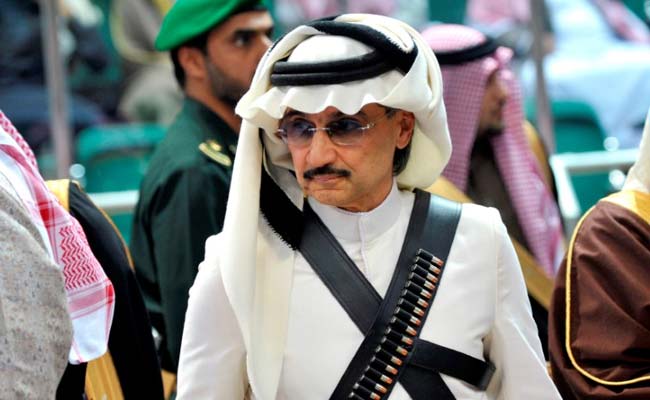
Saudi billionaire Prince Alwaleed Bin Talal raised the possibility that the kingdom may need to depeg its currency in the future as the country undergoes unprecedented social, political and financial change.
"As a last resort maybe sometime two, three years down the line it's a possibility," Alwaleed, speaking in an interview with Bloomberg TV, said of a potential change to the riyal's fixed valuation against the dollar. "Meanwhile it should stay where it is right now. There are so many things happening."
Saudi officials have repeatedly sought to refute speculation on maintaining the currency's peg to the dollar as the country battles slowing growth and slumping oil income. Central Bank Governor Ahmed Alkholifey earlier this week again reiterated the commitment to maintaining the peg.
The world's biggest oil exporter halted payments to contractors last year as it sought to rein in a budget deficit that reached about 15 percent of gross domestic product. Authorities also have introduced a package of austerity measures, including cuts to public-sector wages and energy subsidies. Economic growth is expected to slow to 1.3 percent this year, according to a Bloomberg survey of economists, the lowest level since the 2009 global recession.
The currency has been fixed at about the same rate since the 1980s. Since its introduction, the riyal's 3.75-per dollar peg has been instrumental in shielding the economy from the volatility of oil and natural gas.
Saudi Arabia is working to reduce the the Middle East's biggest economy's reliance on oil, which provides three-quarters of government revenue, as part of a plan for the biggest economic shakeup since the country's founding.
As the government seeks to navigate the worst economic slowdown since the global financial crisis, speculation has mounted this year that the world's biggest oil exporter won't be able to maintain the riyal's peg to the dollar as revenue plunges. Hedge funds such as PointState Capital and Pershing Square Capital Management have wagered that the fixed rate will be dropped.
"It's the first time any policy maker in the kingdom has even raised the prospect of de-pegging, and that's significant," according to Neil Shearing, chief emerging markets economist at Capital Economics Ltd. in New York. "But the message for the next year or so is still steady as she goes -- signs point to keeping the peg in place."
A fixed exchange rate helps the central bank accumulate foreign reserves when oil prices rise and avoid squandering the windfalls that anchor investor confidence during economic downturns. It also helps cap long-term inflation by effectively linking monetary policy to that of the U.S.
The country can still influence energy prices, become more rigorous with capital controls, or tap its more than $500 billion in foreign reserves to defend the riyal's peg if needed, said Michael Bolliger, head of emerging market asset allocation at UBS Wealth Management, which oversees the investment strategy for $2.1 trillion in assets.
"If in four or five years the Saudi economy is indeed more diversified, suddenly a pegged currency might no longer be the prevailing choice for a Saudi policy maker," Bolliger said. "Having a floating exchange rate might be a more interesting proposition for the economic framework -- that's something we have to monitor, along with energy prices, that can change this equation in a meaningful way."
(c) 2016, Bloomberg
(This story has not been edited by NDTV staff and is auto-generated from a syndicated feed.)

-
Where You Live Shapes How You Get To Work | The Reason Why

Two-wheelers are the most popular way to get to work in India, accounting for nearly 43% of workplace commutes.
-
High US Salaries, No Green Card Certainty: The Financial Calculation Facing Indian H-1B Families
The suspension of PERM processing at eight technology employers does not cancel existing H-1B visas. What it does is force a question many Indian families have been avoiding: is the US salary worth tying your career and family plans to one employer?
-
Unhedged Position: Can India See An Indonesia-Style Time Correction?
The Nifty is trading below levels it first clocked in 2024. Is there, then, as I have suggested in the headline, potential that the current time correction drags on painfully for the next three-five, even ten years?
-
Navigating Friction And Energy Realities: An Analysis Of Marco Rubio's October Visit To India
Occurring at a critical juncture marked by stalled trade negotiations and escalating geopolitical pressures over global energy supplies, the visit offers a profound window into modern US-India relations.
-
India Exports Capital. Why Not Export Trusteeship?
The big question, then, is whether India can build an institution that global borrowers, investors, banks, and lawyers can trust, even without an Indian connection.
-
France's Economy & Politics Are In Crisis | The Reason Why
Let's look at how the French economy and politics evolved under Nicolas Sarkozy, Franois Hollande and Emmanuel Macron.
-
You May Inherit The Business. You Must Earn Its Credibility.
Succession tests the founder's ability to share authority as much as it tests the next generation's readiness to assume it.
-
Signing Deals Is One Thing; Making Them Work Is Another | The Week In Whys
Sometimes, things don't turn out as planned. Indian companies have lost some bids to rivals, some projects won't produce until 2030.
-
FOMC Wall, PERM Suspension, Hospital Stocks | Talking Points This Week
A PERM suspension would directly affect green-card sponsorship rather than H-1B visas, so the near-term earnings impact could remain relatively limited. The key question is whether this marks a new phase in US scrutiny of Indian IT.
-
Everything, Everywhere, All At Once: Dalal Street's Week To Forget | Joining The Dots
Visa curbs, a Starlink spat and cancer drug caps: what connects this week's shocks for Indian markets









