Billionaire JD.com Founder Lines Up Next Challenge: Beating Alibaba
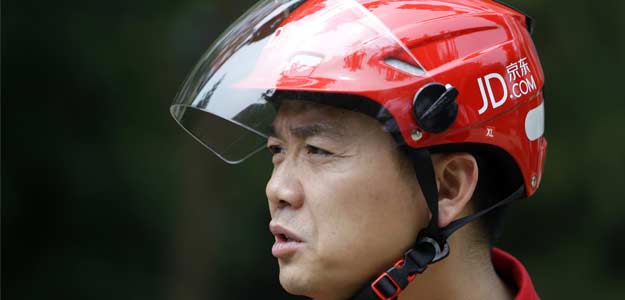
With an iron grip, JD.com Inc founder Richard Liu has dragged China's number two online retailer from a Beijing backwater to a rich New York listing. Beyond the wealth that brought him lies Liu's next target - beating Jack Ma's Alibaba.
"The competition makes the two companies stronger," said Liu, a billionaire at 41. "I'm actually enjoying competing," the chief executive told Reuters in an interview.
On top of shares in a $37 billion company that mean he's now worth close to $8 billion, Liu still controls 84 per cent of voting rights at JD.com. If that causes corporate governance concerns, it makes his resolve to take on his biggest competitor, the Alibaba Group Holding Ltd e-commerce juggernaut co-founded by Ma, all the more personal.
"He has this ambition to win... He says there's only number one, there's no number two," said Kathy Xu, founder and managing partner of Capital Today Group. Xu, one of China's most successful venture capitalists, put $10 million into JD.com in 2006: Her investment's now worth 110 times that amount.
Like Amazon.com Inc, JD.com has a logistics-focused e-commerce business. The company, whose delivery staff outnumbers Alibaba's 22,000 employees, promises same-day delivery in 43 of China's biggest cities.
That sets it apart from Alibaba, which still depends on China's often unreliable postal infrastructure to get goods to its customers' doors as it accounts for about 80 per cent of all e-commerce in China.
"It's who can give customers the best experience, they're the one who'll succeed and achieve ultimate victory," said Liu. According to iResearch, China's e-commerce market will grow nearly two-thirds to 4.45 trillion yuan ($717 billion) in 2017 from 1.84 trillion yuan in 2013.
Like Amazon in its early days, it could also take JD.com time to build a record of lasting profitability. In 2013, the company only scraped a net income of $36 million with the help of Chinese government subsidies, after total losses of more than $430 million for the two previous years.
As Alibaba lines up its own mammoth IPO, investors have instead focused on JD.com's outsized sales growth, with revenue tripling to 69.3 billion yuan ($11.2 billion) in 2013 from two years earlier. Also encouraged by its close ties with Chinese internet giant Tencent Holdings Ltd - Alibaba's arch-rival - investors have pushed JD.com's share price around a third higher since its initial public offering last month.
Personal touch
From a modest background in Suqian, in the eastern province of Jiangsu, where his parents ran a small shipping business, Liu carries a calm demeanour and sports the first flecks of grey in his hair.
Every year, around the June 18 anniversary of his first company's establishment, Liu dons a red JD.com delivery uniform and personally delivers products to unsuspecting customers.
On Monday, Liu took to the streets of northern Beijing, near the Olympic Bird's Nest stadium, at the handlebars of one of JD's 3-wheel delivery scooters. At first berated by a guard for parking at the wrong entrance of the former Olympic village, Liu finally delivered an order of dog food to a bemused office worker on the third storey of an apartment block.
Investors can be sure Liu didn't miss any important decision-making while he was out - with majority control of voting rights, board decisions require his presence.
"The control provisions that Mr. Liu has are, in my view, truly unprecedented," said Raffi Amit, a professor of entrepreneurship and management at the Wharton School. "He has complete and unilateral control of the board, which in turn controls the company."
For Liu, there's no issue.
"For an entrepreneurial business experiencing high-speed growth, the more control a founder has the healthier it is," said Liu. "Investors think giving me control of the company will better protect shareholder interests - I can give them better returns."
Though currently dwarfed by Alibaba, JD.com has a powerful ally in Tencent, which took a 15 per cent stake in JD.com in March and mapped out a strategy for cooperation.
The most valuable weapon for JD.com and Tencent is WeChat. The mobile messaging application, nearly ubiquitous on China's smartphones, has evolved into a potentially lucrative e-commerce platform that allows users to spend on the move.
Mobile e-commerce is surging: In the quarter ended March, mobile purchases accounted for 18 per cent of the total. "I believe JD will definitely obtain the best market position in mobile e-commerce," Liu said.
Dark horse
Kathy Xu is a long-term believer.
"Richard has proven he has vision and capability of execution," said Xu, Liu's first major investor. "I'm very happy he will make all the decisions in the future."
"When I first met Richard it was eight years ago," said Xu. "We met at 10 p.m. and talked until 2 a.m. I felt like this was a dark horse," she said, anticipating a strong future for the then unfancied entrepreneur.
Liu still eschews the celebrity trappings of some of the country's more flamboyant tech entrepreneurs.
"My personal life is very simple. I don't have a ton of friends," said Liu, who describes himself as single-minded and devoted to his work. "I don't have a social circle of entrepreneurs, a social circle of people in entertainment, a circle for media."
In the future, Liu intends for JD.com to remain focused on its core business: e-commerce. This is another strategy that sets it apart from Alibaba, which has spent more than $3.4 billion since the beginning of the year on investments outside core e-commerce - including half a football club.
"I've never done movies, television and so on," said Liu, saying those sectors won't become investment targets. "We will continue to make some investments and do mergers and acquisitions. We mainly revolve around core services for all of e-commerce."
($1 = 6.2090 Chinese yuan renminbi)
Copyright @ Thomson Reuters 2014

-
High US Salaries, No Green Card Certainty: The Financial Calculation Facing Indian H-1B Families

The suspension of PERM processing at eight technology employers does not cancel existing H-1B visas. What it does is force a question many Indian families have been avoiding: is the US salary worth tying your career and family plans to one employer?
-
Swiggy vs Eternal: Food Delivery's Two Rivals Are No Longer In The Same Race
Eternal is building a private AI assistant, dark.ai. Swiggy is still working out how to make Instamart pay, with an operating loss of Rs 895 crore in the July-September quarter while Blinkit stayed profitable.
-
Where You Live Shapes How You Get To Work | The Reason Why
Two-wheelers are the most popular way to get to work in India, accounting for nearly 43% of workplace commutes.
-
Unhedged Position: Can India See An Indonesia-Style Time Correction?
The Nifty is trading below levels it first clocked in 2024. Is there, then, as I have suggested in the headline, potential that the current time correction drags on painfully for the next three-five, even ten years?
-
Navigating Friction And Energy Realities: An Analysis Of Marco Rubio's October Visit To India
Occurring at a critical juncture marked by stalled trade negotiations and escalating geopolitical pressures over global energy supplies, the visit offers a profound window into modern US-India relations.
-
India Exports Capital. Why Not Export Trusteeship?
The big question, then, is whether India can build an institution that global borrowers, investors, banks, and lawyers can trust, even without an Indian connection.
-
France's Economy & Politics Are In Crisis | The Reason Why
Let's look at how the French economy and politics evolved under Nicolas Sarkozy, Franois Hollande and Emmanuel Macron.
-
You May Inherit The Business. You Must Earn Its Credibility.
Succession tests the founder's ability to share authority as much as it tests the next generation's readiness to assume it.
-
Signing Deals Is One Thing; Making Them Work Is Another | The Week In Whys
Sometimes, things don't turn out as planned. Indian companies have lost some bids to rivals, some projects won't produce until 2030.
-
FOMC Wall, PERM Suspension, Hospital Stocks | Talking Points This Week
A PERM suspension would directly affect green-card sponsorship rather than H-1B visas, so the near-term earnings impact could remain relatively limited. The key question is whether this marks a new phase in US scrutiny of Indian IT.









