Big Dreams ≠ Big Cities — Smaller Towns Seeing Strong Jobs Growth

The chaat at Indore's Sarafa gali, the kebabs of Lucknow, the beaches of Visakhapatnam. These non-metro cities may have once been known mostly for their sights and sounds but, slowly, they are also becoming hubs for jobs, particularly after the pandemic reinforced the difficulties of living in large metros.
Ask Yashvee Baid.
After having graduated amidst the pandemic from a college in Visakhapatnam, Baid toyed with the idea of relocating to Hyderabad for a job in advertising and PR. The pros — a large firm, a higher salary and building a life in a metro. The cons — higher expenses, a tougher life and away from the family. Eventually, Baid managed to find a profile of her choice in Visakhapatnam itself. Office is a fifteen minute drive away and working in a small firm has thrown a lot of work her way which she may not have otherwise found an opportunity to do.
While cities like Mumbai, Delhi, Chennai, Bangalore, Pune have led the job market for some time, smaller towns and cities are catching up.
Tier-2 and tier-3 cities have shown a faster rebound and stronger demand for office goers than metropolitans in percentage terms, albeit not in absolute terms, said Balasubramanian A, business head at TeamLease Services. "This has been a win-win situation, with companies able to cut high overhead costs and employees able to stay close to their hometowns, cut costs and increase productivity," he said.
The success of remote work and an untapped talent pool in smaller cities has convinced organisations to look beyond the metros for their requirements, said Sashi Kumar, managing director at job listings portal, Indeed.
Indore, Trivandrum, Bhubaneswar, Lucknow and Visakhapatnam are seeing the fastest rise in hiring, according to jobs portal Monster.
Job listings for Indore rose by 132% in January 2022, compared to January 2020, according to data from Monster.
What's driving job's in 'non-metros' like Indore? When we put that question to Parmod Dafaria, president of the Association of Industries in Madhya Pradesh, we get a curt response at first: "But, Indore is a metropolitan city now."
Dafaria goes to explain that the local manufacturing industry in Indore is working at 126% operating efficiency, he said. "That's how strong demand is."
Printing, packaging, manufacturing of engineering goods and confectionary are some of the industries in the city, he said. In recent years, Indore has also become a hub for IT services, and now boasts of a 12 kms long 'super corridor,' he said.

Official Twitter account of Indore Municipal Corporation.
Job listings for Trivandrum rose 117% in January 2022, compared to January 2020, according to data from Monster.
According to Rajesh Jha, president of the Trivandrum Management Association, Trivandrum's economy is benefiting from recent infrastructure investments. The development of a port and the connecting railway lines are estimated to have cost over Rs 10,000 crore and is now beginning to attract industries who are offering jobs. "After all, infrastructure enables everything."
The local IT park, one of the oldest in the country, also got a fillip from the industry's strong performance during the pandemic, he said.

Devotees stand outside the Sree Padmanabhaswany temple in Trivandrum.
Job listings for Bhubaneswar rose 118% in January 2022, compared to January 2020, according to data from Monster.
Brahma Mishra, president of the Utkal Chamber of Commerce and Industry in Bhubaneshwar said that a rebound in demand has meant that local industries have not just reopened but are expanding, leading to recruitment. Companies such as Larsen and Tubro and Jindal Steel and Power have operations in the state and are expanding, Mishra said. IT sector hiring is adding to the job growth here too.

A street in Bhabaneswar.
Job listings for Lucknow grew by 26.5% in January 2022, compared to January 2020, according to data from Monster.
Amit Gupta, the head of the UP State Council at FICCI, said that call centres and service centres such as the ones by HCL Technologies Ltd are helping provide employment locally. Food processing and the real estate industry have also seen traction. The local government's social security measures, along with it's skill development schemes have led to a dwindling in migration, Gupta claimed. To be sure, while there are more jobs, disguised unemployment persists, he added.
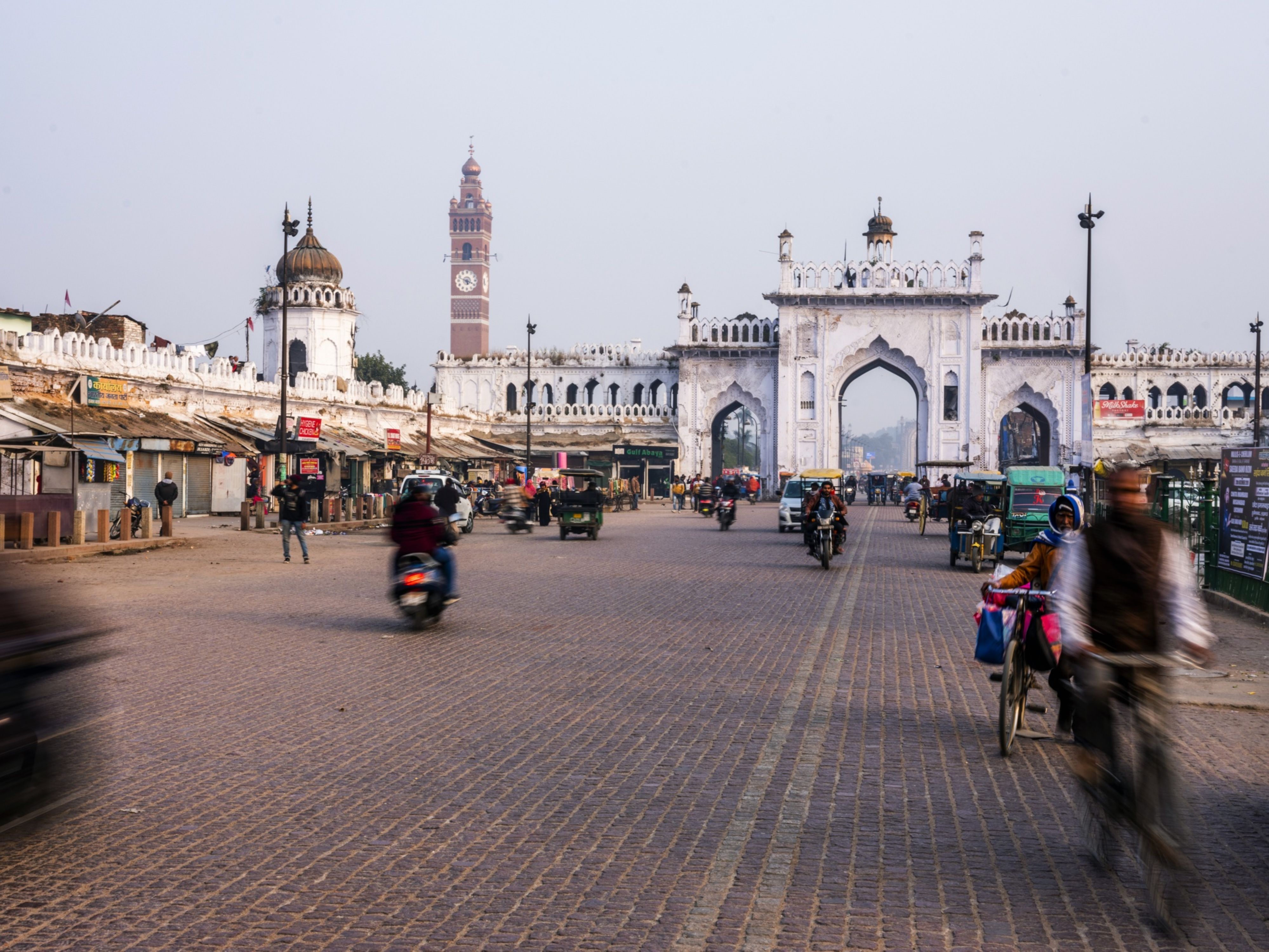
Cyclists and motorists travel along a near a gate to the Imambara Husainabad in Lucknow.
Job listings for Vizag rose 29.3% in January 2022, compared to January 2020, according to data from Monster.
The government's push for exports bodes well for job creation in Visakhapatnam, with the city boasting two ports — the Visakhapatnam Port Trust and the Gangavaram port, said Sambasiva Rao, president of the Andhra Pradesh Chamber of Commerce. Logistics and pharmaceuticals have led employment generation, said Rao, adding that ravel and tourism is still recovering.

R.K beach road in Visakhapatnam.
Other Cities With Hiring Momentum
These cities are leading a general improvement in hiring.
According to job listing portal, Naukri, strong recovery in hiring momentum is seen across Coimbatore, Ahmedabad, and Kochi.
Businesses going digital has led to an increase in tech-enabled roles, which is a major contributing factor towards this growth, Sumeet Singh, Group Chief Marketing Officer, Naukri.com said. "This gives us a lot of confidence in the hiring story across tier-2 cities as it surpasses pre-covid levels.”
Supply chases demand, Subramanian said. The pandemic showed that smaller towns and cities were more resilient, he added. "Non-metros generating more jobs is a positive trend that's going to continue...For a population as large as ours, to just have handful of cities creating jobs was never going to be enough."
Who's Leading Job Growth Across Metros
Bangalore has emerged as the clear post pandemic winner. It now makes up for 23% of all job listings in the country, up from 16.9% in 2020, according to data from Indeed.
Mumbai managed to hold on to its share of 8.2%, while Delhi saw it's share shrink to 1.9% in 2022, from 2.4% in 2020. To be sure, Gurugram and Noida saw a rise in share, pushing up the share held by the National Capital Region. Kolkata lost share, making up for 1.9% of all job listings in 2022, from 2.4% in 2020.

-
Talking Points This Week: Tech Nerves, FII Buying, And A Faraway Banking Shock

The global markets are not shining this Diwali. The exception in the large markets is, India.
-
Midterm Rally Lasted A Day. The Hard Reality Of A Divided US May Last Two Years | Opinion
Between a contested AI boom, a debt ceiling that arrives in 2027 and a president with every incentive to act alone, the next two years may prove more volatile than the first day's rally suggests.
-
Blue Wave Will Derail the AI Trade but Won't Dismantle the AI Era | Unhedged Position
The Democrats' sweep of the US Congress will see politics collide with economic forces both over the long and short term.
-
It's Time To Take The GST Council's Bet On Trust Global
Payment records can prove India's services exports, and clear, proportionate rules can bring foreign digital sellers into the tax net.
-
Opinion | India at 38: From Innovation Overperformer to Innovation Powerhouse
India now has 453 VC-backed deep science startups, 18 of them late-stage, after 117 percent growth since 2020. Laurus Labs, at USD 9.3 billion, is the most valuable deep science company in any middle-income economy outside China.
-
Navigating Energy Crossroads: S Jaishankar's Call For Diversified Supply Chains At G20 Ministerial Meeting
As geopolitical fault lines continue to test maritime trade routes and commodity flows, Jaishankar's message remains pertinent: true economic resilience requires open markets, protected transit lines, and a genuine commitment to multilateral cooperation rather than coercion.
-
Indians Are Travelling, But Not Every Journey Is A Holiday | The Week In Whys
Pilgrims, patients and working women are the real travellers, and the system hasn't quite caught up with them.
-
Getting To Work Costs Women More | The Reason Why
It is not just about women paying more than men. It is about women paying much more in cities than in villages.
-
AI Bias In Investing Cannot Be Eliminated, But It Can Be Governed
Framing is a particularly important example as identical financial information presented in terms of gains rather than losses can lead an LLM to reach a different assessment.









