Employees’ Strike Against Merger Of State-Run Banks Hits Services
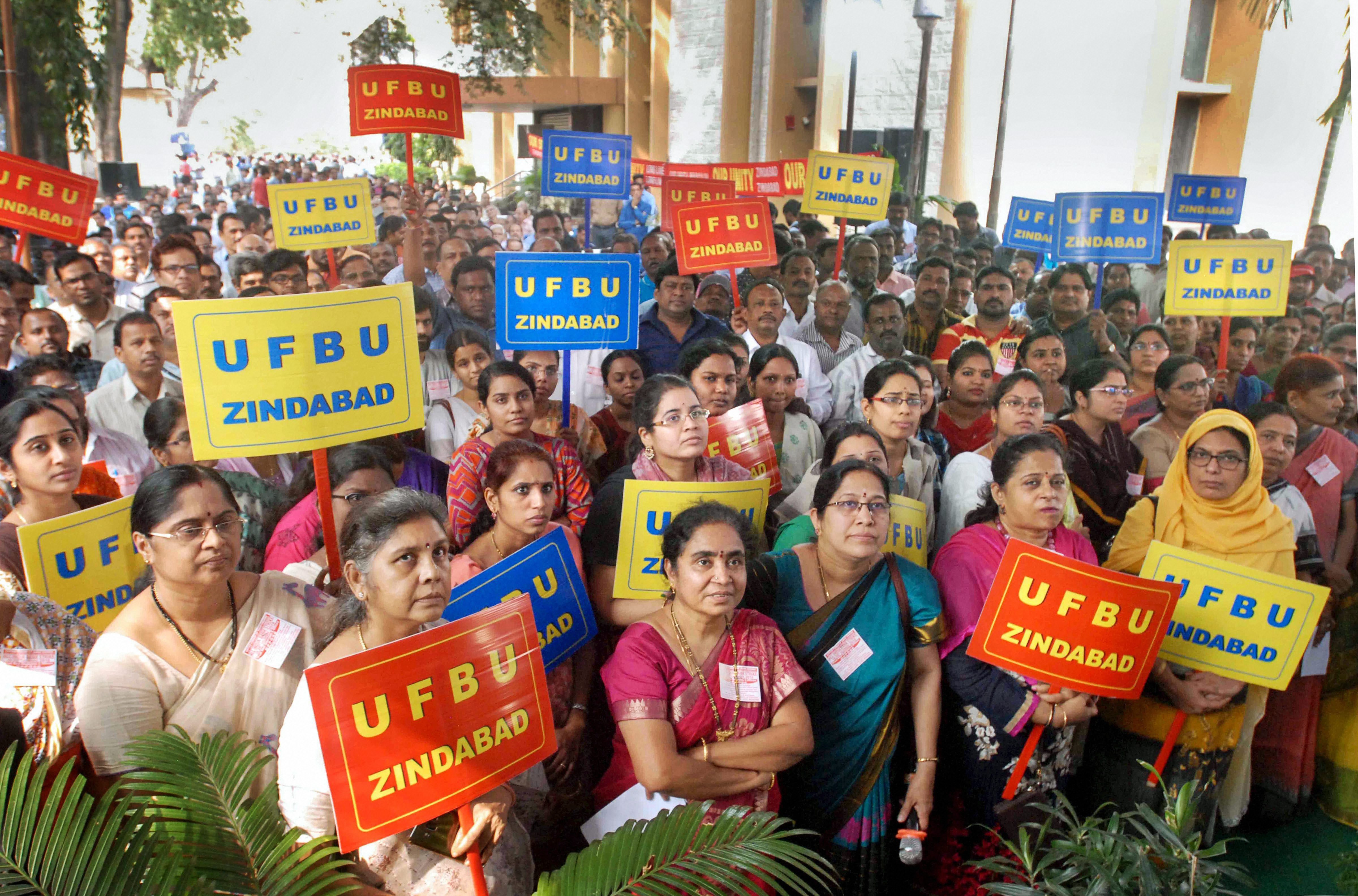
Operations at branches of public sector banks across the country were impacted on Wednesday due to a strike by unions against the proposed merger of Vijaya Bank and Dena Bank with Bank of Baroda. This was the second nation-wide strike within a week and saw the participation of nearly one million workers of all state-run, old-generation private banks and some foreign lenders.
The strike has been called by the United Forum of Bank Unions—an umbrella organisation of nine unions including the All India Bank Officers Confederation, the All India Bank Employees' Association, National Confederation of Bank Employees, and the National Organisation of Bank Workers.
The unions on Wednesday claimed that banking services, including deposits and withdrawal at branches, cheque clearances and issuance of demand drafts, among others, were affected across the country due to the strike.
An officers' union of state-run banks went on a strike last Friday as well demanding immediate salary hikes and opposing the merger of public sector banks.
In Maharashtra, Goa and Gujarat alone, cheques worth Rs 2 lakh crore were held up, a union official claimed.
Meanwhile, reports from Indore, quoting the United Forum of Bank Unions' Madhya Pradesh unit coordinator MK Shukla, said services at about 7,000 branches of state-owned banks were impacted in MP due to the strike. He claimed that the services at some private sector lenders also got affected.
Senior bankers, however, claimed that most operations were normal. "We had deployed senior officials at all cheque clearing centers so that our customers are not affected. All other operations like treasury were also functioning," said a senior official from a state-run bank.
Unions claimed that the merging of Vijaya Bank and Dena Bank with Bank of Baroda is not in the interest of the banks or their customers but in fact is detrimental to both.
In September, the government announced merger of Vijaya Bank and Dena Bank with Bank of Baroda. The merged entity will have a combined business of Rs 14.82 lakh crore, making it the third largest bank after State Bank of India and HDFC Bank.
"This merger will see a large number of branches getting closed and customers will have to face hardships as already banks are burdened with the implementation of various government schemes such as Jan Dhan Yojana, Mudra, social security insurance, prime minister's housing scheme etc," the union said.
Despite the opposition, government had last week accorded in-principle approval for the merger of Dena Bank and Vijaya Bank with Bank of Baroda.
Post-merger, the number of state-run banks will shrink to 19 from 21 now. The merger comes after the State Bank of India merged its five subsidiary banks with itself apart from taking over Mahila Bank last year, which catapulted it to be among top 50 global lenders.
Last week, around 3.20 lakh officers of state-run banks were on a one-day strike opposing the merger and also seeking immediate wage revision. Bank managements have mandated the industry lobby Indian Bank Association to negotiate wages for employees in the scales 1-3 but unions want this to be raised to scale 7.
The wage talks are on for the past 13 months between the unions and industry lobby, the latter has offered a wage revision of 8 percent. In the past wage settlement, which was for the Nov. 1, 2012-Oct. 31, 2017 period, employees got a 15 percent hike.
According to AIBEA General Secretary CH Venkatachalam, the strike is effective across the country and employees are fighting for a right cause.
Branches of new-generation private sector banks, however, remained unaffected by the strike called by UFBU, which claims to have membership of nearly 10 lakh bank employees and officers across 21 public sector banks.
This is the second bank strike in less than a week.
On Dec. 21, an officers' union of state-run banks observed a day-long strike to protest against the merger and also demanded immediate settlement of wage negotiations. Most of the banks have already informed customers about the strike.

-
Where You Live Shapes How You Get To Work | The Reason Why

Two-wheelers are the most popular way to get to work in India, accounting for nearly 43% of workplace commutes.
-
High US Salaries, No Green Card Certainty: The Financial Calculation Facing Indian H-1B Families
The suspension of PERM processing at eight technology employers does not cancel existing H-1B visas. What it does is force a question many Indian families have been avoiding: is the US salary worth tying your career and family plans to one employer?
-
Unhedged Position: Can India See An Indonesia-Style Time Correction?
The Nifty is trading below levels it first clocked in 2024. Is there, then, as I have suggested in the headline, potential that the current time correction drags on painfully for the next three-five, even ten years?
-
Navigating Friction And Energy Realities: An Analysis Of Marco Rubio's October Visit To India
Occurring at a critical juncture marked by stalled trade negotiations and escalating geopolitical pressures over global energy supplies, the visit offers a profound window into modern US-India relations.
-
India Exports Capital. Why Not Export Trusteeship?
The big question, then, is whether India can build an institution that global borrowers, investors, banks, and lawyers can trust, even without an Indian connection.
-
France's Economy & Politics Are In Crisis | The Reason Why
Let's look at how the French economy and politics evolved under Nicolas Sarkozy, Franois Hollande and Emmanuel Macron.
-
You May Inherit The Business. You Must Earn Its Credibility.
Succession tests the founder's ability to share authority as much as it tests the next generation's readiness to assume it.
-
Signing Deals Is One Thing; Making Them Work Is Another | The Week In Whys
Sometimes, things don't turn out as planned. Indian companies have lost some bids to rivals, some projects won't produce until 2030.
-
FOMC Wall, PERM Suspension, Hospital Stocks | Talking Points This Week
A PERM suspension would directly affect green-card sponsorship rather than H-1B visas, so the near-term earnings impact could remain relatively limited. The key question is whether this marks a new phase in US scrutiny of Indian IT.
-
Everything, Everywhere, All At Once: Dalal Street's Week To Forget | Joining The Dots
Visa curbs, a Starlink spat and cancer drug caps: what connects this week's shocks for Indian markets









