Bank Strike: Services Hit, Impact To Continue Today
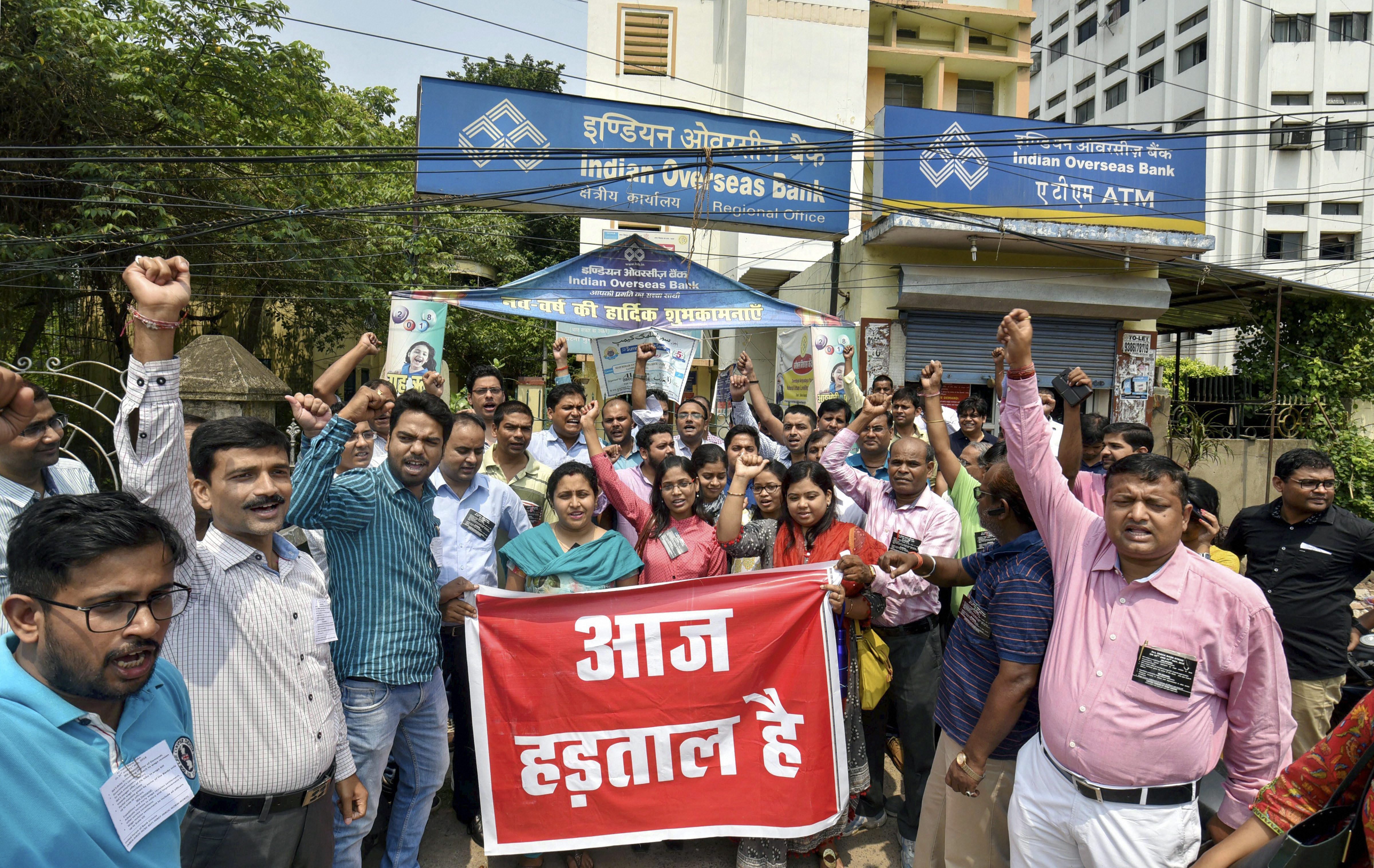
Banking operations in the country were hit today as 10 lakh employees, primarily from PSU banks, went on two-day strike to protest against a “meagre” 2 percent salary hike offered by the management body Indian Banks Association.
The strike, also supported by employees of some old generation private sector banks and foreign banks, will continue on Thursday.
Operations in the new-generation private banks like ICICI Bank Ltd., HDFC Bank Ltd., Axis Bank Ltd. were however almost normal, barring few activities including cheque clearance.
There were reports of disruption in banking operations in various states. The impact of strike in certain states like Kerala, West Bengal, Bihar and Jharkhand was more severe compared to other states.
Nearly 10 lakh employees, working in various branches of 21 public sector banks, 13 old generation private sector banks, six foreign banks and 56 regional rural banks across the country went on the strike as IBA offered them a nominal wage revision, All India Bank Employees Association, affiliate of UFBU said in a statement.
Since the strike coincides with the month-end, salary withdrawals from branches are likely to get affected. Some ATMs went dry by the evening. Operations like deposits, fixed deposits renewals, government treasury operations, money market operations were hit by the strike.
A RBI official said some digital banking work was done through electronic systems like the RTGS but the functioning of banks' servers was hit. Digital banking comprises about 5 percent of the total operations, the official said.
Reserve Bank of India remained operational though the trade unions offered moral support for the ongoing strike, a RBI Trade Union leader said.

As several rounds of talks between banks and the unions of their employees did not make any headway, the United Forum of Banking Unions, an umbrella body of nine bank unions, has gone on strike against the proposed wage hike of 2 percent as against 15 per cent given last time, All India Bank Employees Association, general secretary C H Venkatachalam said.
In the last wage revision in 2012, the bank employees got a raise of 15 percent.
It is kind of an insult to the employees of public sector banks...to be offered this kind of meagre hike. We had no other option but to go on strike, foregoing two days' salary.Ravinder Gupta, Joint General Secretary, All India Bank Officers' Confederation
Success of all government schemes like Mudra, Jandhan and demonetisation were ensured by public sector bankers but the reward is just 2 percent hike, he said, adding that it is gross injustice to bankers who have worked very hard for nation building.
Employees are participating in the nation-wide strike as part of “our democratic right” by forgoing our salary, Venkatachalam said and hoped that good sense would prevail.
IBA has asked the six banks including SBI, Oriental Bank of Commerce, Union Bank and Bank of Baroda to reconsider their decision and allow IBA to settle wages for bank employees up to scale seven instead of up to scale three employees.
There are about 85,000 branches of 21 public sector banks across the country having business share of about 70 percent. Most of the banks, including SBI, PNB and BoB, have already informed their customers about functioning of branches and offices due to strike.
Industry chamber Assocham said the two-day nationwide bank strike may affect customer transactions worth up to Rs 20,000 crore. It also urged the government to come up with a stimulus plan for restoring the health of PSU banks.
State-owned lenders are grappling with high levels of bad loans and as per reports their losses for the quarter ended March 2018 are set to hit a record Rs 50,000 crore which is more than double the losses of Rs 19,000 crore in preceding quarter ended December 2017, Assocham said in a statement.

-
High US Salaries, No Green Card Certainty: The Financial Calculation Facing Indian H-1B Families

The suspension of PERM processing at eight technology employers does not cancel existing H-1B visas. What it does is force a question many Indian families have been avoiding: is the US salary worth tying your career and family plans to one employer?
-
Unhedged Position: Can India See An Indonesia-Style Time Correction?
The Nifty is trading below levels it first clocked in 2024. Is there, then, as I have suggested in the headline, potential that the current time correction drags on painfully for the next three-five, even ten years?
-
Navigating Friction And Energy Realities: An Analysis Of Marco Rubio's October Visit To India
Occurring at a critical juncture marked by stalled trade negotiations and escalating geopolitical pressures over global energy supplies, the visit offers a profound window into modern US-India relations.
-
India Exports Capital. Why Not Export Trusteeship?
The big question, then, is whether India can build an institution that global borrowers, investors, banks, and lawyers can trust, even without an Indian connection.
-
France's Economy & Politics Are In Crisis | The Reason Why
Let's look at how the French economy and politics evolved under Nicolas Sarkozy, Franois Hollande and Emmanuel Macron.
-
You May Inherit The Business. You Must Earn Its Credibility.
Succession tests the founder's ability to share authority as much as it tests the next generation's readiness to assume it.
-
Signing Deals Is One Thing; Making Them Work Is Another | The Week In Whys
Sometimes, things don't turn out as planned. Indian companies have lost some bids to rivals, some projects won't produce until 2030.
-
FOMC Wall, PERM Suspension, Hospital Stocks | Talking Points This Week
A PERM suspension would directly affect green-card sponsorship rather than H-1B visas, so the near-term earnings impact could remain relatively limited. The key question is whether this marks a new phase in US scrutiny of Indian IT.
-
Everything, Everywhere, All At Once: Dalal Street's Week To Forget | Joining The Dots
Visa curbs, a Starlink spat and cancer drug caps: what connects this week's shocks for Indian markets
-
India Is Going Abroad For Critical Minerals. But It May Take Years To Pay Off | The Reason Why
Although India's steps are in the right direction, they remain modest compared with India's growing dependence.









