Axis Bank Prunes Risk To Limit Credibility Hit From Bad Loan Surge
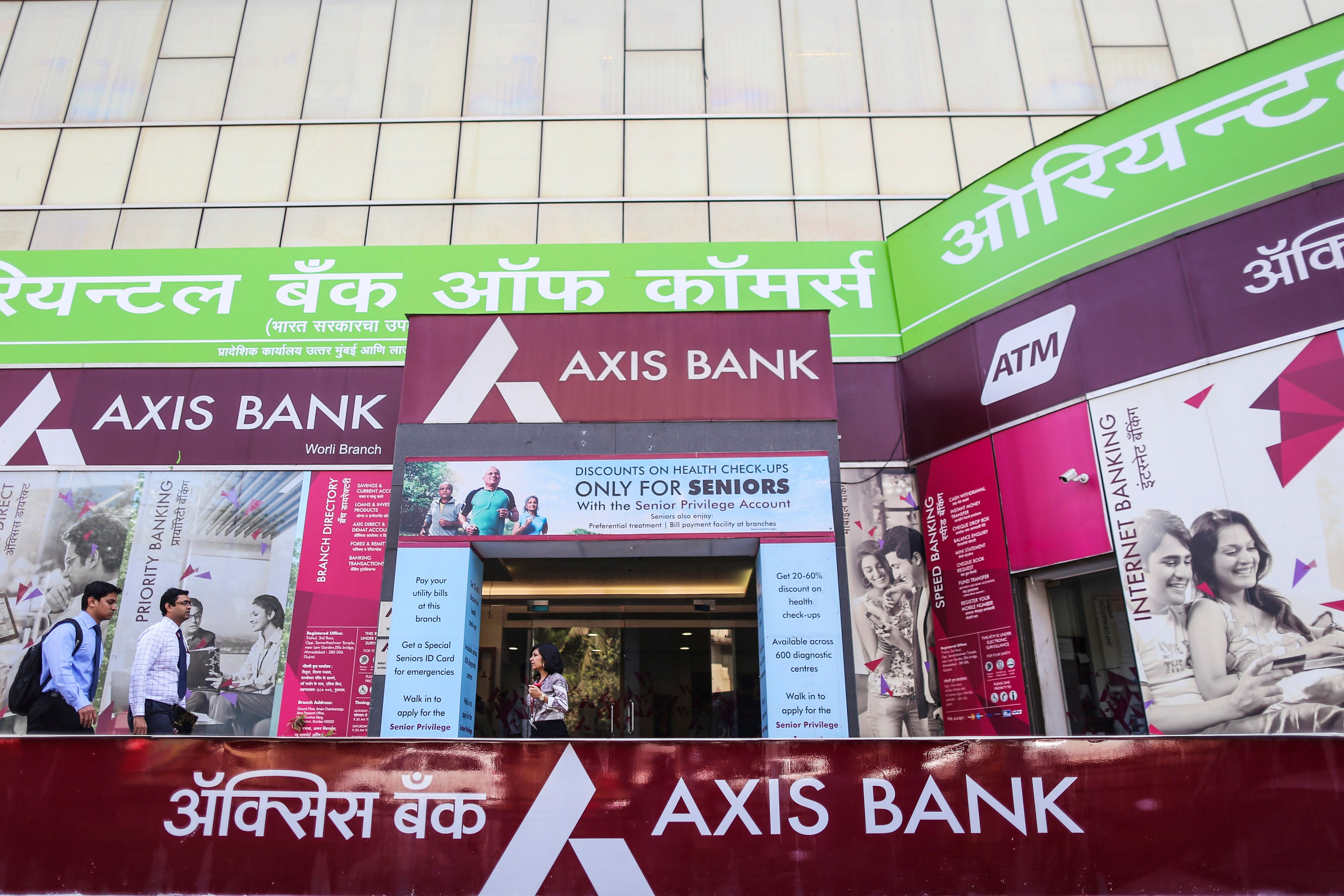
Axis Bank Ltd., the country's third largest private bank by assets, is in the midst of an overhaul of its corporate lending practices as it seeks to reassure investors that the recent surge in bad loans is a one-off.
The process involves reducing the concentration of loans across high-risk sectors and highly-leveraged borrowers while also changing employee incentive structures to ensure the experience of the last few years is not repeated, said Jairam Sridharan, chief financial officer of Axis Bank in an interview with BloombergQuint on Tuesday.
Axis Bank, not unlike other corporate lenders in the country, saw a jump in bad loans after the Reserve Bank of India (RBI) conducted an asset quality review in 2015 and asked banks to classify stressed loans appropriately. The impact of this review has been seen in bank earnings over the past five quarters. In the case of Axis Bank, bad loans or gross non performing assets (GNPAs) have jumped 360 percent – the steepest across the industry.
Sridharan disagrees that the bank's performance has been worse than others. He points to the fact that the increase in the GNPA ratio at Axis Bank is in line with what other corporate lenders have seen.
If you see the largest lenders in the corporate banking space, by and large, everybody has had a GNPA ratio increase of about 300-350 basis points. I am talking about the GNPA ratio now versus five quarters earlier. If you look at the curve of the GNPA ratios of the corporate lenders, what you will see very clearly is that rank ordering of the ending position versus the starting position hasn't changed. The gap hasn't changed either. It is just that everybody has re-baselined to a different place.Jairam Sridharan, Chief Financial Officer, Axis Bank

While defending its track record, Sridharan acknowledged that the bank has been left worse for wear after the infrastructure lending binge at the start of the decade. Loans given between FY10 and FY12, to companies in sectors like infrastructure, metals and power, continue to give the bank the most “heartburn”, said Sridharan.
At the end of March 2009, Axis Bank had a corporate loan book (excluding loans to small and medium enterprises or SMEs) of Rs 41,211 crore, shows data from the bank's investor presentations. By March 2012, this portfolio had grown to a size of Rs 91,055 crore.
We made a choice, a very explicit choice, to be lenders to the infrastructure sector 5-7 years ago. As it turns out, parts of that bet have just not turned out the way we expected it to. Some of these sectors have unraveled in entirety over the past year and a half. You see that impact on the bank's numbers.Jairam Sridharan, Chief Financial Officer, Axis Bank
The pain is still not over.
The bank had created a watchlist of Rs 22,000 crore in loans in April 2016, of which about half has slipped into the bad loan bucket already. “Substantially more than 60 percent” of this is expected to turn bad, said Sridharan. The bank is also seeing stress emerging from outside this watchlist. Thirty percent of slippages (or new bad loans) in the December quarter came from outside the watchlist, leaving analysts concerned.
Ravikant Bhat, research analyst at IDBI Capital said the view and valuations on the bank have corrected cyclically to reflect the bad loan problem.
At this stage, we are factoring in that the entire watchlist will go bad and there could be some loans outside that which could turn bad as well.Ravikant Bhat, Research Analyst, IDBI Capital
Lack of clarity on the true extent of bad loans has meant that Axis Bank has lost its status as the market darling. The consensus estimate for the stock has slipped from Rs 660 per share at the start of September 2015 to Rs 494.59 now. The stock is currently trading at Rs 513 per share. Only a third of analysts have a ‘buy' rating on the stock now compared to more than 80 percent last year.

Once Bitten; Twice Shy
The bank's top management, including Sridharan, know this needs to be corrected. They are doing this by rebalancing the loan portfolio and reducing so-called concentration risk. “That's the first thing we are doing - tightening our concentration guardrails,” said Sridharan.
The proportion of corporate credit will be reduced to near about 40 percent of the loan book from 45 percent now, he said while adding that the bank will retail its corporate lending DNA. The bank is also reducing the ticket size of loans in the corporate and the SME segment.
In addition, the bank has substantially cut lending to its top 20 borrowers.
“If you look at exposure to top 20 borrowers as a percent of a Tier-1 capital, that ratio has come down to less than half of what it was in FY13,” said Sridharan without giving the exact ratio.
Meanwhile, the credit rating mix of the portfolio is being altered with most incremental lending going to firms with a rating higher than A. The focus of lending, too, is shifting towards lower risk working capital loans.
Eighty percent of incremental sanctions are happening to clients rated higher than A. Overall, about 63 percent of the book is above that level. In terms of product mix, as well, we are focusing more on working capital than on project loans and term loans. We still like the term loans business, but incrementally more of our business is coming from working capital loans.Jairam Sridharan, Chief Financial Officer, Axis Bank
“These correctives have not gone unnoticed by the street. Even before they acknowledged the bad loan problem, they had started to diversify the book and had adopted a more retail focused strategy. That was timely. The bad loan problem could have been worse if they hadn't diversified,” said Bhat of IDBI Capital.
As corporate credit has been de-emphasized, Axis Bank, like many others, has increased its focus on retail lending over the last couple of years. Retail loans now form 43 percent of the bank's loan book and could rise to “the mid-to-high fourties”, said Sridharan.
Could this rapid lending to retail clients prove to be a risk in itself?
Retail lending has had a “dream run” with risk in the business reducing significantly between 2010 and 2016, explained Sridharan. This risk cycle slowly started to turn last year. “I think you have to think very seriously about the probability that risk (in retail lending) may be on its way up... So now is the time when you should have tightened your norms. We, at the bank, have done that and have been doing so for the last year and a half.”
Also Read: Why Uday Kotak May Stay Away From Axis Bank
Is The Bank More Vulnerable Now?
Bad loans are not the only cause for heartburn for the bank's top management. Over the past few months, the lender has found itself embroiled in a series of controversies.
In December, the Enforcement Directorate arrested two Axis Bank officials for alleged involvement in illegal activities during the currency exchange exercise kicked off by the government in November.
More recently, The Times of India reported that biometric identity (Aadhaar) data has been compromised via a business correspondent of the bank, leading to the Unique Identification Authority of India (UIDAI) temporarily halting all Aadhaar-based transactions by Axis Bank.
To top it all, there has been speculation about competitors like Kotak Mahindra Bank expressing unsolicited interest in merging with the bank.
“We see no reason for a merger at this stage,” said Sridharan repeating the bank's denial of merger talks.
As far as the bank is concerned, we find ourselves in a nice spot. We feel that in terms of businesses etc, we have no significant gaps where a merger may be useful to the Axis Bank shareholder. We feel that we have had a fantastic run as a largely organic story.Jairam Sridharan, Chief Financial Officer, Axis Bank
Also Read: Axis' Merger With Kotak Mahindra Bank A Positive If It Happens, Says BofA ML
When asked whether the bank's poor run over the past few quarters has left it vulnerable to attack, Sridharan said that along with tightening lending practices the bank has also made internal processes more rigorous and strengthened its governance infrastructure.
To ensure that high growth (which could lead to high risk down the road) is not the only thing rewarded, the bank has also tweaked incentive structures.
Citing an example of this change, Sridharan said that five years ago the bank may have rewarded an employee based on how big a rainmaker she or he has been. Over time, this has morphed into an assessment based on the risk-adjusted return on capital. Employees are no longer measured on topline growth but on the risk profile of their portfolio, he said.
The final aspect (of our strategy) is internal culture. This is the toughest part. It is about getting a hold of what are the internal incentive structures? What are the reward and recognition structures? What kind of actions get internal glory? Who gets more face time with top management? All these things matter and those have changed.Jairam Sridharan, Chief Financial Officer, Axis Bank

-
Navigating Energy Crossroads: S Jaishankar's Call For Diversified Supply Chains At G20 Ministerial Meeting

As geopolitical fault lines continue to test maritime trade routes and commodity flows, Jaishankar's message remains pertinent: true economic resilience requires open markets, protected transit lines, and a genuine commitment to multilateral cooperation rather than coercion.
-
Indians Are Travelling, But Not Every Journey Is A Holiday | The Week In Whys
Pilgrims, patients and working women are the real travellers, and the system hasn't quite caught up with them.
-
Getting To Work Costs Women More | The Reason Why
It is not just about women paying more than men. It is about women paying much more in cities than in villages.
-
AI Bias In Investing Cannot Be Eliminated, But It Can Be Governed
Framing is a particularly important example as identical financial information presented in terms of gains rather than losses can lead an LLM to reach a different assessment.
-
Joining The Dots | Dark Skies, Steady Diya: Why Hope Holds This Diwali
With war, a weak rupee and foreign outflows weighing on sentiment, policymakers at the NDTV World Summit and market veterans at NDTV Profit Ignite: Diwali Edition offered the same advice: stay invested and filter out the noise.
-
The Curious Case of Equitas Small Finance Bank And A CEO Who Quit For Stock
PN Vasudevan believes persistent investor concerns over a perceived conflict of interest had become a governance overhang on Equitas Small Finance Bank's stock, even as the lender improved profitability and asset quality.
-
Talking Points This Week: AI Cash Burn, A Tiger Comeback And An India That Still Finds Its Own Path
India is not immune to higher oil or tighter global liquidity, yet its earnings base is broader, its domestic policy levers are still available.
-
Foreign Investors Own Half Of HDFC Bank and ICICI Bank. An LTCG Cut Could Matter Most Here
Foreign portfolio investors have US$115 billion parked in HDFC Bank, ICICI Bank. If the government cuts long-term capital gains tax, Jefferies says returning foreign money could land here first.
-
'Never Seen This Level Of Negativity': Sandeep Tandon Says The Next Rally May Be Closer Than You Think
Veteran investor Sandeep Tandon says foreign selling is easing, large-caps are due a comeback and mid-caps are crowded, while he turns positive on gold, power and pharma this Diwali.










