Government To Release List Of Strategic Sectors Soon: Nirmala Sitharaman
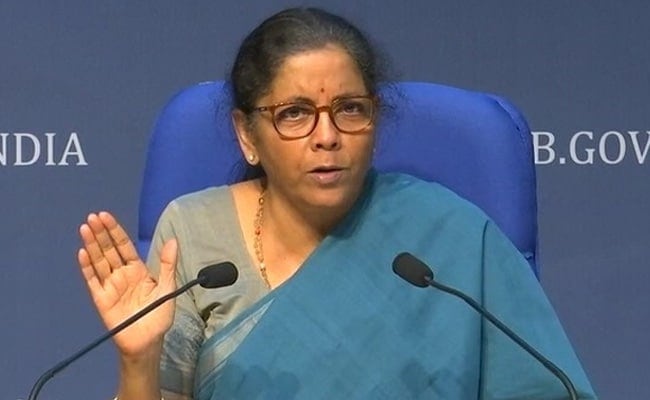
The government will soon come out with a new policy on public sector enterprises that will define strategic sectors which will not have more than four public sector undertakings, Finance Minister Nirmala Sitharaman said on Saturday. "We are working on it... it should go to Cabinet soon," she told media when asked about the list of strategic sectors. As part of the government's ''Aatmanirbhar Bharat'' package, the finance minister had announced in May that there would be a maximum of four public sector companies in strategic sectors, and state-owned firms in other segments will eventually be privatised.
She said there could be various models to achieve maximum four PSUs in case of those falling under the strategic sector. Either they will be merged, or they will be brought together in such a way that there are only four or lesser, the finance minister said.
Under the policy, a list of strategic sectors will be notified where there will be at least one and a maximum of four public sector enterprise, apart from private sector companies.
In other sectors, central public sector enterprises (CPSEs) will be privatised depending upon the feasibility.
"We would like to announce a PSE policy (as) a self-reliant India needs a coherent policy. All sectors will be opened to private sectors also."
"PSEs will continue to play an important role in defined areas. We need a coherent policy because sometimes you open up some sectors in piecemeal... Now we shall define the areas... where their presence will be impactfully felt," Ms Sitharaman had said while announcing the package.
Asked about expectations from the meeting of the Monetary Policy Committee next week, the finance minister said that''s for the RBI to decide.
Speaking about the state of economy, she said it is definitely trying to come out of difficulty but would be difficult to get a complete picture at this point of time due to uncertainty around the pandemic.
Value chains are getting disrupted due to containment zones in many parts of the country because of the pandemic, she explained.
Emphasising that the Prime Minister is speaking with various stakeholders on regular basis to get feedback on the evolving situation, she said the government is keeping all options open to help support economy.
There are some kinds of green shoots but the government is cautious about these parameters, she said, adding that the economy is at a stage where every sector is trying to beat pandemic and revive.
"Hopefully this spirit will help revive the economy, and the government is willing to hear and keep all options open...RBI has reached out to the industry with liquidity, and other than just monitoring inflation it has also kept growth in mind. Economy will benefit from this," she said.
Asked about the privatisation of banks, she said the government has only cleared the proposal to privatise IDBI Bank so far.
The government currently owns a 46.5 per cent stake in IDBI Bank.
In January 2019, LIC completed the acquisition of a controlling 51 per cent stake in the lender. The state-owned life insurer infused Rs 21,624 crore into the bank.

-
High US Salaries, No Green Card Certainty: The Financial Calculation Facing Indian H-1B Families

The suspension of PERM processing at eight technology employers does not cancel existing H-1B visas. What it does is force a question many Indian families have been avoiding: is the US salary worth tying your career and family plans to one employer?
-
Unhedged Position: Can India See An Indonesia-Style Time Correction?
The Nifty is trading below levels it first clocked in 2024. Is there, then, as I have suggested in the headline, potential that the current time correction drags on painfully for the next three-five, even ten years?
-
Navigating Friction And Energy Realities: An Analysis Of Marco Rubio's October Visit To India
Occurring at a critical juncture marked by stalled trade negotiations and escalating geopolitical pressures over global energy supplies, the visit offers a profound window into modern US-India relations.
-
India Exports Capital. Why Not Export Trusteeship?
The big question, then, is whether India can build an institution that global borrowers, investors, banks, and lawyers can trust, even without an Indian connection.
-
France's Economy & Politics Are In Crisis | The Reason Why
Let's look at how the French economy and politics evolved under Nicolas Sarkozy, Franois Hollande and Emmanuel Macron.
-
You May Inherit The Business. You Must Earn Its Credibility.
Succession tests the founder's ability to share authority as much as it tests the next generation's readiness to assume it.
-
Signing Deals Is One Thing; Making Them Work Is Another | The Week In Whys
Sometimes, things don't turn out as planned. Indian companies have lost some bids to rivals, some projects won't produce until 2030.
-
FOMC Wall, PERM Suspension, Hospital Stocks | Talking Points This Week
A PERM suspension would directly affect green-card sponsorship rather than H-1B visas, so the near-term earnings impact could remain relatively limited. The key question is whether this marks a new phase in US scrutiny of Indian IT.
-
Everything, Everywhere, All At Once: Dalal Street's Week To Forget | Joining The Dots
Visa curbs, a Starlink spat and cancer drug caps: what connects this week's shocks for Indian markets
-
India Is Going Abroad For Critical Minerals. But It May Take Years To Pay Off | The Reason Why
Although India's steps are in the right direction, they remain modest compared with India's growing dependence.









