TCS Buyback Can Be Its Highest Ever At Up To Rs 22,000 Crore

Come Wednesday, Tata Consultancy Services Ltd. will potentially declare its biggest share buyback yet. Its balance sheet is that healthy.
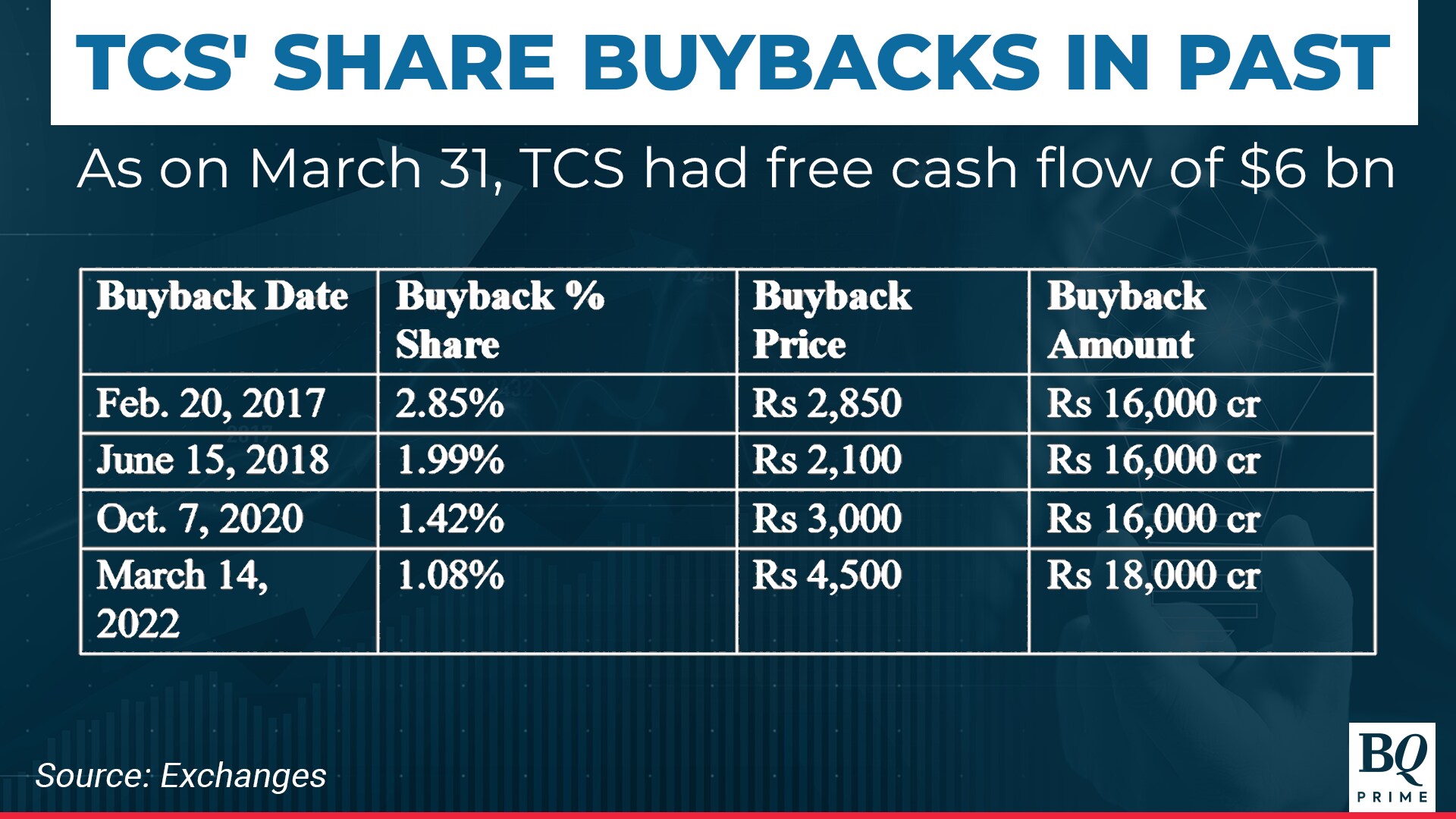
The board of India's largest IT services firm by market capitalisation will consider a share buyback proposal—the company's fifth in six years—along with the second-quarter earnings, according to an exchange filing after market hours on Oct. 6. The news propelled the stock to a 52-week high on Monday.
But how big will the buyback be, and at what cost?
Under the current regulation, a listed company can repurchase shares up to 25% of its net worth (current assets — liabilities). By that measure, TCS can buy back shares worth up to Rs 22,620 crore—or 25% of its net worth at the end of June 30. That's higher than the company's previous four buybacks dating back to 2017. In the last buyback, TCS repurchased shares worth around 20% of the net worth. Since then, the net worth of the India's largest IT company has grown further.
A share buyback affects a company's financials in several ways. It reduces the company's available cash—which in TCS' case stood at Rs 15,622 crore as on June 30—and equity available to shareholders.
The reduction in shares outstanding, however, boosts earnings per share. In TCS' case, that could improve it by 1.7% over the current consensus EPS of Rs 127.5 per share.
A share buyback is also a tool to mask muted earnings—something that's afflicting TCS and the wider Indian IT services sector.
In April-June, the revenue of the industry bellwether rose 0.37% over the previous three months to Rs 59,391 crore. That was the slowest pace of growth clocked in the past twelve quarters. Net profit dipped nearly 3% to Rs 11,074 crore, while operational profitability shrank 5%.
The picture isn't any rosier for the July-September quarter.
Growth in India's $250 billion IT services industry likely remained weak in the three months ended Sept. 30 as macroeconomic headwinds in their biggest market—the United States—continued to weigh on discretionary spending. The large deals are coming in, sure, but they are spread over years. Snap returns from short-term projects are still hard to come by.
“While the industry has witnessed an uptick in order inflow over the past two months with a focus on cost efficiency, the slowdown in project-based business is expected to hamper overall industry growth, even though Q2 is traditionally a robust season for the sector,” Motilal Oswal Financial Services Ltd. said in a research report.
Accenture Plc's latest guidance paints an even murkier picture—that of “slower for longer” demand that'll persist well into the next fiscal. The threat of a shallow recession in the US makes the scenario worse still.
“Accelerated normalisation of monetary policy in the US raises probabilities of a shallow recession and, consequently, a high probability of negative surprises on the fundamental side over the next 12 months,” Nirmal Bang said in its Oct. 2 research report. “We believe consensus is underestimating growth and margin risks in FY25, as it did in FY24.”

-
A New Samvat Wishlist: Inclusive Prosperity And Human Development

India has strengthened its economic foundations through infrastructure, digital access and enterprise. Its next growth chapter must deepen productivity, create better livelihoods and widen participation in prosperity.
-
Love, Sex Aur Dhokha: The Audacious Plot To Spy On Jensen Huang
A Taipei dinner, a Singapore chip buyer and a suspected Chinese asset: inside the alleged spy operation that got close to NVIDIA's Jensen Huang.
-
Ten Things I Learnt This Samvat
Patience can be a trap. Cheap stocks can stay cheap. Leverage can wipe you out. What did Samvat 2082 teach us? Niraj Shah writes on 10 lessons from the year gone by.
-
Talking Points This Week: Tech Nerves, FII Buying, And A Faraway Banking Shock
The global markets are not shining this Diwali. The exception in the large markets is, India.
-
Midterm Rally Lasted A Day. The Hard Reality Of A Divided US May Last Two Years | Opinion
Between a contested AI boom, a debt ceiling that arrives in 2027 and a president with every incentive to act alone, the next two years may prove more volatile than the first day's rally suggests.
-
Blue Wave Will Derail the AI Trade but Won't Dismantle the AI Era | Unhedged Position
The Democrats' sweep of the US Congress will see politics collide with economic forces both over the long and short term.
-
It's Time To Take The GST Council's Bet On Trust Global
Payment records can prove India's services exports, and clear, proportionate rules can bring foreign digital sellers into the tax net.
-
Opinion | India at 38: From Innovation Overperformer to Innovation Powerhouse
India now has 453 VC-backed deep science startups, 18 of them late-stage, after 117 percent growth since 2020. Laurus Labs, at USD 9.3 billion, is the most valuable deep science company in any middle-income economy outside China.
-
Navigating Energy Crossroads: S Jaishankar's Call For Diversified Supply Chains At G20 Ministerial Meeting
As geopolitical fault lines continue to test maritime trade routes and commodity flows, Jaishankar's message remains pertinent: true economic resilience requires open markets, protected transit lines, and a genuine commitment to multilateral cooperation rather than coercion.









