Ukraine War And Inflation Hurts Asia's Factories In March
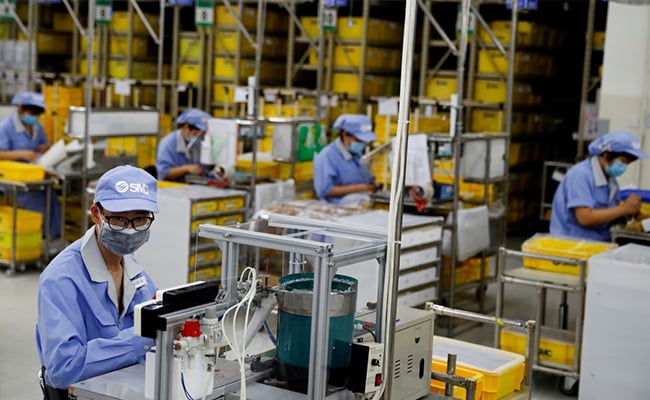
Most Asian factories saw activity slow in March, as slumping Chinese demand and rising raw material costs blamed on the Ukraine crisis added strains to firms already suffering from lingering supply chain disruptions.
While Japan benefited from easing COVID-19 infections, the spike in fuel and grain costs clouded the outlook for many Asian economies that are reliant on energy imports.
China's factory activity slumped at the fastest pace in two years in March, a private sector purchasing managers' index (PMI) showed on Friday, as the fallout from the Ukraine crisis and resurgence in domestic coronavirus cases hit external and domestic demand.
The outcome was in line with Thursday's official data showing activity in Chinese manufacturing and services simultaneously contracted in March for the first time since the height of the country's COVID-19 outbreak in 2020.
The slowdown in China bodes ill for Asia, which is host to big manufacturers dependent on consumption in the world's second-largest economy, analysts say.
South Korea's factory activity slowed in March with new export orders posting the sharpest reduction since July 2020, as companies took a hit from rise in input prices for goods ranging from oil, metals and semiconductors.
Factory activity also slowed in Taiwan and Vietnam, and contracted in Malaysia, as the region felt the pain from rising raw material prices, other PMIs released on Friday showed.
"The main channel for transmission is going to be from commodity prices, so energy, oil, gas, as well as foodstuff," said Tai Hui, chief Asia market strategist at J.P. Morgan Asset Management.
"What's going to happen is that the manufacturers, especially some of the more downstream ones, they're going to face a bit more cost pressure," he said.
By contrast, Japan saw manufacturing activity grew at a faster pace from the prior month in March, as domestic demand got a lift from the waning impact of the pandemic.
But Japan's export orders slumped as external demand suffered from pandemic curbs in China and supply chain disruptions caused by Russia's war in Ukraine.
South Korea's PMI fell to 51.2 in March from 53.8 in February, standing above the 50-mark threshold that indicates expansion in activity, but the lowest in four months.
Japan's final au Jibun Bank PMI rose to 54.1 in March, up from 52.7 in the previous month.

-
Why Amazon And Flipkart Are Struggling To Beat Meesho In India's Smaller Cities

With 274 million users and lowest-cost logistics, Meesho is defending its value commerce crown against giants like Amazon and Flipkart.
-
High US Salaries, No Green Card Certainty: The Financial Calculation Facing Indian H-1B Families
The suspension of PERM processing at eight technology employers does not cancel existing H-1B visas. What it does is force a question many Indian families have been avoiding: is the US salary worth tying your career and family plans to one employer?
-
Swiggy vs Eternal: Food Delivery's Two Rivals Are No Longer In The Same Race
Eternal is building a private AI assistant, dark.ai. Swiggy is still working out how to make Instamart pay, with an operating loss of Rs 895 crore in the July-September quarter while Blinkit stayed profitable.
-
Where You Live Shapes How You Get To Work | The Reason Why
Two-wheelers are the most popular way to get to work in India, accounting for nearly 43% of workplace commutes.
-
Unhedged Position: Can India See An Indonesia-Style Time Correction?
The Nifty is trading below levels it first clocked in 2024. Is there, then, as I have suggested in the headline, potential that the current time correction drags on painfully for the next three-five, even ten years?
-
Navigating Friction And Energy Realities: An Analysis Of Marco Rubio's October Visit To India
Occurring at a critical juncture marked by stalled trade negotiations and escalating geopolitical pressures over global energy supplies, the visit offers a profound window into modern US-India relations.
-
India Exports Capital. Why Not Export Trusteeship?
The big question, then, is whether India can build an institution that global borrowers, investors, banks, and lawyers can trust, even without an Indian connection.
-
France's Economy & Politics Are In Crisis | The Reason Why
Let's look at how the French economy and politics evolved under Nicolas Sarkozy, Franois Hollande and Emmanuel Macron.
-
You May Inherit The Business. You Must Earn Its Credibility.
Succession tests the founder's ability to share authority as much as it tests the next generation's readiness to assume it.
-
Signing Deals Is One Thing; Making Them Work Is Another | The Week In Whys
Sometimes, things don't turn out as planned. Indian companies have lost some bids to rivals, some projects won't produce until 2030.










