Asian Stocks Slip To 4-Week Low As Higher US Rates Bite
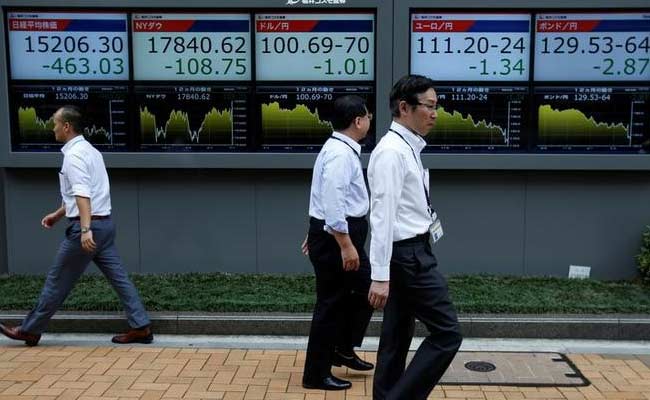
Tokyo: Asian shares slipped to four-week lows on Monday as the prospect of higher US interest rates and a strong dollar stemming from the incoming Trump administration's purported policies of cutting taxes and spending heavily threatened to suck capital out of emerging markets.
European shares are seen having better luck, following recent gains in shares of banks, resource companies and some automakers.
Spread-betters see a rise of about 0.1 per cent in the main indices including Britain's FTSE, Germany's DAX and France's CAC.
MSCI's broadest index of Asia-Pacific shares outside Japan dipped 0.3 per cent to a four-week low. It has lost 3.7 per cent since Mr Trump was elected.
Leading the losses, Hong Kong shares hit a four-month low as the Hong Kong dollar soared in line with the US dollar to which it is pegged, and after insurance shares were hit by a Chinese regulator's warnings.
In addition, investors turned cautious after China's top leaders vowed over the weekend to stem asset bubbles in 2017 and place greater importance on the prevention of financial risk
Japan's Nikkei, which has benefited from the yen's sharp fall against the dollar, snapped its nine-day winning streak, dipping 0.1 per cent from Friday's one-year high.
"I think the markets' trend will continue. Share prices will edge higher and so will bond yields. The dollar will remain strong. One key question is whether the Dow Jones will hit the 20,000 mark," said Koichi Yoshikawa, executive director of financial markets at Standard Chartered Bank in Tokyo.
The Dow Jones industrial average ended down 0.04 per cent to 19,843.41 on Friday, while the S&P 500 lost 0.18 per cent to 2,258.07.
Financial markets briefly turned "risk-off" in late US trade on Friday following news that a Chinese Navy warship had seized a US underwater drone in international waters in the South China Sea.
The diplomatic incident appears to have been resolved for now after the two countries said on Saturday that China will return the drone.
Still, doubts on the future of Sino-US relations with Trump in the White House could eventually cast a shadow on financial markets, some market players say.
Mr Trump has previously threatened to declare China a currency manipulator and force changes in US-Chinese trade policy, which he described as leading to the theft of American jobs.
He has also questioned a highly-sensitive aspect of US-China diplomacy, notably whether Washington will continue to recognise that Taiwan is part of the "One China" line mandated by Beijing.
"Their relations seem to be getting worse. Towards Trump's inauguration next month, we could see more volatility in the yuan," said Kenta Tadaide, senior economist at Mizuho Research.
"If the yuan hits 7 per dollar, that would attract a lot of attention," he added.
The yuan was little moved in Asia, firming slightly from Friday's eight-and-a-half-year low of 6.9616 to the dollar.
Diplomacy aside, many Asian shares have been hit by higher US rates and a stronger dollar, which was sparked by expectations that Trump's planned fiscal spending and tax cuts will fuel growth and inflation.
The 10-year US Treasuries yield stood at 2.584 percent in Asia on Monday, near its two-year high of 2.641 per cent touched on Thursday.
As higher US yields shore up the dollar, the dollar's index against a trade-weighted basket of six major currencies jumped to a 14-year high of 103.56 last week, though it gave up some gains to profit-taking on Monday.
The index last stood at 102.68.
The euro traded at $1.0459, bouncing back from last week's low of $1.03665, its weakest since January 2003.
The dollar traded at 117.32 yen, down 0.5 percent on the day and off Thursday's 10-1/2-month high of 118.66.
The Bank of Japan started its two-day policy meeting on Monday. It is widely expected to hold its policy, including its twin targets of minus 0.10 per cent interest on a part of excess reserves and the zero percent 10-year government bond yield.
Federal Reserve Chair Janet Yellen will be speaking on "the State of the Job Market" at 1330 EST/1830 GMT, an opportunity for market players to gauge her assessment of the US economy.
In Europe, troubled Italian bank Monte dei Paschi di Siena will offer new shares for sale between Monday and Thursday in a last-ditch attempt to raise 5 billion euros ($5.2 billion) by the end of the year and avoid a state bailout.
A failure to secure funds would lead to a rescue by the government, a move that requires private investors to share the costs of rescue according to new European Union rules.
Oil prices held firm in anticipation of tighter crude supply going into 2017 following the decision by OPEC and other producers to cut output.
Brent futures rose 0.5 per cent to $55.48 a barrel, while US West Texas Intermediate crude added 0.7 per cent to $52.24 per barrel.

-
Navigating Energy Crossroads: S Jaishankar's Call For Diversified Supply Chains At G20 Ministerial Meeting

As geopolitical fault lines continue to test maritime trade routes and commodity flows, Jaishankar's message remains pertinent: true economic resilience requires open markets, protected transit lines, and a genuine commitment to multilateral cooperation rather than coercion.
-
Indians Are Travelling, But Not Every Journey Is A Holiday | The Week In Whys
Pilgrims, patients and working women are the real travellers, and the system hasn't quite caught up with them.
-
Getting To Work Costs Women More | The Reason Why
It is not just about women paying more than men. It is about women paying much more in cities than in villages.
-
AI Bias In Investing Cannot Be Eliminated, But It Can Be Governed
Framing is a particularly important example as identical financial information presented in terms of gains rather than losses can lead an LLM to reach a different assessment.
-
Joining The Dots | Dark Skies, Steady Diya: Why Hope Holds This Diwali
With war, a weak rupee and foreign outflows weighing on sentiment, policymakers at the NDTV World Summit and market veterans at NDTV Profit Ignite: Diwali Edition offered the same advice: stay invested and filter out the noise.
-
The Curious Case of Equitas Small Finance Bank And A CEO Who Quit For Stock
PN Vasudevan believes persistent investor concerns over a perceived conflict of interest had become a governance overhang on Equitas Small Finance Bank's stock, even as the lender improved profitability and asset quality.
-
Talking Points This Week: AI Cash Burn, A Tiger Comeback And An India That Still Finds Its Own Path
India is not immune to higher oil or tighter global liquidity, yet its earnings base is broader, its domestic policy levers are still available.
-
Foreign Investors Own Half Of HDFC Bank and ICICI Bank. An LTCG Cut Could Matter Most Here
Foreign portfolio investors have US$115 billion parked in HDFC Bank, ICICI Bank. If the government cuts long-term capital gains tax, Jefferies says returning foreign money could land here first.
-
'Never Seen This Level Of Negativity': Sandeep Tandon Says The Next Rally May Be Closer Than You Think
Veteran investor Sandeep Tandon says foreign selling is easing, large-caps are due a comeback and mid-caps are crowded, while he turns positive on gold, power and pharma this Diwali.
-
Indians Stay With Family, Not In Hotels | The Reason Why
India still lacks enough clean, reliable and affordable hotels for budget-conscious travellers.










