Asian Stocks Slip On Growth Risks And Demand For Safe-Havens
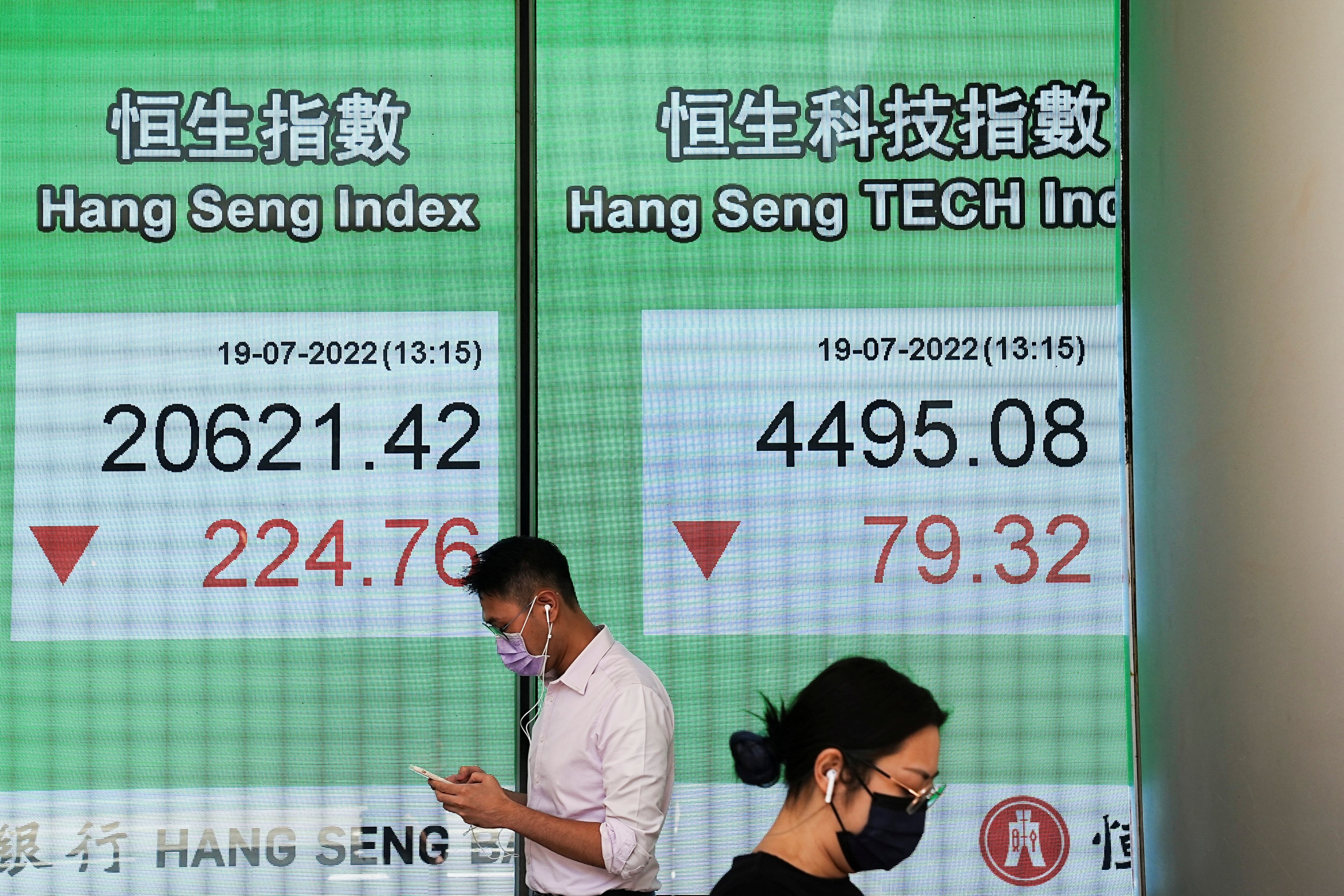
Asian stocks lost ground on Monday, retreating from over three-week highs as worries about a global economic downturn sapped investors' risk appetite.
Bond yields eased amid bets that a US recession would slow the Federal Reserve's aggressive tightening campaign, with markets looking for policy clues from its two-day Federal Open Market Committee meeting which begins on Tuesday.
At the same time, the dollar built on its recovery from a 2 1/2-week low against major peers, supported by demand for the US currency as a safe haven.
"Risk markets are obviously priced for some kind of slowdown, but are they priced for an outright recession? I would argue no," said Ray Attrill, head of currency strategy at National Australia Bank.
"In that sense, it's hard to say we've reached a bottom as far as risk sentiment is concerned."
Japan's Nikkei retreated 0.75 per cent, while Chinese blue chips eased 0.13 per cent.
Hong Kong's Hang Seng slid 0.45 per cent, with its tech index tumbling 1.51per cent.
MSCI's broadest index of Asia-Pacific shares lost 0.62 per cent to 158.68, after touching the highest since June 29 at 160.03 on Friday.
US S&P 500 emini futures slipped 0.09 per cent, pointing to an extension of the benchmark's 0.93 per cent slump on Friday, when a survey showed business activity contracting for the first time in nearly two years amid persistently heated inflation and rapidly rising interest rates.
Earlier that day, data also showed euro zone business activity unexpectedly shrank.
Nasdaq futures eased 0.04 per cent, after a 1.77 per cent tumble for the tech-heavy stock index, as the bottom dropped out from under Snap Inc after the Snapchat owner posted its weakest-ever sales growth.
Investors are on guard this week for how much a strong dollar will hurt financial results from heavyweights Apple and Microsoft, among others.
The dollar index - which measures the safe-haven currency against six major peers - edged 0.1 per cent higher to 106.81, climbing further from a 2 1/2-week low of 106.10 reached Friday.
The greenback added 0.29 per cent to 136.485 yen, while the euro slipped 0.24 per cent to $1.01875.
The 10-year US Treasury yield was little changed at 2.79 per cent after sliding from as high as 3.083 per cent over the previous two sessions.
Equivalent Japanese government bond yields dropped to the lowest since March 14 at 0.19 per cent, and Australian yields dipped to the lowest since May 31 at 3.285 per cent.
The Fed concludes a two-day meeting on Wednesday and markets are priced for a 75 basis-point rate hike, with about a 9 per cent chance of a full one percentage-point increase.
In commodities, Brent crude added 0.15 per cent, or 15 US cents, to $103.35 per barrel. Nymex light crude was slightly higher at $94.75.
Gold slipped 0.14 per cent to $1,724.05 per ounce.

-
High US Salaries, No Green Card Certainty: The Financial Calculation Facing Indian H-1B Families

The suspension of PERM processing at eight technology employers does not cancel existing H-1B visas. What it does is force a question many Indian families have been avoiding: is the US salary worth tying your career and family plans to one employer?
-
Swiggy vs Eternal: Food Delivery's Two Rivals Are No Longer In The Same Race
Eternal is building a private AI assistant, dark.ai. Swiggy is still working out how to make Instamart pay, with an operating loss of Rs 895 crore in the July-September quarter while Blinkit stayed profitable.
-
Where You Live Shapes How You Get To Work | The Reason Why
Two-wheelers are the most popular way to get to work in India, accounting for nearly 43% of workplace commutes.
-
Unhedged Position: Can India See An Indonesia-Style Time Correction?
The Nifty is trading below levels it first clocked in 2024. Is there, then, as I have suggested in the headline, potential that the current time correction drags on painfully for the next three-five, even ten years?
-
Navigating Friction And Energy Realities: An Analysis Of Marco Rubio's October Visit To India
Occurring at a critical juncture marked by stalled trade negotiations and escalating geopolitical pressures over global energy supplies, the visit offers a profound window into modern US-India relations.
-
India Exports Capital. Why Not Export Trusteeship?
The big question, then, is whether India can build an institution that global borrowers, investors, banks, and lawyers can trust, even without an Indian connection.
-
France's Economy & Politics Are In Crisis | The Reason Why
Let's look at how the French economy and politics evolved under Nicolas Sarkozy, Franois Hollande and Emmanuel Macron.
-
You May Inherit The Business. You Must Earn Its Credibility.
Succession tests the founder's ability to share authority as much as it tests the next generation's readiness to assume it.
-
Signing Deals Is One Thing; Making Them Work Is Another | The Week In Whys
Sometimes, things don't turn out as planned. Indian companies have lost some bids to rivals, some projects won't produce until 2030.
-
FOMC Wall, PERM Suspension, Hospital Stocks | Talking Points This Week
A PERM suspension would directly affect green-card sponsorship rather than H-1B visas, so the near-term earnings impact could remain relatively limited. The key question is whether this marks a new phase in US scrutiny of Indian IT.









