Asian Shares Mixed, Yen Holds Gains After Germany, Turkey Incidents
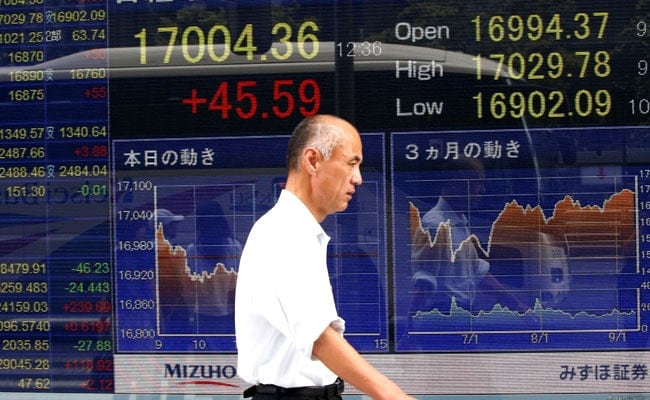
Singapore: The safe-haven Japanese yen held on to gains on Tuesday, with investors spooked after deadly incidents in Germany and Turkey, while regional stocks were mixed following upbeat comments from Federal Reserve Chair Janet Yellen.
The Bank of Japan kept monetary policy steady as widely expected, maintaining its pledge to guide short-term rates at minus 0.1 per cent and the 10-year government bond yield around zero per cent.
MSCI's broadest index of Asia-Pacific shares outside Japan pared earlier gains to trade little changed. Japan's Nikkei was flat.
Reduced volumes ahead of the Christmas holidays tempered buying in some Asian markets.
China's CSI 300 index slid 0.4 per cent, and Taiwan shares retreated 0.3 per cent. Hong Kong shares reversed earlier losses to trade little changed.
Wall Street ended higher on Monday, albeit below the session's highs, as optimism over Ms Yellen's upbeat comments about the US labour market offset some of the risk aversion following the attacks.
"Yellen painted a very positive picture in her commentary overnight," said James Woods, global investment strategist at Rivkin Securities in Sydney.
"The (Federal Open Market Committee) has done a fantastic job preparing the market for this second and subsequent hikes. Importantly they have continued to stress that the FOMC remains data dependent, only hiking when the underlying fundamentals of the economy support this."
Still, markets were rattled after a truck ploughed into a crowded Christmas market in central Berlin Monday evening, killing 12 people and injuring 48 others in what Germany's interior minister said looked like an attack.
The euro, which slid 0.5 per cent to $1.0401 on Monday, recovered 0.1 per cent to $1.04125 on Tuesday.
The euro was also pressured after the Russian ambassador to Turkey, Andrei Karlov, was shot and killed at an art gallery in the Turkish capital of Ankara.
The Turkish lira was steady at 3.532 per dollar on Tuesday after falling 0.7 per cent on Monday. The rouble was also little changed on Tuesday at 61.8115 per dollar. It slumped to as low as 62.0907 per dollar on Monday but recovered to end the day up 0.3 per cent at 61.8475.
The flight to safety following both incidents boosted the Japanese yen, although it pared some of the gains as the dollar strengthened after Ms Yellen's comments.
The US dollar, which fell as much as 1.2 per cent on Monday against the yen, ended the session down 0.7 per cent at 117.205 yen. It was steady at 117.21 yen on Tuesday.
The US dollar has risen 11.4 per cent versus the yen since Donald Trump's surprise election victory. Trump formally won the presidency after the Electoral College gave him more than the 270 votes required to be elected.
The dollar index, which tracks the greenback against a basket of six global peers, climbed 0.2 percent on Monday after Ms Yellen's upbeat labour market assessment. It was 0.1 per cent lower at 103.05 on Tuesday.
Gold, which rose 0.4 per cent on Monday, was little changed at $1,138.45 on Tuesday.
Oil pulled back on Tuesday as traders began to unwind positions in the run-up to the holiday season.
US crude slid 0.4 per cent to $51.92 per barrel after closing up 0.4 per cent on Monday.
Global benchmark Brent slipped 0.2 per cent to $54.82.

-
High US Salaries, No Green Card Certainty: The Financial Calculation Facing Indian H-1B Families

The suspension of PERM processing at eight technology employers does not cancel existing H-1B visas. What it does is force a question many Indian families have been avoiding: is the US salary worth tying your career and family plans to one employer?
-
Unhedged Position: Can India See An Indonesia-Style Time Correction?
The Nifty is trading below levels it first clocked in 2024. Is there, then, as I have suggested in the headline, potential that the current time correction drags on painfully for the next three-five, even ten years?
-
Navigating Friction And Energy Realities: An Analysis Of Marco Rubio's October Visit To India
Occurring at a critical juncture marked by stalled trade negotiations and escalating geopolitical pressures over global energy supplies, the visit offers a profound window into modern US-India relations.
-
India Exports Capital. Why Not Export Trusteeship?
The big question, then, is whether India can build an institution that global borrowers, investors, banks, and lawyers can trust, even without an Indian connection.
-
France's Economy & Politics Are In Crisis | The Reason Why
Let's look at how the French economy and politics evolved under Nicolas Sarkozy, Franois Hollande and Emmanuel Macron.
-
You May Inherit The Business. You Must Earn Its Credibility.
Succession tests the founder's ability to share authority as much as it tests the next generation's readiness to assume it.
-
Signing Deals Is One Thing; Making Them Work Is Another | The Week In Whys
Sometimes, things don't turn out as planned. Indian companies have lost some bids to rivals, some projects won't produce until 2030.
-
FOMC Wall, PERM Suspension, Hospital Stocks | Talking Points This Week
A PERM suspension would directly affect green-card sponsorship rather than H-1B visas, so the near-term earnings impact could remain relatively limited. The key question is whether this marks a new phase in US scrutiny of Indian IT.
-
Everything, Everywhere, All At Once: Dalal Street's Week To Forget | Joining The Dots
Visa curbs, a Starlink spat and cancer drug caps: what connects this week's shocks for Indian markets
-
India Is Going Abroad For Critical Minerals. But It May Take Years To Pay Off | The Reason Why
Although India's steps are in the right direction, they remain modest compared with India's growing dependence.









