Asia Stocks Struggle As Fed Tightening Fears Flare
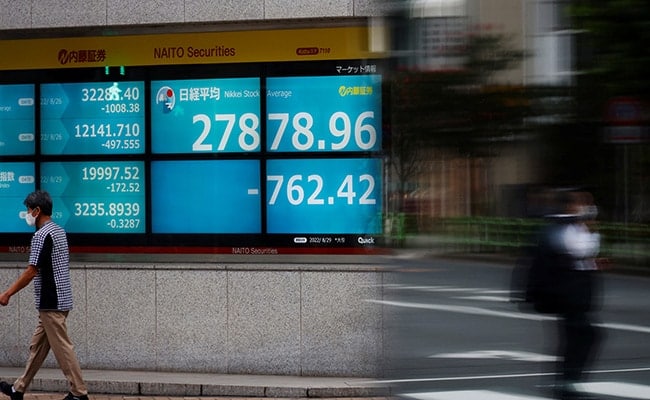
Asian stock markets attempted a comeback from big early losses on Wednesday, although most major markets were still in the red as investors worried about further aggressive monetary tightening following blowout US labour data.
European markets looked somewhat steadier, with UK FTSE futures signalling a 0.24% rise and Germany's DAX futures up 0.62%. US e-mini equity futures pointed to a 0.65% rebound for the S&P 500 from its 1.1% slide on Tuesday.
The overnight JOLTS report on job openings - closely watched by the Federal Reserve - pointed to extremely tight labour conditions, defying a string of large rate hikes and bolstering the case for more.
In addition, New York Fed President John Williams discouraged speculation about rate cuts next year if the economy slows too sharply, saying on Tuesday that the central bank likely needs to get the policy rate above 3.5% and is unlikely to lower rates at all in 2023.
"The strong JOLTS data and Fed rhetoric was the overwhelming narrative," knocking stocks further and pushing up bond yields, Tapas Strickland, an analyst at National Australia Bank, wrote in a note to clients.
"Financial conditions are a key transmission mechanism for monetary policy, and equities are part of that."
m Hong Kong's Hang Seng recovered from steep early declines to be down 0.39%.
However, MSCI's broadest index of Asia-Pacific stocks was flat.
Tuesday's heated US labour data will make investors even more attentive to the monthly US non-farm payrolls (NFP) report on Friday, with economists surveyed by Reuters expecting 300,000 jobs were added in August.
"The market is in a 'good news is bad news' phase," Thomas Westwater, an analyst at IG, wrote in a report.
"A rosy NFP print may drag on risk assets, including equities, which is unlikely to remain contained to Wall Street."
Money markets currently place 70.5% odds of a 75 basis-point increase by the Fed on Sept. 21.
The two-year US Treasury yield, which is relatively more sensitive to the monetary policy outlook, hit a fresh 15-year high at 3.497% overnight, but eased back to 3.4681% in Tokyo trading.
The 10-year Treasury yield, which hit a two-month high of 3.153% on Tuesday, stood at 3.1155%.
The dollar index, which measures the currency against six major peers, softened 0.18% to 108.57, after starting the week by marking a new two-decade high at 109.48.
Gold was little changed at $1,724.50, hovering near a one-month low of $1,719.56, set Monday.
Crude oil rebounded from declines of more than $5 overnight, as industry data showed US fuel stocks fell more than expected.
US West Texas Intermediate (WTI) crude futures jumped 90 cents, or 1%, to $92.54 a barrel, after sliding $5.37 in the previous session driven by recession fears.
Brent crude futures for October climbed 70 cents, or 0.7%, to $100.01 a barrel, trimming Tuesday's $5.78 loss.
(This story has not been edited by NDTV staff and is auto-generated from a syndicated feed.)

-
High US Salaries, No Green Card Certainty: The Financial Calculation Facing Indian H-1B Families

The suspension of PERM processing at eight technology employers does not cancel existing H-1B visas. What it does is force a question many Indian families have been avoiding: is the US salary worth tying your career and family plans to one employer?
-
Unhedged Position: Can India See An Indonesia-Style Time Correction?
The Nifty is trading below levels it first clocked in 2024. Is there, then, as I have suggested in the headline, potential that the current time correction drags on painfully for the next three-five, even ten years?
-
Navigating Friction And Energy Realities: An Analysis Of Marco Rubio's October Visit To India
Occurring at a critical juncture marked by stalled trade negotiations and escalating geopolitical pressures over global energy supplies, the visit offers a profound window into modern US-India relations.
-
India Exports Capital. Why Not Export Trusteeship?
The big question, then, is whether India can build an institution that global borrowers, investors, banks, and lawyers can trust, even without an Indian connection.
-
France's Economy & Politics Are In Crisis | The Reason Why
Let's look at how the French economy and politics evolved under Nicolas Sarkozy, Franois Hollande and Emmanuel Macron.
-
You May Inherit The Business. You Must Earn Its Credibility.
Succession tests the founder's ability to share authority as much as it tests the next generation's readiness to assume it.
-
Signing Deals Is One Thing; Making Them Work Is Another | The Week In Whys
Sometimes, things don't turn out as planned. Indian companies have lost some bids to rivals, some projects won't produce until 2030.
-
FOMC Wall, PERM Suspension, Hospital Stocks | Talking Points This Week
A PERM suspension would directly affect green-card sponsorship rather than H-1B visas, so the near-term earnings impact could remain relatively limited. The key question is whether this marks a new phase in US scrutiny of Indian IT.
-
Everything, Everywhere, All At Once: Dalal Street's Week To Forget | Joining The Dots
Visa curbs, a Starlink spat and cancer drug caps: what connects this week's shocks for Indian markets
-
India Is Going Abroad For Critical Minerals. But It May Take Years To Pay Off | The Reason Why
Although India's steps are in the right direction, they remain modest compared with India's growing dependence.









