Asia Shares Buckle Beneath Global Growth Woes
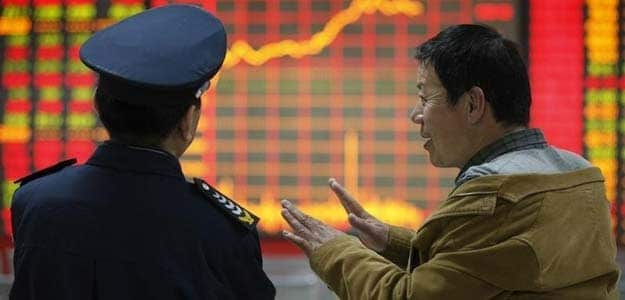
Asian stocks slid on Wednesday as worries about waning global growth lifted safe-haven bonds and the yen, while shoving oil prices to their lowest in more than two years.
Government bonds were in big demand as investors wagered global inflation would continue to slow and even put off the day when US interest rates might rise.
Minutes of the Federal Reserve's last policy meeting are due later in the session and markets will be acutely sensitive to how the debate between hawks and doves on the committee was playing out.
In Asia, Japan's Topix shed 1.6 per cent while the Nikkei dropped 1.4 per cent.
MSCI's broadest index of Asia-Pacific shares outside Japan fell 0.4 per cent, while Australia's main index lost 1.1 per cent.
Dealers were now waiting anxiously to see how China's markets react as they return from a week-long break. China also has the only major piece of economic news in the region with the release of the HSBC PMI for the services sector.
Traders will be hoping the figures are better than Tuesday's dismal selection. German industrial output fell 4.0 per cent in the biggest decline since the height of the financial crisis, piling yet more pressure on the European Central Bank to be more urgent in its actions.
At the same time, the IMF shaved its global growth forecast to 3.3 per cent for this year, from 3.4 per cent, warning of weakness in core euro zone countries, Japan and big emerging markets such as Brazil.
"Weak numbers like the German production report fuel concern that ECB stimulus will be inadequate given the gloomier news," said Westpac analyst James Shugg.
"With the IMF waving its knife at its global growth forecasts, US markets couldn't avoid the downdraft either."
The Dow fell 1.6 per cent, while the S&P 500 lost 1.51 per cent and the Nasdaq 1.56 per cent. The pan-European FTSEurofirst 300 also shed 1.5 per cent.
The small-cap Russell 2000 ended near a one-year low as investors reined in riskier bets ahead of this week's start of third-quarter earnings reports.
WHAT INFLATION?
Inflation swaps for the euro zone, which essentially show what investors think inflation will average over the next five years, have been in precipitous decline, touching an historic low of 1.89 per cent this week.
This is one of ECB President Mario Draghi's favoured measures of inflation and its decline was a major reason the central bank launched a fresh stimulus package last month.
But the downdraft in inflation expectations is hardly confined to Europe. The US swaps rate has sunk to 2.62 per cent, from 2.88 per cent in August, even as the run of US economic data has been generally encouraging.
Likewise, longer-dated US Treasury yields have fallen noticeably as investors price in low inflation for longer.
Yields on 30-year bonds are now at their lowest since May 2013 at 3.05 per cent, while their premium over two-year yields shrank to the smallest since late 2012.
Futures contracts predicting the course of the Fed funds rate have rallied hard in recent days as the market pushed out the date for the first hike.
They now show less than 50 basis points of tightening for 2015 and all of it in the second half of the year.
The fall in US yields dragged the dollar down from its recent highs. The dollar index eased to 85.569, off a four-year peak of 86.746 hit on Friday.
The dollar slid to a three-week low of 107.76 yen, further recoiling from a six-year high of 110.09 set a week ago. The euro edged up to $1.2677, and away from a two-year trough near $1.2500.
Commodities were under pressure as global demand fell short of supply. Brent crude oil fell 31 cents to $91.80 a barrel. It hit $91.25 on Monday, the lowest since June 2012.
US November crude eased another 27 cents to $88.58 a barrel, uncomfortably close to its recent trough of $88.18.
Copyright: Thomson Reuters 2014

-
Blue Wave Will Derail the AI Trade but Won't Dismantle the AI Era | Unhedged Position

The Democrats' sweep of the US Congress will see politics collide with economic forces both over the long and short term.
-
It's Time To Take The GST Council's Bet On Trust Global
Payment records can prove India's services exports, and clear, proportionate rules can bring foreign digital sellers into the tax net.
-
Opinion | India at 38: From Innovation Overperformer to Innovation Powerhouse
India now has 453 VC-backed deep science startups, 18 of them late-stage, after 117 percent growth since 2020. Laurus Labs, at USD 9.3 billion, is the most valuable deep science company in any middle-income economy outside China.
-
Navigating Energy Crossroads: S Jaishankar's Call For Diversified Supply Chains At G20 Ministerial Meeting
As geopolitical fault lines continue to test maritime trade routes and commodity flows, Jaishankar's message remains pertinent: true economic resilience requires open markets, protected transit lines, and a genuine commitment to multilateral cooperation rather than coercion.
-
Indians Are Travelling, But Not Every Journey Is A Holiday | The Week In Whys
Pilgrims, patients and working women are the real travellers, and the system hasn't quite caught up with them.
-
Getting To Work Costs Women More | The Reason Why
It is not just about women paying more than men. It is about women paying much more in cities than in villages.
-
AI Bias In Investing Cannot Be Eliminated, But It Can Be Governed
Framing is a particularly important example as identical financial information presented in terms of gains rather than losses can lead an LLM to reach a different assessment.
-
Joining The Dots | Dark Skies, Steady Diya: Why Hope Holds This Diwali
With war, a weak rupee and foreign outflows weighing on sentiment, policymakers at the NDTV World Summit and market veterans at NDTV Profit Ignite: Diwali Edition offered the same advice: stay invested and filter out the noise.
-
The Curious Case of Equitas Small Finance Bank And A CEO Who Quit For Stock
PN Vasudevan believes persistent investor concerns over a perceived conflict of interest had become a governance overhang on Equitas Small Finance Bank's stock, even as the lender improved profitability and asset quality.










