Asia Plastic Makers Frustrated By Delay In China Demand Recovery

(Bloomberg) -- Asian plastic makers have been eagerly anticipating a post-lockdown pick-up in Chinese consumption, but weak consumer demand and high inventories mean it could be a long time coming.
Petrochemicals has been the hardest hit segment of the oil market this year. Covid-19 restrictions in manufacturing giant China decimated demand over April and May, while the invasion of Ukraine upended fuel flows and raised costs for naphtha, a major feedstock.
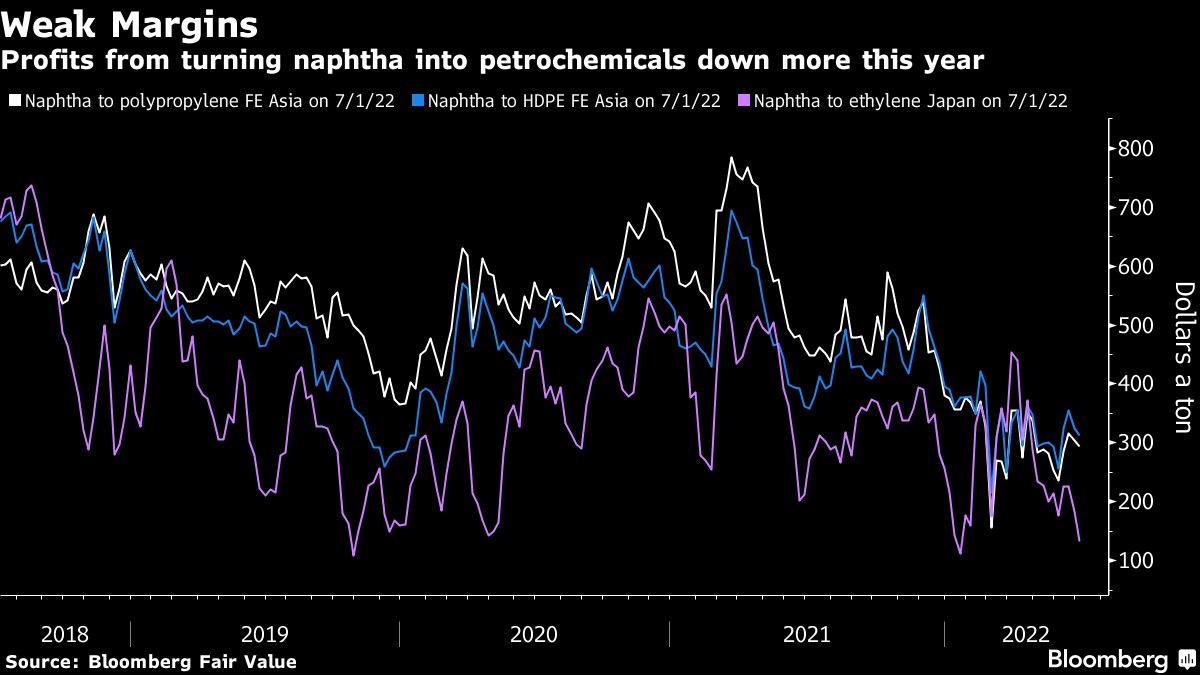
Producers of the building blocks used to make everything from car interiors to packaging and cables have seen margins fall further this year. Profits from turning naphtha into ethylene, a petrochemical that's the base for many plastic products, have dropped to $133 a ton from above $450 in early April.
China accounts for about 40% of global petrochemicals demand, according to S&P Global Commodity Insights, so the fortunes of big producers like LG Chem Ltd. and Formosa Petrochemical Corp. are closely tied to what's happening there. While lockdowns have eased, there are signs that Chinese consumer confidence will take longer to recover amid price gains and a very gradual economic rebound.
“Durable plastics for domestic white goods and for automotive applications have yet to see a strong demand recovery,” said Larry Tan, vice president for chemical consulting in Asia at S&P Global. Inflationary pressures in China are “causing consumers to be more cautious on spending on bigger-ticket items,” although domestic sentiment is slowly improving, he said.
China's Consumer Confidence Crisis Will Leave Permanent Scars
Higher shipping costs and disruptions to supply chains are also complicating the global plastics trade, making it tougher for Asian producers to offset sluggish local demand by exporting to Europe.
Chinese petrochemical plants have increased operating rates over the last few weeks, but they're still only running at 85% of capacity, compared with 100% normally, according to Kelly Cui, a consultant at Wood Mackenzie Ltd. Stockpiles are also high, she said.
There are some optimistic signs for plastics producers, however. Benchmark North Asian naphtha prices have fallen by around 30% since spiking in early March after the Russian invasion of Ukraine, although are still high on a historical basis. Some of their products -- such as xylene, toluene, benzene and MTBE -- that can be blended with gasoline are also seeing strong demand.
And Chinese household spending should also start to improve. Goldman Sachs Group Inc. sees it increasing 4.5% in the second half from a year earlier, compared with a 1.5% contraction last quarter.
However, Beijing's Covid Zero policy means the risk of more lockdowns hasn't gone away, said Wood Mackenzie's Cui. Consumption is slowly on the mend, but it could take until September, usually the peak-demand period for polyolefins -- a key petrochemical segment -- to see a firmer turnaround, she said.
More stories like this are available on bloomberg.com
©2022 Bloomberg L.P.

-
A New Samvat Wishlist: Inclusive Prosperity And Human Development

India has strengthened its economic foundations through infrastructure, digital access and enterprise. Its next growth chapter must deepen productivity, create better livelihoods and widen participation in prosperity.
-
Love, Sex Aur Dhokha: The Audacious Plot To Spy On Jensen Huang
A Taipei dinner, a Singapore chip buyer and a suspected Chinese asset: inside the alleged spy operation that got close to NVIDIA's Jensen Huang.
-
Ten Things I Learnt This Samvat
Patience can be a trap. Cheap stocks can stay cheap. Leverage can wipe you out. What did Samvat 2082 teach us? Niraj Shah writes on 10 lessons from the year gone by.
-
Talking Points This Week: Tech Nerves, FII Buying, And A Faraway Banking Shock
The global markets are not shining this Diwali. The exception in the large markets is, India.
-
Midterm Rally Lasted A Day. The Hard Reality Of A Divided US May Last Two Years | Opinion
Between a contested AI boom, a debt ceiling that arrives in 2027 and a president with every incentive to act alone, the next two years may prove more volatile than the first day's rally suggests.
-
Blue Wave Will Derail the AI Trade but Won't Dismantle the AI Era | Unhedged Position
The Democrats' sweep of the US Congress will see politics collide with economic forces both over the long and short term.
-
It's Time To Take The GST Council's Bet On Trust Global
Payment records can prove India's services exports, and clear, proportionate rules can bring foreign digital sellers into the tax net.
-
Opinion | India at 38: From Innovation Overperformer to Innovation Powerhouse
India now has 453 VC-backed deep science startups, 18 of them late-stage, after 117 percent growth since 2020. Laurus Labs, at USD 9.3 billion, is the most valuable deep science company in any middle-income economy outside China.
-
Navigating Energy Crossroads: S Jaishankar's Call For Diversified Supply Chains At G20 Ministerial Meeting
As geopolitical fault lines continue to test maritime trade routes and commodity flows, Jaishankar's message remains pertinent: true economic resilience requires open markets, protected transit lines, and a genuine commitment to multilateral cooperation rather than coercion.









