Arvind Subramanian Quits. Five Things For Which Arun Jaitley Lauded Him
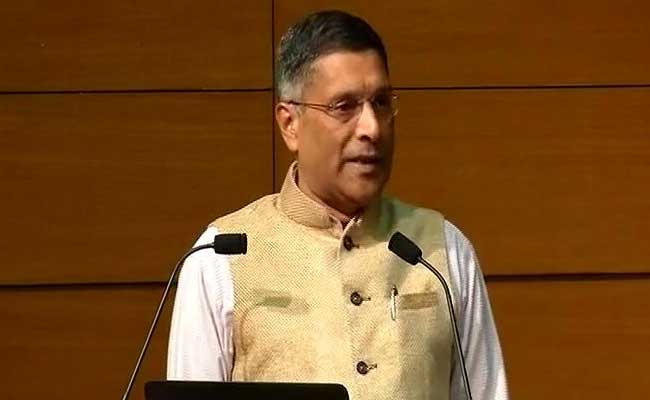
After spending four years in India as chief economic advisor, Arvind Subramanian left the job to return to America for personal reasons. Mr Subramanian had joined Chief Economic Advisor on October 16, 2014 for a period of three years. On the expiry of the three year he was requested by Union finance minister Arun Jaitley to continue for some more time. In a blog post announcing his exit, Mr Jaitley said that Arvind Subramanian used to think ahead and, therefore, came out with futuristic ideas on rationalisation of removal of "subsidies for the rich", universal basic income, climate change, from "socialism without entry and capitalism without exit".
Before Mr Subramanian, former RBI governor Raghuram Rajan and Niti Aayog's vice chairman Arvind Panagariya have also left their high-profile jobs as top economists in central bank and India's policy think tank respectively.
Arvind Subramanian's five achievements for which Arun Jaitley credited him:
1. JAM Trinity: Arvind Subramanian conceptualised JAM (Jan Dhan, Aadhar, Mobile) as a data base for availing public benefits. He came out with newer ideas, policy reforms in the sectors of clothing, fertilizers, kerosene, power and pulses.
2. Online Education Platform: Arvind Subramanian launched the government's online education platform "Swayam", which, As Mr Jaitley said, became one of the most followed courses in India.
3. Detecting Twin balance sheet problem: Mr Subramanian's early diagnosis of the twin balance-sheet prompted the government to adopt the macro-economic strategy of higher public investment in the Budget of 2015-16.
4. Raising the bar of Economic Surveys: Mr Subramaninan elevated the quality of the analysis and the presentation of ideas for public deliberation in his four Economic Surveys. His documents for four years was treated by several independent critics as one of the best ever produced. The latest survey had about 15 million visitors from 117 countries. The Economic Survey today is a basic teaching material all over India.
5. Report on revenue neutral rate: Mr Subramanian's report on the Revenue Neutral Rate was of great use in forging a consensus which led to the constitution amendment enabling the GST. He participated in every meeting of GST, gave his independent views and was heard in rapt attention by almost every Finance Minister.

-
High US Salaries, No Green Card Certainty: The Financial Calculation Facing Indian H-1B Families

The suspension of PERM processing at eight technology employers does not cancel existing H-1B visas. What it does is force a question many Indian families have been avoiding: is the US salary worth tying your career and family plans to one employer?
-
Unhedged Position: Can India See An Indonesia-Style Time Correction?
The Nifty is trading below levels it first clocked in 2024. Is there, then, as I have suggested in the headline, potential that the current time correction drags on painfully for the next three-five, even ten years?
-
Navigating Friction And Energy Realities: An Analysis Of Marco Rubio's October Visit To India
Occurring at a critical juncture marked by stalled trade negotiations and escalating geopolitical pressures over global energy supplies, the visit offers a profound window into modern US-India relations.
-
India Exports Capital. Why Not Export Trusteeship?
The big question, then, is whether India can build an institution that global borrowers, investors, banks, and lawyers can trust, even without an Indian connection.
-
France's Economy & Politics Are In Crisis | The Reason Why
Let's look at how the French economy and politics evolved under Nicolas Sarkozy, Franois Hollande and Emmanuel Macron.
-
You May Inherit The Business. You Must Earn Its Credibility.
Succession tests the founder's ability to share authority as much as it tests the next generation's readiness to assume it.
-
Signing Deals Is One Thing; Making Them Work Is Another | The Week In Whys
Sometimes, things don't turn out as planned. Indian companies have lost some bids to rivals, some projects won't produce until 2030.
-
FOMC Wall, PERM Suspension, Hospital Stocks | Talking Points This Week
A PERM suspension would directly affect green-card sponsorship rather than H-1B visas, so the near-term earnings impact could remain relatively limited. The key question is whether this marks a new phase in US scrutiny of Indian IT.
-
Everything, Everywhere, All At Once: Dalal Street's Week To Forget | Joining The Dots
Visa curbs, a Starlink spat and cancer drug caps: what connects this week's shocks for Indian markets
-
India Is Going Abroad For Critical Minerals. But It May Take Years To Pay Off | The Reason Why
Although India's steps are in the right direction, they remain modest compared with India's growing dependence.









