Apple Sees Biggest Rally of the Year After Sales Top Estimates
(Bloomberg) -- Apple Inc. rallied Friday after reporting a rebound in iPhone sales last quarter, helping the world's most valuable company top earnings estimates and weather an industrywide downturn that has battered much of its product lineup.
The shares jumped as much as 5.1% to $174.20, the biggest intraday gain since Nov. 30. They're now up 34% in 2023.
Overall revenue amounted to $94.8 billion in the fiscal second quarter, Apple said Thursday, exceeding the $92.6 billion analysts predicted. Though the sales fell 2.5% in the period, the company had warned investors to expect a drop of roughly twice that.
The results suggest that Apple is beginning to recover from a slump that's plagued both the computer and smartphone industries. It's a particular relief for investors after Qualcomm Inc., a key supplier, raised fresh concerns about phone demand earlier this week. Apple's sales in China — a weak spot for other tech companies — also came in a bit better than expected.
As expected, Apple announced plans for $90 billion in stock repurchases — the same as last year's plan. The company also raised its quarterly dividend 4% to 24 cents a share.
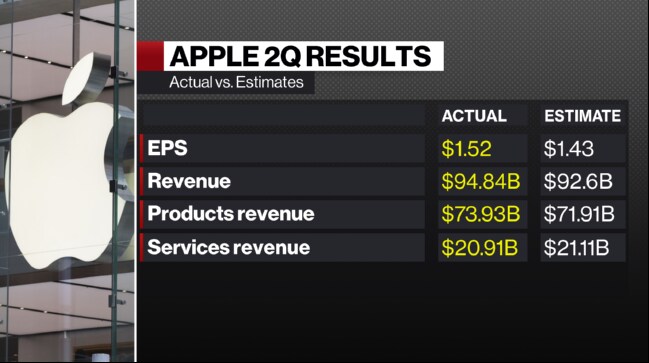
Though the performance was better than expected, it marked two straight quarters of sales declines — a first for Apple since the pandemic began. Earnings, meanwhile, were unchanged from a year earlier, at $1.52 a share. That compared with an average estimate of $1.43 a share.
On a conference call with analysts, Apple said that revenue in the current period would drop by a similar amount as in the past quarter, which ended April 1. That suggests a dip of about 3%. The company also said it would continue to see a negative impact from foreign exchange rates.
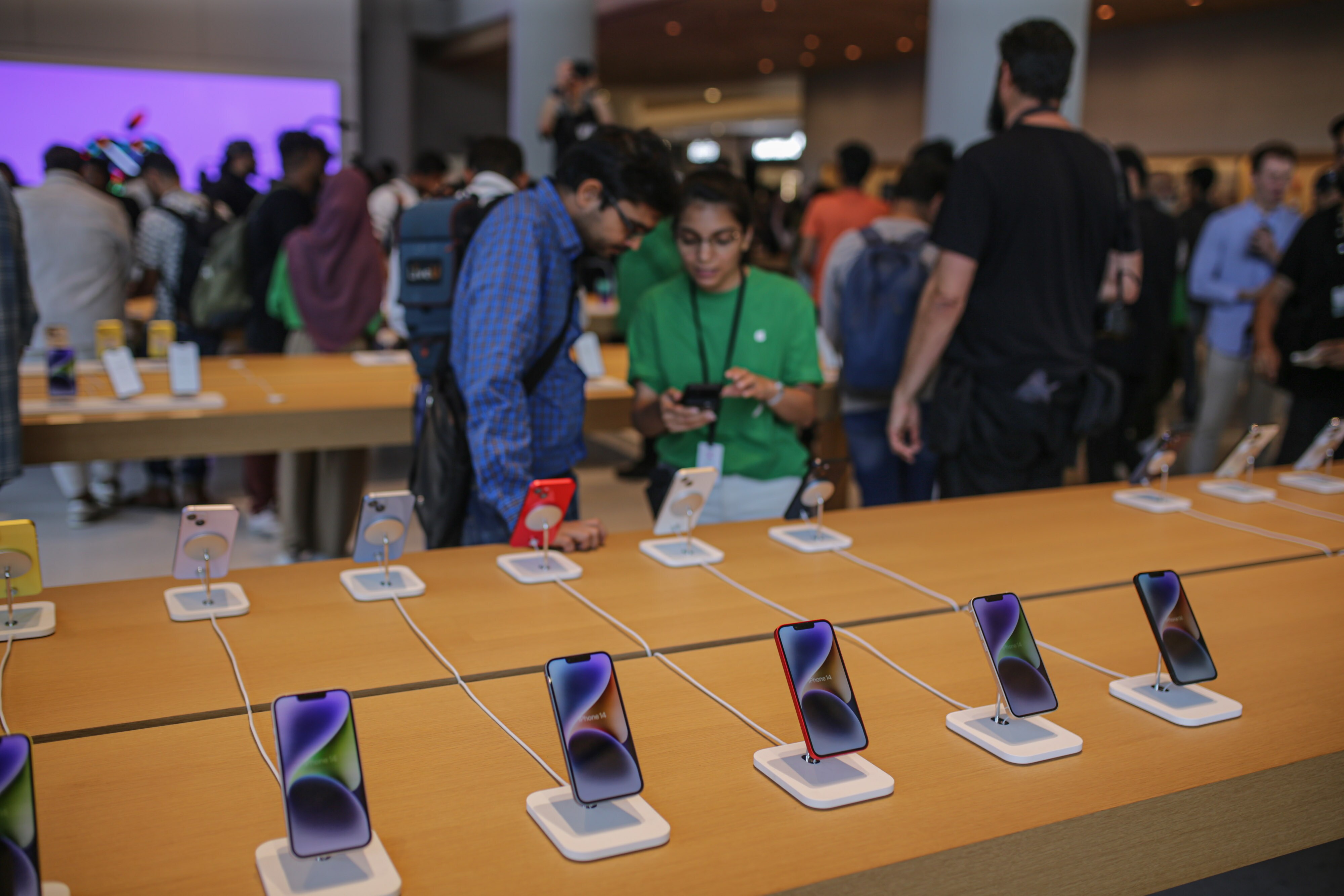
Apple generated $51.3 billion in sales from the iPhone — its flagship product — in the second quarter, topping analyst predictions of $49 billion. That's just a 1.5% rise from a year ago but marked a record performance for a March quarter, Chief Executive Officer Tim Cook said. The increase came “despite the challenging macroeconomic environment,” he said in the statement.
Like many tech CEOs delivering earnings reports, Cook also discussed artificial intelligence. He said it had enormous potential and that Apple would continue weaving it into products in a “very thoughtful” way.
Read More: Apple's Tim Cook Says AI Concerns Still Need to Be Sorted Out
From a supply perspective, the second quarter was an opportunity for the iPhone 14 to rebound. The device had suffered from constraints during the previous period due to Covid policies in China.
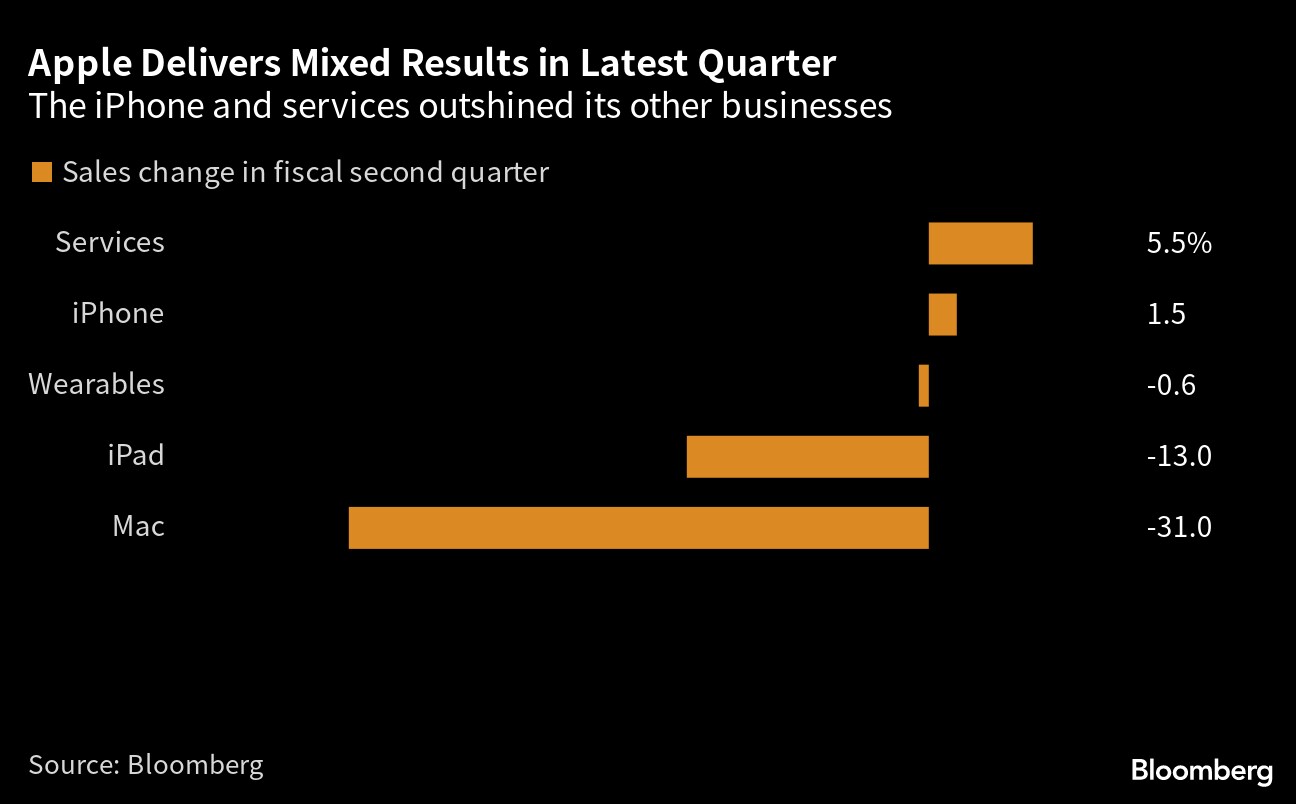
The iPad saw revenue fall 13% to $6.67 billion, roughly in line with estimates of $6.7 billion. New models, which included a revamped entry-level version and Pro models with M2 chips, didn't do much to spur purchases in the quarter.
Likewise, revenue in the Mac division dropped 31% to $7.17 billion. That trailed forecasts of $7.7 billion. Research firms already warned that it was a bleak quarter for the lineup, with IDC estimating that Mac shipments fell about 40% in the quarter. Apple had updated the MacBook Pro and Mac mini, adding faster processors, but they failed to reignite the unit's sales.
The home, wearables and accessories division, which includes AirPods, the Apple Watch and the TV set-top box — fell less than 1% to $8.76 billion. That beat estimates of $8.5 billion. The company added a faster processor to the Apple TV during the holiday quarter and updated its HomePod speaker during the March quarter.
The services business, which includes iCloud, Apple Music, the App Store and the TV+ streaming service, brought in $20.91 billion, missing estimates of $21.1 billion. Still, it was a 5.5% gain from a year earlier. Last quarter, Apple promised that services revenue — alongside the iPhone — would accelerate.
The company did particularly well in emerging markets, Cook said, pointing to record quarterly sales in Mexico, Indonesia, the Philippines, Saudi Arabia, Turkey and the United Arab Emirates. And the company's overall sales would have been up if you held currencies constant, he said.
For Apple and other US companies with a global footprint, a strong dollar has decreased the value of revenue generated in other parts of the world.
“Despite these challenges, we continue to manage for the long term,” Cook said.
More stories like this are available on bloomberg.com
©2023 Bloomberg L.P.

-
Ten Things I Learnt This Samvat

Patience can be a trap. Cheap stocks can stay cheap. Leverage can wipe you out. What did Samvat 2082 teach us? Niraj Shah writes on 10 lessons from the year gone by.
-
Talking Points This Week: Tech Nerves, FII Buying, And A Faraway Banking Shock
The global markets are not shining this Diwali. The exception in the large markets is, India.
-
Midterm Rally Lasted A Day. The Hard Reality Of A Divided US May Last Two Years | Opinion
Between a contested AI boom, a debt ceiling that arrives in 2027 and a president with every incentive to act alone, the next two years may prove more volatile than the first day's rally suggests.
-
Blue Wave Will Derail the AI Trade but Won't Dismantle the AI Era | Unhedged Position
The Democrats' sweep of the US Congress will see politics collide with economic forces both over the long and short term.
-
It's Time To Take The GST Council's Bet On Trust Global
Payment records can prove India's services exports, and clear, proportionate rules can bring foreign digital sellers into the tax net.
-
Opinion | India at 38: From Innovation Overperformer to Innovation Powerhouse
India now has 453 VC-backed deep science startups, 18 of them late-stage, after 117 percent growth since 2020. Laurus Labs, at USD 9.3 billion, is the most valuable deep science company in any middle-income economy outside China.
-
Navigating Energy Crossroads: S Jaishankar's Call For Diversified Supply Chains At G20 Ministerial Meeting
As geopolitical fault lines continue to test maritime trade routes and commodity flows, Jaishankar's message remains pertinent: true economic resilience requires open markets, protected transit lines, and a genuine commitment to multilateral cooperation rather than coercion.
-
Indians Are Travelling, But Not Every Journey Is A Holiday | The Week In Whys
Pilgrims, patients and working women are the real travellers, and the system hasn't quite caught up with them.
-
Getting To Work Costs Women More | The Reason Why
It is not just about women paying more than men. It is about women paying much more in cities than in villages.









