Animal Spirits Subdued as India Cash Crunch, Trade Wars Hit Home: Report
India is beginning to feel the heat of global trade tensions and tighter monetary conditions at home, as rising oil prices and waning consumption threaten to muzzle animal spirits in the world's fastest-growing major economy.
Demand for services and manufactured goods slowed in August, while a cross-section of high-frequency indicators compiled by Bloomberg News suggest economic growth may moderate in the coming months from an 8 percent-plus pace in the quarter to June. The business activity tracker, which feeds into the dashboard's overall reading, dialed back a notch to the third-highest rating from second previously.
A debt crisis at a local lender and a cash crunch in the banking system add to the risks to the economy that's dealing with costlier oil and a weaker rupee.
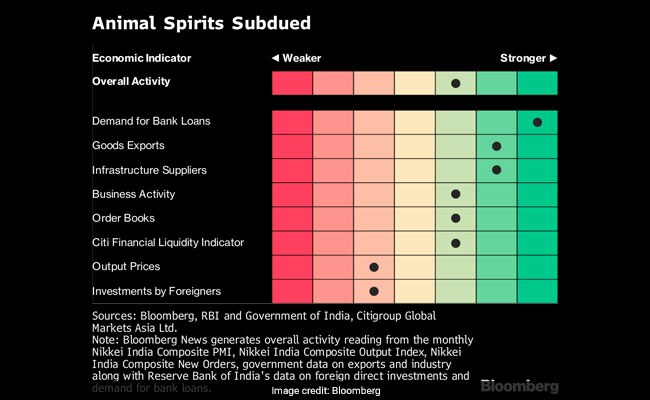
Here are the full details of the dashboard:
Business Activity
India's main services index expanded in August at the slowest pace in three months as both new orders as well as hiring slowed. The Nikkei India Composite PMI Output Index retreated from July's near two-year high, mirroring weaker growth in both the manufacturing and services gauges. The services sector accounts for about 55 percent of India's gross domestic product.
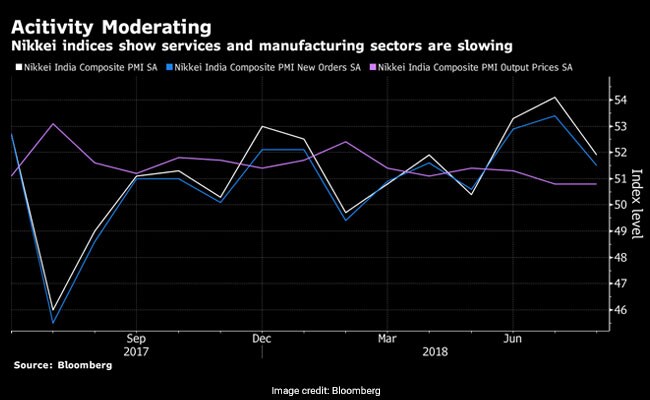
More worryingly for the Reserve Bank of India, input cost inflation rose to its highest in nine months, although output prices remained more or less stable.
The central bank's six-member monetary policy committee meets next week to decide on interest rates, having delivered two hikes since June. The swap markets are pricing in at least 100 basis points of rate increases in the coming months, which will take the repurchase rate to 7.5 percent.
Exports
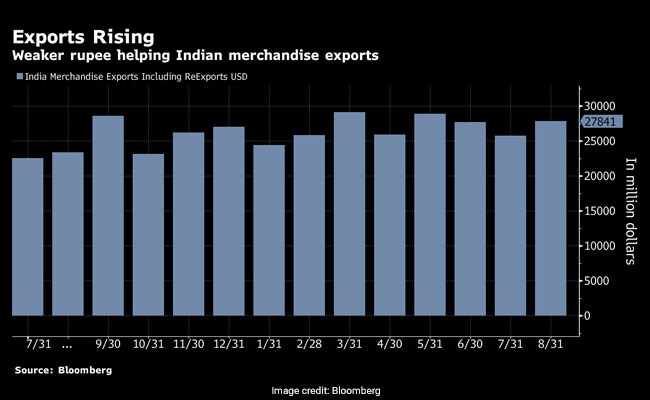
India's merchandise exports grew by a relatively strong 19.2 percent in August from a year earlier, helped by a weaker rupee. Economists say sectors such as textiles, pharmaceutical and engineering goods are witnessing some benefit from a weak currency, although imports -- especially costly crude -- are handily outpacing shipments abroad. That could see trade become an overall drag on growth.
The talk of $100-a-barrel oil is bad news for India, the world's fastest-growing oil consumer.
Consumer Activity
Data from the Society of Indian Automobile Manufacturers show that local car sales fell in August as rising cost of loans and a sharp rise in domestic fuel prices likely put off buyers. That apart, devastating floods in the southern state of Kerala just before a key festival hit purchases. Nevertheless, commercial vehicles and two-wheelers sales were higher, underpinning a view that overall domestic demand is, for now, holding up.
Bank credit rose 13.5 percent in August from a year ago, with most of the loans being made to the services sector. But there is bad news in store for borrowers with the government increasing interest rates on small savings instruments. That is likely to see banks raise deposit rates and consequently lending rates to protect their margins.
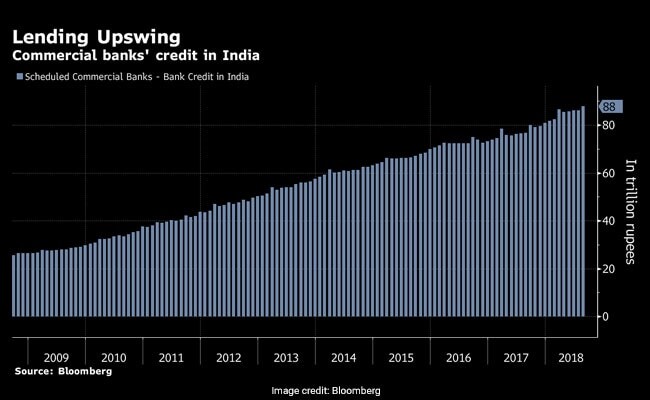
Bloomberg Economics' Abhishek Gupta says that while India's bank credit, which accounts for about three-quarters of the funding extended to companies, is showing signs of recovery, it's too early to conclude that the growth will be sustained.
"The pickup may partly reflect relaxed supply constraints at public-sector banks following the resolution of certain large bad loan cases," he added.
The Citi India Financial Conditions Index shows a considerable tightening in the first three weeks of September as advance tax outflows crimped surplus funds in the banking system and back-to-back rate hikes hit home. The index incorporates among other indicators, short-term money market rates, government bond yields (short and long tenor), the yield curve, credit and credit default spreads.
Economic Activity
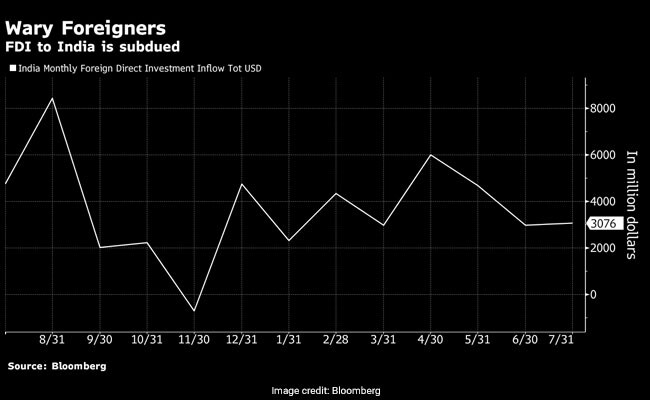
Foreign direct investments rose slightly in July. With a general election due in early 2019, concerns about policy paralysis and whether Prime Minister Narendra Modi will manage to repeat his 2014 landslide-win is likely to keep many investors on the sidelines.
Add to that, problems in India's financial sector, especially those concerning shadow banks and state-run lenders, are likely to weigh on investors' minds.
Industrial Activity
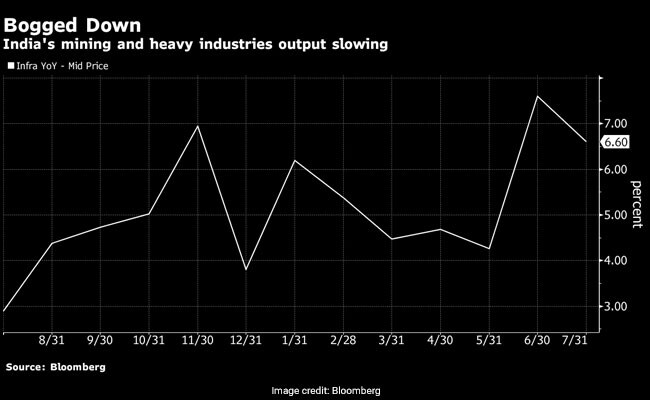
Output of infrastructure industries -- which contribute 40 percent to the industrial production index -- slowed in July. That was partly due to a decline in crude oil output, natural gas production and slowing down in the coal sector and electricity generation. Overall, the index for industrial production growth also slowed slightly to 6.6 percent year-on-year in July.
(This story has not been edited by NDTV staff and is auto-generated from a syndicated feed.)

-
Opinion | India at 38: From Innovation Overperformer to Innovation Powerhouse

India now has 453 VC-backed deep science startups, 18 of them late-stage, after 117 percent growth since 2020. Laurus Labs, at USD 9.3 billion, is the most valuable deep science company in any middle-income economy outside China.
-
Navigating Energy Crossroads: S Jaishankar's Call For Diversified Supply Chains At G20 Ministerial Meeting
As geopolitical fault lines continue to test maritime trade routes and commodity flows, Jaishankar's message remains pertinent: true economic resilience requires open markets, protected transit lines, and a genuine commitment to multilateral cooperation rather than coercion.
-
Indians Are Travelling, But Not Every Journey Is A Holiday | The Week In Whys
Pilgrims, patients and working women are the real travellers, and the system hasn't quite caught up with them.
-
Getting To Work Costs Women More | The Reason Why
It is not just about women paying more than men. It is about women paying much more in cities than in villages.
-
AI Bias In Investing Cannot Be Eliminated, But It Can Be Governed
Framing is a particularly important example as identical financial information presented in terms of gains rather than losses can lead an LLM to reach a different assessment.
-
Joining The Dots | Dark Skies, Steady Diya: Why Hope Holds This Diwali
With war, a weak rupee and foreign outflows weighing on sentiment, policymakers at the NDTV World Summit and market veterans at NDTV Profit Ignite: Diwali Edition offered the same advice: stay invested and filter out the noise.
-
The Curious Case of Equitas Small Finance Bank And A CEO Who Quit For Stock
PN Vasudevan believes persistent investor concerns over a perceived conflict of interest had become a governance overhang on Equitas Small Finance Bank's stock, even as the lender improved profitability and asset quality.
-
Talking Points This Week: AI Cash Burn, A Tiger Comeback And An India That Still Finds Its Own Path
India is not immune to higher oil or tighter global liquidity, yet its earnings base is broader, its domestic policy levers are still available.
-
Foreign Investors Own Half Of HDFC Bank and ICICI Bank. An LTCG Cut Could Matter Most Here
Foreign portfolio investors have US$115 billion parked in HDFC Bank, ICICI Bank. If the government cuts long-term capital gains tax, Jefferies says returning foreign money could land here first.










