Andhra Pradesh’s Push To Cut Renewable Tariffs By Half Could Spook Investors
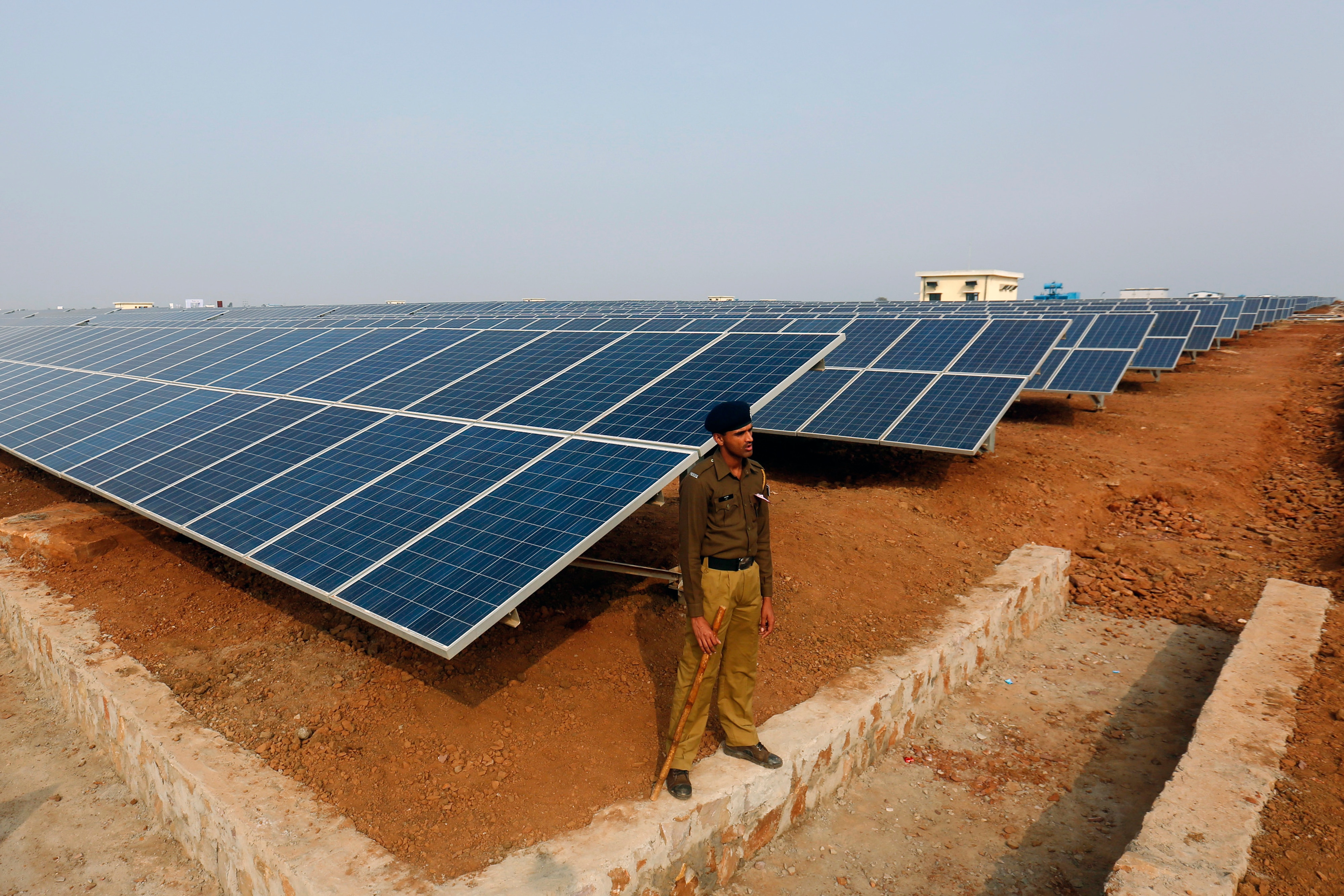
Andhra Pradesh's plan to renege on contracts to buy power from solar and wind farms citing high tariffs threatens to hurt investments in clean energy when Prime Minister Narendra Modi is looking to cut emissions and use of fossil fuels.
The state wants renewable power producers to cut tariffs—which distribution companies had agreed to—nearly by half. While generating companies got relief from the state high court that stayed the decision, companies, analysts and even the central government voiced concern.
“We are mindful of the difficulties being faced by investors in some instances where the state government is trying to renegotiate some of the executed contracts,” Dharmendra Pradhan, minister for petroleum and natural gas, said at the Bloomberg New Energy Finance Summit in New Delhi on Friday. “Our government has requested state governments to reconsider their decision, as this will jeopardise future investment in not only the concerned state but also the country as a whole.”
Reneging on contracts would threaten India's targets 175-gigawatt of renewable energy by 2022 as the nation looks to cut emissions to meet commitments under the Paris agreement. That would increase the share of solar and wind power in the electricity mix dominated by coal-fired units, the biggest contributors to toxic air.
The situation stems from transition from feed-in tariffs to competitive bidding in 2017 that drove renewable energy tariffs to record lows.
The newly formed Andhra Pradesh government, led by Chief Minister YS Jagan Mohan Reddy, on July 1 ordered creation of a high-level negotiation committee to “review, negotiate and bring down” the tariff of “abnormally priced wind and solar power purchase agreements” in Andhra Pradesh citing “huge power purchase dues” worth Rs 20,000 crore.
Power producers moved the Andhra Pradesh High Court on July 22, which granted a stay and fixed the matter for hearing on Aug. 22. BloombergQuint has reviewed a copy of the petition.
Some of the power producers who are petitioners in the case had signed agreements in 2015 and 2016 with the Southern Power Distribution Company of Andhra Pradesh Ltd. for 25 years. The tariffs were set at Rs 4.83 and Rs 4.84 a unit, respectively, by the Andhra Pradesh Electricity Regulatory Commission.
The state discoms asked to reduce it to Rs 2.43 a unit, Sunil Jain, chief executive officer at Hero Future Energies, told BloombergQuint over the phone. That's around the level of the last auctioned tariffs and also close to the record lows.
The petitioners include ReNew Power Ltd., ReNew Wind Energy (Shivpur) Pvt Ltd., Helios Infratech Pvt Ltd., Molagavalli Renewable Pvt Ltd., Zemira Renewable Energy Ltd., KCT Renewable Energy Pvt Ltd., Ostro AP Wind Private Ltd., Ostro Andhra Wind Pvt Ltd., and Ostro Anantpur Pvt Ltd. They had signed agreements for a capacity of 717.4 megawatts. But, according to Jain, total impacted capacity is higher.
Andhra Pradesh has an installed capacity of 7,400 MW capacity of solar and wind energy, Jain said. The impacted capacity due to renegotiation of PPAs (power purchase agreements) would have been 6,500 MW, he said.
In their petition, power producers said:
- The Andhra Pradesh discom “has been acting in an arbitrary manner in violation of the principles of Article 14 of the Constitution of India and exploiting its dominant position”.
- The business undertaken by the discom is “monopolistic” since it operates in an exclusive territorial jurisdiction and there is no other distribution licensee in the state with which power purchase agreements can be executed.
- The cumulative outstanding liability of the discom towards the petitioners under the power-purchase agreements stood at Rs 569 crore as on date.
- The state's discoms have been arbitrarily, continuously and illegally curtailing generation of wind power set up by the petitioners.
- Because of backing down by the state discoms since April 1 last year, the total generation of the ReNew Power Prpjects has been curtailed by 356.78 hours and 6.67 crore KWH, resulting in a loss of Rs 32.29 crore.
ReNew has yet to respond to BloombergQuint's emailed queries.
The Andhra Pradesh government's move could aggravate the problem of delayed payments from distribution companies and cause stress for about 5.2 gigawatt of projects with an estimated debt exposure of over Rs 21,000 crore, said Crisil said in a statement. Nearly half of this capacity is at a higher risk of default since they lack liquidity support beyond the project level, it said.
Why Tariffs Fell
Renewable energy producers argue they had bid based on cost of setting up the plant.
The tariff was Rs 4 a unit in 2014 as solar panels were costly at the time at 35-40 cents each, Shashi Shekhar, vice chairman at Acme Solar, told BloombergQuint over phone. “When I have invested taking that cost into account, my return on investment is linked to that investment. 25-year return factors that cost.”
Today, the panels cost around 25 cents each, and the tariff has come down to Rs 2.44 a unit, he said.
But at current tariffs, “my returns will become zero and I may not be able to pay to the banks”, he said. “The question of renegotiation will drive away the investors. What is the sanctity of the contract?”
Naina Lal Kidwai, former banker and now chairman at Altico Capital India Ltd. and Advent Private Equity India Advisory Board, said at the BNEF summit that the governments should ensure that sanctity of agreements is maintained for growth to happen. “They cannot change terms once investment has happened.”
In fact, RK Singh, minister for power and new and renewable energy, had written to Chief Minister YS Reddy stating that if the contracts are not honoured, investments will stop coming. “It will be wrong and against the law to cancel all PPAs (power purchase agreements).”
Renegotiating Contracts Not Easy
Jain of Hero Future Energies said the plan to alter the power purchase agreements is unlikely to stand up to legal scrutiny.
“There is already a ruling from the Supreme Court in the Tata Mundra (plant) case. Contracts are sacrosanct and you cannot renegotiate a contract,” he said. “Investors realise that there are courts in the country to take care of such eventuality,” said Jain, who has also moved the Andhra Pradesh High Court.
Hero Future Energies has three renewable energy projects in Andhra Pradesh with a total capacity of 195 megawatt. “The central government is in full support of the developers that this cannot be done. This is a temporary dip (back down). It will be sorted out.”
State-run NTPC Ltd., India's largest power producer that also has about 4,740 MW of wind and solar capacity, said the way forward would be to build merchant power plants—that sell power in exchanges—in the renewable sector. According to Gurdeep Singh, chairman and managing director at NTPC, “There is reluctance to enter 25-year power purchase agreements.”

-
A New Samvat Wishlist: Inclusive Prosperity And Human Development

India has strengthened its economic foundations through infrastructure, digital access and enterprise. Its next growth chapter must deepen productivity, create better livelihoods and widen participation in prosperity.
-
Love, Sex Aur Dhokha: The Audacious Plot To Spy On Jensen Huang
A Taipei dinner, a Singapore chip buyer and a suspected Chinese asset: inside the alleged spy operation that got close to NVIDIA's Jensen Huang.
-
Ten Things I Learnt This Samvat
Patience can be a trap. Cheap stocks can stay cheap. Leverage can wipe you out. What did Samvat 2082 teach us? Niraj Shah writes on 10 lessons from the year gone by.
-
Talking Points This Week: Tech Nerves, FII Buying, And A Faraway Banking Shock
The global markets are not shining this Diwali. The exception in the large markets is, India.
-
Midterm Rally Lasted A Day. The Hard Reality Of A Divided US May Last Two Years | Opinion
Between a contested AI boom, a debt ceiling that arrives in 2027 and a president with every incentive to act alone, the next two years may prove more volatile than the first day's rally suggests.
-
Blue Wave Will Derail the AI Trade but Won't Dismantle the AI Era | Unhedged Position
The Democrats' sweep of the US Congress will see politics collide with economic forces both over the long and short term.
-
It's Time To Take The GST Council's Bet On Trust Global
Payment records can prove India's services exports, and clear, proportionate rules can bring foreign digital sellers into the tax net.
-
Opinion | India at 38: From Innovation Overperformer to Innovation Powerhouse
India now has 453 VC-backed deep science startups, 18 of them late-stage, after 117 percent growth since 2020. Laurus Labs, at USD 9.3 billion, is the most valuable deep science company in any middle-income economy outside China.
-
Navigating Energy Crossroads: S Jaishankar's Call For Diversified Supply Chains At G20 Ministerial Meeting
As geopolitical fault lines continue to test maritime trade routes and commodity flows, Jaishankar's message remains pertinent: true economic resilience requires open markets, protected transit lines, and a genuine commitment to multilateral cooperation rather than coercion.









