Reliance Vs Adani On 5G Spectrum Race, But No Full-Blown Direct Market Clash Yet
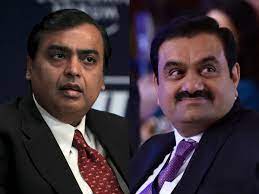
For years they tiptoed around each other but now the groups led by billionaires Mukesh Ambani and Gautam Adani will for the first time be in direct competition when they later this month participate in the auction of airwaves capable of providing fifth generation or 5G telecom services.
But the rivalry between the two politically well-connected Gujarati businessmen will not yet see a full-blown market clash despite overlaps.
On Saturday, Adani group confirmed plans to participate in the July 26 5G spectrum auction but said the airwaves it was seeking was to set up a private network to help digitise its businesses from airports to energy to data centres.
This meant no entry into the consumer mobile telephony space, where Ambani's Reliance Jio is the largest player.
Media Statement on Adani Group's interest in the 5G space. pic.twitter.com/iyAmvJOf2T
July 9, 2022Jio as well as telecom czar Sunil Bharti Mittal's Bharti Airtel and Vodafone Idea Ltd -- the other two dominated telecom companies in the country -- have also made applications to participate in the 5G auction, three sources with knowledge of the matter said.
While the three will be bidding to corner spectrum to support a pan-India rollout of 5G voice and data services, Adani will compete to get the same airwaves for private captive networks.
Incidentally, the telecom companies in the run-up for the auction bitterly opposed any direct allocation of spectrum to non-telecom entities for setting up private captive networks as it would severely impact their businesses.
They wanted the non-telcos to lease out spectrum from them or they set up private captive networks for them. But the government weighed in favour of private networks.
The nation's richest -- Adani and Ambani -- had taken contrasting approaches to business diversification, which in recent months has seen increasing overlap.
While Mr Ambani, 65, expanded from the oil refining and petrochemicals business into consumer facing telecom and retail businesses, Adani diversified from operating ports to producing coal, energy distribution, airports, data centres and more recently into cement and copper.
Mr Adani, 60, has in recent months set up a subsidiary for a foray into petrochemicals -- a business that Ambani's father Dhirubhai began with before its downstream and upstream operations.
Mr Ambani too has announced multi-billion-dollar plans for new energy business, including Giga factories for solar panels, batteries, green hydrogen and fuel cells.
Mr Adani, who had previously announced plans to be the world's largest renewable energy producer by 2030, too has unveiled hydrogen ambitions.
Sources, however, said while there is an overlap in the clean energy space, there is no direct competition between the two.
While Adani group is looking to split water using solar power to produce green hydrogen, Mr Ambani's Reliance is looking at producing hydrogen from natural gas and other hydrocarbons supported by carbon capture and storage.
"Where is the direct competition," a source asked. "Adani will desalinate sea water for use in electrolysers to produce green hydrogen while Ambani is looking to decarbonise his oil business." And while they will have a face-off at the spectrum auction, there will be no direct competition on ground yet, another source said.
Reliance owns the world's largest refining complex at Jamnagar in Gujarat and is also a leading manufacturer of polymers, polyester and fiber-intermediates. Adani, on the other hand, is focused on coal in the hydrocarbon space, with mines in India, Indonesia and Australia, and thermal power plants.
While Mr Ambani made a slew of investments in clean energy space, Adani's petrochemical ambitions came unstuck twice -- Covid pandemic led to shelving of a $4 billion acrylics complex near Mundra in Gujarat that was planned in collaboration with BASF SE, Borealis AG and Abu Dhabi National Oil Co (Adnoc), and a plant with Taiwan's CPC Corp too couldn't make much headway.
But their balance sheets are quite different. While Adani group firms have borrowed, Ambani has ploughed cash generated from traditional oil refining and petrochemicals business into newer areas.
Ambani raised $27 billion in 2020 from the likes of Facebook, Google and an array of private equity funds.
Adani, which has sold stakes in the renewable energy firm, gas distribution company and new energy unit to France's TotalEnergies SE, isn't lagging with $17 billion spent on 32 acquisitions.
On Saturday, Adani said the spectrum it intends to buy is "to provide private network solutions along with enhanced cyber security in the airport, ports and logistics, power generation, transmission, distribution, and various manufacturing operations."
Adani Group plans to use the airwaves for its data centre as well as the super app it is building to support businesses from electricity distribution to airports, gas retailing to ports.
"As we build our own digital platform encompassing super apps, edge data centres, and industry command and control centres, we will need ultra high quality data streaming capabilities through a high frequency and low latency 5G network across all our businesses," it had said in a statement.
But all this doesn't mean a market confrontation with Mr Ambani yet.
(Except for the headline, this story has not been edited by NDTV staff and is published from a syndicated feed.)

-
Opinion | India at 38: From Innovation Overperformer to Innovation Powerhouse

India now has 453 VC-backed deep science startups, 18 of them late-stage, after 117 percent growth since 2020. Laurus Labs, at USD 9.3 billion, is the most valuable deep science company in any middle-income economy outside China.
-
Navigating Energy Crossroads: S Jaishankar's Call For Diversified Supply Chains At G20 Ministerial Meeting
As geopolitical fault lines continue to test maritime trade routes and commodity flows, Jaishankar's message remains pertinent: true economic resilience requires open markets, protected transit lines, and a genuine commitment to multilateral cooperation rather than coercion.
-
Indians Are Travelling, But Not Every Journey Is A Holiday | The Week In Whys
Pilgrims, patients and working women are the real travellers, and the system hasn't quite caught up with them.
-
Getting To Work Costs Women More | The Reason Why
It is not just about women paying more than men. It is about women paying much more in cities than in villages.
-
AI Bias In Investing Cannot Be Eliminated, But It Can Be Governed
Framing is a particularly important example as identical financial information presented in terms of gains rather than losses can lead an LLM to reach a different assessment.
-
Joining The Dots | Dark Skies, Steady Diya: Why Hope Holds This Diwali
With war, a weak rupee and foreign outflows weighing on sentiment, policymakers at the NDTV World Summit and market veterans at NDTV Profit Ignite: Diwali Edition offered the same advice: stay invested and filter out the noise.
-
The Curious Case of Equitas Small Finance Bank And A CEO Who Quit For Stock
PN Vasudevan believes persistent investor concerns over a perceived conflict of interest had become a governance overhang on Equitas Small Finance Bank's stock, even as the lender improved profitability and asset quality.
-
Talking Points This Week: AI Cash Burn, A Tiger Comeback And An India That Still Finds Its Own Path
India is not immune to higher oil or tighter global liquidity, yet its earnings base is broader, its domestic policy levers are still available.
-
Foreign Investors Own Half Of HDFC Bank and ICICI Bank. An LTCG Cut Could Matter Most Here
Foreign portfolio investors have US$115 billion parked in HDFC Bank, ICICI Bank. If the government cuts long-term capital gains tax, Jefferies says returning foreign money could land here first.










