Alibaba's Ma Meets Trump, Promises To Bring One Million Jobs To US
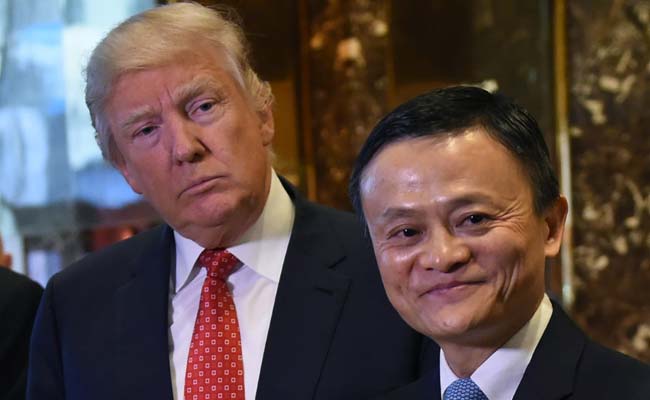
New York/Beijing: Alibaba Executive Chairman Jack Ma met U.S. President-elect Donald Trump on Monday and laid out the Chinese e-commerce giant's new plan to bring one million small U.S. businesses onto its platform to sell to Chinese consumers over the next five years, an Alibaba spokesman said.
Alibaba Group Holding Ltd expects the initiative to create one million U.S. jobs as each company adds a position, company spokesman Bob Christie said in a phone call.
Alibaba has previously campaigned to bring more small U.S. businesses onto the company's sites, but this is the first time Ma has discussed specific targets.
Trump and Ma emerged from their meeting at Trump Tower in New York together. The president-elect told reporters they had a "great meeting" and would do great things together. Ma called Trump "smart" and "open-minded."
Ma said the two mainly discussed supporting small businesses, especially in the Midwest, such as farmers and small clothing makers, who could tap the Chinese market directly through Alibaba, whose Tmall online shopping platform offers virtual store fronts and payment portals to merchants.
The company has in recent years been aggressively courting foreign brands to set up Tmall stores to sell to China's vast and growing middle class by offering to smoothen out Chinese sales, payment and shipping processes.
Ma, a Chinese citizen, appears frequently with leaders from the highest echelons of the Communist Party, and both sides have voiced their support and admiration for each other.
Trump often targeted China in the election campaign, blaming Beijing for U.S. job losses and vowing to impose 45 percent tariffs on Chinese imports. He also promised to call China a currency manipulator on his first day in office.
Alibaba has deep ties with the Chinese government, working closely on some of the country's core technology development goals including cloud infrastructure and big data.
"It's important, given the anti-China rhetoric that has been coming out, to innoculate the company and himself from that." said Duncan Clark, chairman of investment advisory firm BDA China and author of a book on Alibaba, of Ma's meeting with Trump.
"There's nothing to lose in talking about what they're trying to do here which is stimulate demand in China," said Clark.
About 7,000 U.S. brands including wholesaler Costco Wholesale Corp and apparel seller Levi's currently sit on Alibaba's Tmall, an Alibaba spokeswoman said. They made $15 billion in sales to Chinese consumers last year, she added.
But some foreign retailers have had mixed success on Tmall. In September, the Wall Street Journal reported that luxury handbag maker Coach closed its flagship store on Tmall. It quoted a Coach spokeswoman as saying that they wanted to consolidate resources.
"It'll require a big effort," Clark said of Ma's prediction that the platform could help create one million U.S. jobs.
"There's no one who could prove or disprove how likely that's going to be," he said.
Alibaba did not mention whether Trump and Mas spoke about an ongoing U.S. Securities and Exchange Commission investigation into Alibaba's accounting practices. Trump's top choice for the incoming head of the commission, Wall Street lawyer Jay Clayton, worked on Alibaba's initial public offering.
The U.S Trade Representative last month returned the Chinese e-commerce giant to an infamous list of blacklisted online retailers over concerns that the company was not doing enough to stop counterfeiting on their sites.
(This story has not been edited by NDTV staff and is auto-generated from a syndicated feed.)

-
Where You Live Shapes How You Get To Work | The Reason Why

Two-wheelers are the most popular way to get to work in India, accounting for nearly 43% of workplace commutes.
-
High US Salaries, No Green Card Certainty: The Financial Calculation Facing Indian H-1B Families
The suspension of PERM processing at eight technology employers does not cancel existing H-1B visas. What it does is force a question many Indian families have been avoiding: is the US salary worth tying your career and family plans to one employer?
-
Unhedged Position: Can India See An Indonesia-Style Time Correction?
The Nifty is trading below levels it first clocked in 2024. Is there, then, as I have suggested in the headline, potential that the current time correction drags on painfully for the next three-five, even ten years?
-
Navigating Friction And Energy Realities: An Analysis Of Marco Rubio's October Visit To India
Occurring at a critical juncture marked by stalled trade negotiations and escalating geopolitical pressures over global energy supplies, the visit offers a profound window into modern US-India relations.
-
India Exports Capital. Why Not Export Trusteeship?
The big question, then, is whether India can build an institution that global borrowers, investors, banks, and lawyers can trust, even without an Indian connection.
-
France's Economy & Politics Are In Crisis | The Reason Why
Let's look at how the French economy and politics evolved under Nicolas Sarkozy, Franois Hollande and Emmanuel Macron.
-
You May Inherit The Business. You Must Earn Its Credibility.
Succession tests the founder's ability to share authority as much as it tests the next generation's readiness to assume it.
-
Signing Deals Is One Thing; Making Them Work Is Another | The Week In Whys
Sometimes, things don't turn out as planned. Indian companies have lost some bids to rivals, some projects won't produce until 2030.
-
FOMC Wall, PERM Suspension, Hospital Stocks | Talking Points This Week
A PERM suspension would directly affect green-card sponsorship rather than H-1B visas, so the near-term earnings impact could remain relatively limited. The key question is whether this marks a new phase in US scrutiny of Indian IT.
-
Everything, Everywhere, All At Once: Dalal Street's Week To Forget | Joining The Dots
Visa curbs, a Starlink spat and cancer drug caps: what connects this week's shocks for Indian markets









