Alibaba's Jack Ma Rides 'Forrest Gump' Story to Riches
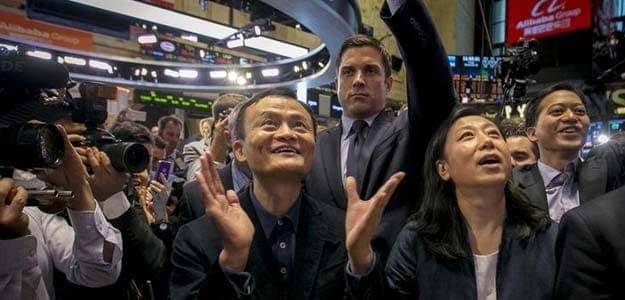
In his long road to riches, Alibaba founder Jack Ma says his inspiration has been the film character "Forrest Gump."
"I like that guy. I've been watching that movie about 10 times," Mr Ma said in an interview with a TV news channel as his Chinese online firm made its historic Wall Street trading debut on Friday.
"Every time I get frustrated, I watch the movie."
Mr Ma said the lesson he learned from the blockbuster featuring Tom Hanks was "that no matter whatever changed, you are you. I'm still the guy I was 15 years ago (when I earned) $20 a month."
Mr Ma became excited about the Internet during a visit to the United States in 1995 and wanted to find a way to bring the online world to China. In 1999, he convinced friends to give him $60,000 to start an e-commerce firm called Alibaba.
Fifteen years later, the company is an Internet giant and Ma -- a former English teacher -- is among the topmost ranks of China's super-rich, with wealth estimated at $11 billion by Forbes magazine.
Alibaba Group includes Tmall.com for business-to-consumer transactions and Taobao, China's most popular online consumer marketplace with hundreds of millions of products and services listed. (Read: Alibaba: China's Giant Online Shopping 'Crocodile')
Mr Ma, now 50, gave up his university teaching job after discovering the Internet.
Seeing an opportunity for small businesses to buy and sell their goods online, he started Alibaba, initially running the company out of his apartment in the eastern city of Hangzhou.
"The first time I used the Internet, I touched the keyboard and I find 'well, this is something I believe, it is something that is going to change the world and change China,'" Ma said in the interview.
Compared to Steve Jobs
Ma has inspired strong devotion among his employees and users, drawing comparisons with late Apple co-founder Steve Jobs -- although he practices a more open management style.
A devotee of t'ai chi, he has made references to Chinese martial arts in both business strategy and corporate culture.
Porter Erisman, a former Alibaba employee who made a documentary about the firm, "Crocodile in the Yangtze," said: "What Silicon Valley is known for, he embodies a lot of that with Chinese characteristics -- that spirit of openness, risk-taking, innovation."
Mr Ma graduated from the Hangzhou Teachers' Institute with a major in English-language education, and went on to teach at another university in the city, where Alibaba is still headquartered.
Chinese state media have burnished his rags-to-riches story, saying his parents were poorly educated and his father depended on a monthly retirement allowance of just $40 to support the family.
Ma's success was evident after Alibaba's Taobao bested eBay in China, forcing the US auction site to largely withdraw from the country in 2006.
In characteristic language, he threw down a challenge to the world's global Internet giants in a memo sent to the company's more than 20,000 employees as it filed for the IPO. (Read: With Alibaba's Big Debut, 10 Things to Know)
"Fifteen years ago, Alibaba's 18 founders were determined to set up a global Internet company originated by Chinese people, with hopes it would become one of the world's top 10 Internet companies, a company which will exist for 102 years," he said.
On Friday, he told a TV news channel that he hopes Alibaba will one day be "bigger than Wal-Mart" and have a huge impact on the world.
"We have a dream," he said. "We hope people say in 15 years this is a company like Microsoft, like IBM."

-
Where You Live Shapes How You Get To Work | The Reason Why

Two-wheelers are the most popular way to get to work in India, accounting for nearly 43% of workplace commutes.
-
High US Salaries, No Green Card Certainty: The Financial Calculation Facing Indian H-1B Families
The suspension of PERM processing at eight technology employers does not cancel existing H-1B visas. What it does is force a question many Indian families have been avoiding: is the US salary worth tying your career and family plans to one employer?
-
Unhedged Position: Can India See An Indonesia-Style Time Correction?
The Nifty is trading below levels it first clocked in 2024. Is there, then, as I have suggested in the headline, potential that the current time correction drags on painfully for the next three-five, even ten years?
-
Navigating Friction And Energy Realities: An Analysis Of Marco Rubio's October Visit To India
Occurring at a critical juncture marked by stalled trade negotiations and escalating geopolitical pressures over global energy supplies, the visit offers a profound window into modern US-India relations.
-
India Exports Capital. Why Not Export Trusteeship?
The big question, then, is whether India can build an institution that global borrowers, investors, banks, and lawyers can trust, even without an Indian connection.
-
France's Economy & Politics Are In Crisis | The Reason Why
Let's look at how the French economy and politics evolved under Nicolas Sarkozy, Franois Hollande and Emmanuel Macron.
-
You May Inherit The Business. You Must Earn Its Credibility.
Succession tests the founder's ability to share authority as much as it tests the next generation's readiness to assume it.
-
Signing Deals Is One Thing; Making Them Work Is Another | The Week In Whys
Sometimes, things don't turn out as planned. Indian companies have lost some bids to rivals, some projects won't produce until 2030.
-
FOMC Wall, PERM Suspension, Hospital Stocks | Talking Points This Week
A PERM suspension would directly affect green-card sponsorship rather than H-1B visas, so the near-term earnings impact could remain relatively limited. The key question is whether this marks a new phase in US scrutiny of Indian IT.
-
Everything, Everywhere, All At Once: Dalal Street's Week To Forget | Joining The Dots
Visa curbs, a Starlink spat and cancer drug caps: what connects this week's shocks for Indian markets









