Alibaba Shares Close Up 38 Percent on Opening Day
The long-awaited public market debut of the Alibaba Group, the Chinese Internet titan, did not disappoint Friday, eclipsing every other company that has started to sell stock so far this year.
After pricing at $68 a share Thursday night, Alibaba's shares opened sharply higher Friday and finished the day up 38 percent, at $93.89.
Yet even Alibaba's blockbuster stock sale appears unlikely to dampen a yearlong enthusiasm for initial public offerings as startups and private companies continue to flock to the stock markets.
Ever since it filed to go public in May, Alibaba has dominated headlines about its public offering. But it was entering a market that has already been filled with new stock issues. There have been 195 US public offerings priced so far this year, according to data from Renaissance Capital, an increase of 34 per cent compared with the numbers in the period a year earlier.
"The IPO market right now is robust and healthy," said David Ethridge, the head of capital markets for the New York Stock Exchange. "We're seeing participation from every sector of the economy."
Alibaba, which raised $21.8 billion in its stock sale, instantly became one of the biggest publicly traded technology companies in the world. (The amount of money raised in the public offering will rise if underwriters make use of an overallotment option to meet strong investor demand, an event that is widely expected.)
To truly appreciate how enormous Alibaba is, consider that its market value is nearly as much as the combined value of all the U.S. initial public offerings so far this year.
At its offering price, Alibaba's market value was about $168 billion. The combined market value of the other US companies that have gone public this year is $180.5 billion, according to Standard & Poor's Capital IQ, a research firm.
None of the companies that have gone public this year could command the attention that Alibaba has enjoyed.
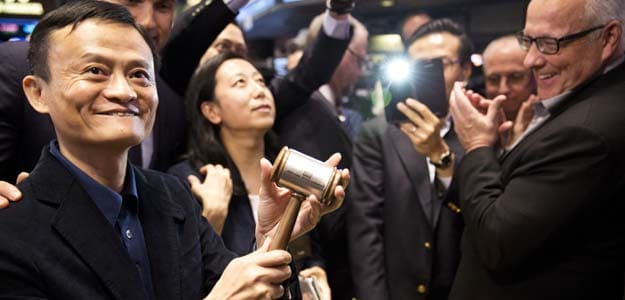
Ringing the bell were eight customers of Alibaba as the company's senior managers watched from a special cordoned-off section of the floor. Jack Ma, the company's executive chairman and co-founder, watched bemusedly before strolling along the floor of the Big Board.
Other senior executives, including Alibaba's head of corporate development, whipped out their smartphones for selfies and snapshots.
As bankers at one underwriter, Goldman Sachs, and market makers at Barclays sorted through a flood of orders, a din filled the cavernous exchange - only to be quieted on occasion when a specialist bellowed yet another rise in the potential opening price of Alibaba shares.
Finally, several minutes before noon, one market maker called out that Alibaba's "book was frozen" at $92.70. Within a minute, Alibaba's shares finally began trading on the Big Board under the ticker symbol BABA. Trading was heavy, with more than 270 million shares changing hands during the session.
Few companies sought to compete with that kind of spectacle, with just four small health care companies pricing IPOs on Friday. The pace is expected to pick up next week, with 13 companies on deck to go public.
Among them is the Citizens Financial Group, the retail bank that is being spun off from the Royal Bank of Scotland. The company, which is seeking to raise as much as $3.5 billion from its stock sale, initially planned to list this week but chose to wait and make room for Alibaba.
Wayfair, a technology company based in Boston, had also considered going public this week but pushed the timing back to stay out of Alibaba's shadow.
Investment bankers said that companies with significantly less impressive financial performance would most likely take their time going public. The GoDaddy Group, the Web registrar busy trying to become more of an all-around service provider for small businesses, is now leaning toward going public early next year rather than late this year, according to people briefed on its plans.
Over the longer term, however, analysts and executives in the capital markets business said that Alibaba's stock sale was unlikely to squash investors' appetites for other newly minted public companies. Big mutual fund operators like Fidelity and Vanguard have a plethora of funds, some of which focus on giant companies, others that specialize in health care companies and still others devoted to technology businesses.
The few biotechnology companies that priced this week, for example, drew primarily from smaller funds and not the big money managers who flocked to Alibaba.
"They wouldn't be on the same radar," Matt Kennedy, an analyst at Renaissance Capital, said of the biotechnology investors. "It's a different investor."
It is impossible for one stock sale - even one as big as Alibaba's - to completely sap demand for initial public offerings, said Ethridge of the New York Stock Exchange.
"Historically there's no pause after a big IPO," said Jackie Kelley, the global IPO markets leader for Ernst & Young. "That's assuming the transaction goes well."
Indeed, Alibaba, together with underwriters, market makers and the New York Stock Exchange, took pains to avoid the pitfalls that befell Facebook, whose market debut was marred by trading flaws and an overaggressive fundraising strategy that left it vulnerable to a botched first day of trading.
As long as initial offerings continue to perform and make money for investors, they will continue to find buyers. An exchange-traded fund that tracks initial public offerings and is run by Renaissance Capital is up 6.9 percent for the year, compared with a 4.2 percent rise in the Dow Jones industrial average. (The IPO fund falls behind the Standard & Poor's 500-stock index, however, which is up nearly 9 percent for the year.)
Should Alibaba's stock perform strongly in the coming days, its success could help persuade even more companies to go to market. Ethridge speculated that other foreign companies, particularly those in China, could then seek to emulate Alibaba.
"We're going to end the year on an incredibly strong note," said Nelson Griggs, head of new listings at Nasdaq. "The pipeline is exceptionally strong."
© 2014, The New York Times News Service

-
Where You Live Shapes How You Get To Work | The Reason Why

Two-wheelers are the most popular way to get to work in India, accounting for nearly 43% of workplace commutes.
-
High US Salaries, No Green Card Certainty: The Financial Calculation Facing Indian H-1B Families
The suspension of PERM processing at eight technology employers does not cancel existing H-1B visas. What it does is force a question many Indian families have been avoiding: is the US salary worth tying your career and family plans to one employer?
-
Unhedged Position: Can India See An Indonesia-Style Time Correction?
The Nifty is trading below levels it first clocked in 2024. Is there, then, as I have suggested in the headline, potential that the current time correction drags on painfully for the next three-five, even ten years?
-
Navigating Friction And Energy Realities: An Analysis Of Marco Rubio's October Visit To India
Occurring at a critical juncture marked by stalled trade negotiations and escalating geopolitical pressures over global energy supplies, the visit offers a profound window into modern US-India relations.
-
India Exports Capital. Why Not Export Trusteeship?
The big question, then, is whether India can build an institution that global borrowers, investors, banks, and lawyers can trust, even without an Indian connection.
-
France's Economy & Politics Are In Crisis | The Reason Why
Let's look at how the French economy and politics evolved under Nicolas Sarkozy, Franois Hollande and Emmanuel Macron.
-
You May Inherit The Business. You Must Earn Its Credibility.
Succession tests the founder's ability to share authority as much as it tests the next generation's readiness to assume it.
-
Signing Deals Is One Thing; Making Them Work Is Another | The Week In Whys
Sometimes, things don't turn out as planned. Indian companies have lost some bids to rivals, some projects won't produce until 2030.
-
FOMC Wall, PERM Suspension, Hospital Stocks | Talking Points This Week
A PERM suspension would directly affect green-card sponsorship rather than H-1B visas, so the near-term earnings impact could remain relatively limited. The key question is whether this marks a new phase in US scrutiny of Indian IT.
-
Everything, Everywhere, All At Once: Dalal Street's Week To Forget | Joining The Dots
Visa curbs, a Starlink spat and cancer drug caps: what connects this week's shocks for Indian markets









