Akasa Air To Launch At Navi Mumbai Airport With Over 100 Weekly Departures
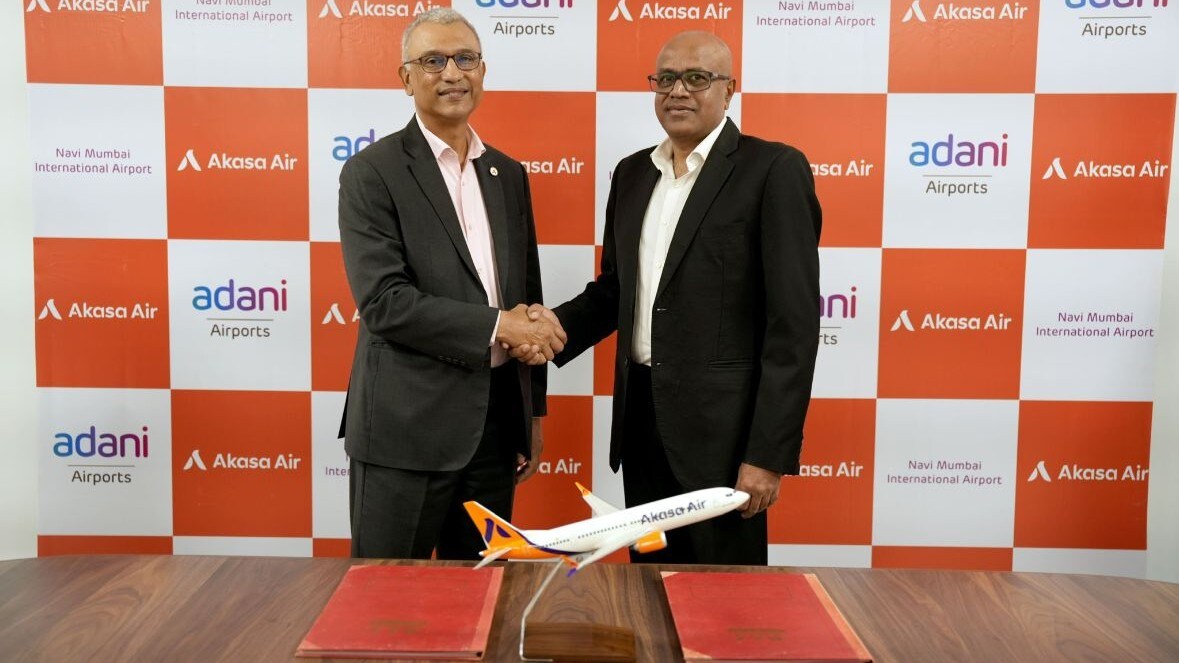
Akasa Air has entered into a partnership with Adani Airport Holdings Ltd, to begin commercial flight operations from the upcoming Navi Mumbai International Airport, starting with over 100 weekly domestic departures.
The country's youngest airline will operate 15 daily domestic flights initially and scale up to 40-45 domestic and 8-10 international in the winter schedule. This corresponds to over 300 domestic and more than 50 international departures weekly, it said in a statement on Friday. The winter schedule usually runs from the end of October to the end of March.
Akasa Air will have the largest percentage of its fleet and operations based out of Navi Mumbai Airport, its Founder and CEO Vinay Dube said. "We will have 10 aircraft based at Navi Mumbai airport by fiscal 2027."
"Our foray into Navi Mumbai International Airport is a strategic step aligned with Akasa Air's long-term vision to build a future-ready airline that is responsive to the evolving needs of Indian travellers," he said, adding that this move supports the airline's commitment to supplement existing capacities, unlock new demand centres, and enable sustainable growth.
"Enhanced connectivity from Navi Mumbai will not only strengthen its network in the western region but will also fuel India's economic engine by improving connectivity, stimulating regional development, and ensuring that the benefits of aviation-led growth reach every corner of the country."
As part of its broader network strategy, Akasa Air is also set to ramp up to 10 parking bases by FY27, with a focused international expansion into key Middle Eastern and Southeast Asian markets.
NMIA is being developed by Navi Mumbai International Airport Ltd., a joint venture between Adani Airport Holdings Ltd., which holds a 74% stake, and CIDCO, the Maharashtra government's development body, owning the remaining 26%. AAHL also owns Mumbai International Airport Ltd, which operates the existing Chhatrapati Shivaji Maharaj International Airport in Mumbai. The launch of NMIA is expected to create a dual-airport system for the financial capital of India, enabling the decongestion of Chhatrapati Shivaji Maharaj International Airport. Besides, its strategic location is aimed at meeting the rising air traffic demands of the wider Western India.
Spanning over 2,866 acres, NMIA is designed to handle 90 million passengers per annum and 3.2 million metric tonnes of cargo annually, once complete. In its initial phase, NMIA is set to handle 20 million passengers annually and 0.5 million metric tonnes of cargo per annum.
"We are pleased to welcome Akasa Air as one of the inaugural airline partners at Navi Mumbai International Airport," said Arun Bansal, chief executive officer, Adani Airports Holdings Ltd. "Their rapid growth and forward-looking approach make them an ideal partner in NMIA's journey to becoming a key domestic and international hub. Our collaboration aims to offer a seamless and enhanced travel experience for millions, with NMIA playing a central role in reshaping Mumbai's air connectivity ecosystem."
Disclaimer: NDTV is a subsidiary of AMG Media Networks Limited, an Adani Group Company.

-
High US Salaries, No Green Card Certainty: The Financial Calculation Facing Indian H-1B Families

The suspension of PERM processing at eight technology employers does not cancel existing H-1B visas. What it does is force a question many Indian families have been avoiding: is the US salary worth tying your career and family plans to one employer?
-
Swiggy vs Eternal: Food Delivery's Two Rivals Are No Longer In The Same Race
Eternal is building a private AI assistant, dark.ai. Swiggy is still working out how to make Instamart pay, with an operating loss of Rs 895 crore in the July-September quarter while Blinkit stayed profitable.
-
Where You Live Shapes How You Get To Work | The Reason Why
Two-wheelers are the most popular way to get to work in India, accounting for nearly 43% of workplace commutes.
-
Unhedged Position: Can India See An Indonesia-Style Time Correction?
The Nifty is trading below levels it first clocked in 2024. Is there, then, as I have suggested in the headline, potential that the current time correction drags on painfully for the next three-five, even ten years?
-
Navigating Friction And Energy Realities: An Analysis Of Marco Rubio's October Visit To India
Occurring at a critical juncture marked by stalled trade negotiations and escalating geopolitical pressures over global energy supplies, the visit offers a profound window into modern US-India relations.
-
India Exports Capital. Why Not Export Trusteeship?
The big question, then, is whether India can build an institution that global borrowers, investors, banks, and lawyers can trust, even without an Indian connection.
-
France's Economy & Politics Are In Crisis | The Reason Why
Let's look at how the French economy and politics evolved under Nicolas Sarkozy, Franois Hollande and Emmanuel Macron.
-
You May Inherit The Business. You Must Earn Its Credibility.
Succession tests the founder's ability to share authority as much as it tests the next generation's readiness to assume it.
-
Signing Deals Is One Thing; Making Them Work Is Another | The Week In Whys
Sometimes, things don't turn out as planned. Indian companies have lost some bids to rivals, some projects won't produce until 2030.
-
FOMC Wall, PERM Suspension, Hospital Stocks | Talking Points This Week
A PERM suspension would directly affect green-card sponsorship rather than H-1B visas, so the near-term earnings impact could remain relatively limited. The key question is whether this marks a new phase in US scrutiny of Indian IT.









