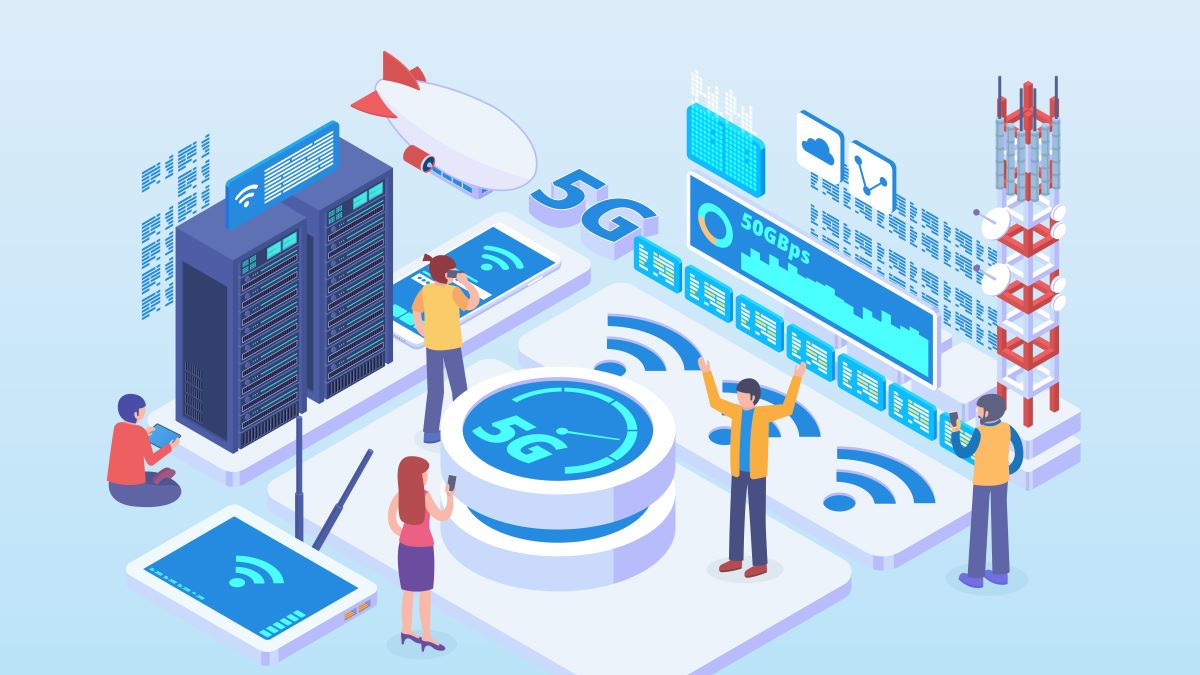
The rollout of 5G services in India is unlikely to be as capital intensive as 4G that churned the country's telecom industry into essentially a two-player market.
Bharti Airtel Ltd. and Reliance Jio Infocomm Ltd. are likely to incur a capital expenditure of Rs 45,400 crore and Rs 65,500 crore, respectively, to achieve 5G coverage of 70% and 75% by the fiscal ending March 31, 2025, brokerage ICICI Securities Ltd. said in a note dated Feb. 27. By FY27, the telcos are likely to have 5G capex of Rs 66,600 crore and Rs 94,000 crore, respectively, to achieve coverage of 85% and 95%.
Airtel has guided for 5G capex of Rs 75,000 crore over three years. Spending will be high in FY23 and FY24 and start tapering from FY25 onwards.
Jio has announced 5G investments worth Rs 2,00,000 crore, which includes Rs 90,000 crore on spectrum and Rs 60-70,000 crore on network rollout.
In comparison, Airtel has incurred 4G capex of Rs 1,11,500 crore since 2016-17, when Reliance Industries Ltd. disrupted the telecom space with cheap data and free calling. At Rs 2,27,400 crore, Reliance Jio's investment has been higher as it had to build its network from scratch. The capex includes spending on tower and optic fibres that has since been divested into infrastructure investment trusts worth Rs 60,600 crore.
5G < 4G
Rolling out 5G will be cheaper and faster as the services will be deployed on fewer spectrum bands, ICICI Securities said.
Airtel has only one 5G spectrum band, 3,500 megahertz, as compared to four 4G bands—900 MHz, 1,800 MHz, 2,100 MHz and 2,300 MHz. Reliance Jio has two 5G bands—700 MHz and 3,500 MHz—and three 4G bands of 800 MHz, 1,800 MHz and 2,300 MHz.
Airtel is piggybacking its 5G services on existing 4G infrastructure—the 3,500 MHz band will be used for downlink and 2,100 MHz for uplink. Jio, on the other hand, is deploying pure 5G on its 3,500 MHz and 700 MHz spectrum bands.
Need For Speed
The difference in deployment strategy is showing in the broadband speeds of the two telcos.
“The reason we see Jio speeds being better is because of the backhaul infrastructure, which plays a really important role,” Sylwia Kechiche, principal industry analyst at Ookla, said.
Backhaul refers to transmitting a signal from a remote site or network to another site, usually a central one. While Reliance Jio is leveraging its superior fibre network for this process, Airtel is relying on its mobile broadband network.
The 700 MHz spectrum also plays to Jio's advantage. The propagation of the 5G network is more far-reaching, reducing the need for infrastructure over large expanses.
Also Read: Why 5G Rollouts Of Airtel, Jio Are Different
The final difference in speeds is based on the device ecosystem. The mix of luxury and mass-market smartphones on Airtel's network is more homogenous when compared to Reliance Jio's, according to Kechiche's research.
Nearly 27% of devices on Jio's network are Apple devices, making them ready to leverage the best of 5G. However, the remaining users tend to use mass-market, low-end devices, representing high volume but lower consumption.
Essential Business Intelligence, Continuous LIVE TV, Sharp Market Insights, Practical Personal Finance Advice and Latest Stories — On NDTV Profit.