After Ban, Government Allows Small Quantity Of Wheat For Export
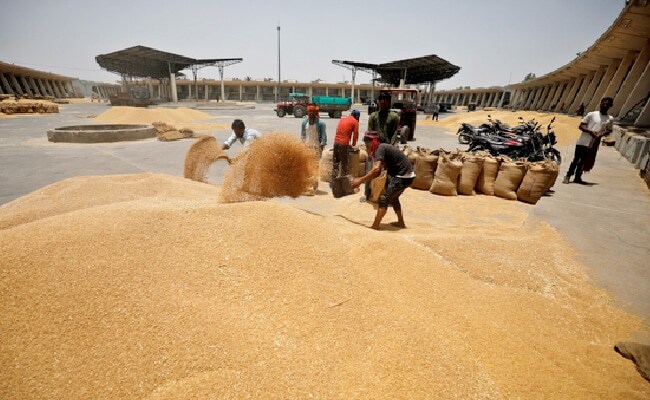
India has allowed wheat shipments of 469,202 tonnes since banning most exports last month, but at least 1.7 million tonnes is lying at ports and could be damaged by looming monsoon rains, government and industry officials told Reuters.
Shipments that have been allowed moved mainly to Bangladesh, the Philippines, Tanzania and Malaysia, said a senior government official, who also stated the total quantity.
The ban pulled Indian wheat exports down to 1.13 million tonnes in May from a record 1.46 million tonnes in April, the official said, declining to be named.
India, the world's second-biggest wheat producer, imposed a general ban on exports on May 14 as a scorching heat wave curtailed output and pushed domestic prices to record highs.
Exceptions were allowed for shipments backed by letters of credit that had already been issued and those to countries that requested supplies to meet their food security needs.
But even after the departure of some wheat, at least 1.7 million tonnes remained piled up at various ports, three dealers with global trading firms told Reuters.
Before the ban, exporters moved unusually large quantities to ports, because the crop was then expected to be strong and the government was encouraging them to replace Black Sea supply lost because of the war in Ukraine.
They expected New Delhi to authorise shipments this year of 8 million to 10 million tonnes or even more, compared with 7.2 million tonnes last year.
"Kandla and Mundra ports have maximum wheat stocks," said a Mumbai-based dealer with a global trading firm. "Together they are holding more than 1.3 million tonnes."
The Government needed to issue export permits promptly, because wheat at the ports was in loose form and therefore vulnerable to monsoon rains, said a New Delhi based dealer with a global trading firm.
India receives heavy rainfall during the monsoon season, from June to September.
"The government banned wheat exports to ensure food security, but if stocks get damaged by rains, then it will not serve any purpose," the dealer said.
Moving the wheat back out of ports and into interior towns for local consumption was unfeasible, as traders would incur additional losses on loading and transportation fees, said the Mumbai-based dealer.
"The Government should allow exports of wheat lying at ports for government-to-government deals," he said.
India has received requests to supply more than 1.5 million tonnes of wheat from several countries facing shortages.
(Except for the headline, this story has not been edited by NDTV staff and is published from a syndicated feed.)

-
High US Salaries, No Green Card Certainty: The Financial Calculation Facing Indian H-1B Families

The suspension of PERM processing at eight technology employers does not cancel existing H-1B visas. What it does is force a question many Indian families have been avoiding: is the US salary worth tying your career and family plans to one employer?
-
Unhedged Position: Can India See An Indonesia-Style Time Correction?
The Nifty is trading below levels it first clocked in 2024. Is there, then, as I have suggested in the headline, potential that the current time correction drags on painfully for the next three-five, even ten years?
-
Navigating Friction And Energy Realities: An Analysis Of Marco Rubio's October Visit To India
Occurring at a critical juncture marked by stalled trade negotiations and escalating geopolitical pressures over global energy supplies, the visit offers a profound window into modern US-India relations.
-
India Exports Capital. Why Not Export Trusteeship?
The big question, then, is whether India can build an institution that global borrowers, investors, banks, and lawyers can trust, even without an Indian connection.
-
France's Economy & Politics Are In Crisis | The Reason Why
Let's look at how the French economy and politics evolved under Nicolas Sarkozy, Franois Hollande and Emmanuel Macron.
-
You May Inherit The Business. You Must Earn Its Credibility.
Succession tests the founder's ability to share authority as much as it tests the next generation's readiness to assume it.
-
Signing Deals Is One Thing; Making Them Work Is Another | The Week In Whys
Sometimes, things don't turn out as planned. Indian companies have lost some bids to rivals, some projects won't produce until 2030.
-
FOMC Wall, PERM Suspension, Hospital Stocks | Talking Points This Week
A PERM suspension would directly affect green-card sponsorship rather than H-1B visas, so the near-term earnings impact could remain relatively limited. The key question is whether this marks a new phase in US scrutiny of Indian IT.
-
Everything, Everywhere, All At Once: Dalal Street's Week To Forget | Joining The Dots
Visa curbs, a Starlink spat and cancer drug caps: what connects this week's shocks for Indian markets
-
India Is Going Abroad For Critical Minerals. But It May Take Years To Pay Off | The Reason Why
Although India's steps are in the right direction, they remain modest compared with India's growing dependence.









