After 3 Years As Microsoft Boss, Satya Nadella Warns Against 'Hubris'
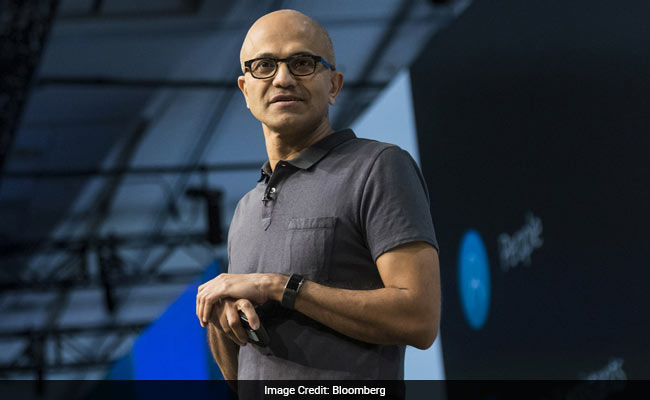
Microsoft Corp. and its competitors should eschew artificial intelligence systems that replace people instead of maximizing their time, Chief Executive Officer Satya Nadella said in an interview Monday.
"The fundamental need of every person is to be able to use their time more effectively, not to say, 'let us replace you'," Nadella said in an interview at the DLD conference in Munich. "This year and the next will be the key to democratizing AI. The most exciting thing to me is not just our own promise of AI as exhibited by these products, but to take that capability and put it in the hands of every developer and every organization."
Nadella is pushing Microsoft into consumer and industrial applications of software that can make inferences about its environment. He cautioned his own company and competitors about "parlor tricks" that show AI's power without preserving workers' dignity.
The 49-year-old who's entering his fourth year as Microsoft's CEO after succeeding Steve Ballmer in 2014, has presided over a 73 percent run-up in Microsoft's shares and Azure cloud-computing revenue that's been doubling year over year. He's compelled Microsoft's product groups to cooperate to ship products faster and has greatly expanded Microsoft software available on platforms other than Windows, including those from Apple Inc. and Google. Microsoft last month closed its $26 billion acquisition of LinkedIn Corp.
"There's a thin line between hubris and confidence," Nadella said. "Always there is risk of hubris coming back, missing trends. The only long-term indicator of success is, 'how good is your internal culture?'"
"What I've learned if anything in three years as CEO is, it's not about celebrating one product," he said. "That, to me, is the sign of a company that's built to last. In tech it's even more harsh."
Tablets, Watches
Microsoft suffered for a decade from a tendency to make stabs at technology it failed to propagate widely that ended up benefiting other companies -- mainly Apple. It developed tablet PCs, pocket computers and smartwatches in the early 2000s, and was selling software for cars in the 1990s.
"Because of Microsoft's technical orientation, engineers have always wanted to stuff more and more features and tricks into the products," said Michael Cusumano, a professor of management at MIT Sloan School of Management who's written three books about Microsoft and its leaders. "The products ended up becoming huge. That's what slowed them down."
On the AI frontier, Japan Airlines Co. is using Microsoft-developed holographic capabilities to simulate aircraft engines for training of repair technicians and to avoid costs of sending full repair crews to each broken plane. McDonald's Corp. used Microsoft technology to develop an automated order-taking system that compensates for noise encountered during orders at a drive-through. Microsoft has also designed software that can protect staff who work in environments surrounded by robots.
Microsoft last Friday said it acquired Maluuba, a Montreal-based AI startup specializing in analyzing written content, for example sifting through businesses' documents to find experts in given fields.
Yet Amazon.com Inc.'s Web Services division has been rapidly releasing AI services for businesses including the ability for developers to build spoken conversation support and speech translation. Alphabet Inc.'s Google last year rebuilt its Translate service using neural networks to improve accuracy and produce language that sounds more like what a native speaker would say, and has made strides in image recognition, music and art.
"They're all great advances," said Nadella, who's reorganized the company's research arm around AI and shipped products including Azure cloud-computing services and tools for developers to build applications for artificial intelligence applications.
"We should be competitive there and we should be pushing there and we will be doing that," he said. "But what's Microsoft's unique contribution beyond doing that is democratizing the access to the same tools that we use for ourselves so that every developer can use them to create their own intelligence," he said.
Cloud Concerns
As Nadella and other tech leaders head to the Davos elite gathering in Switzerland this week, cloud-computing's relationship with data privacy in Europe is also top of mind for Microsoft and its competitors. European businesses and governments could be reluctant to store data in clouds operated by American tech companies if the U.S. government can order access to it, and Microsoft has sued the U.S. Department of Justice in two cases over the issue.Nadella said having data centers in Germany operated by Deutsche Telekom AG has "helped build trust with the German customers." The incoming Trump administration, European Union and China together need to weigh issues including the balance between security and data privacy, the CEO said.
"We have business in each one of these countries," Nadella said. "These countries are going to have to work together and there are rightful concerns each one of these constituents has."
(Except for the headline, this story has not been edited by NDTV staff and is published from a syndicated feed.)

-
Talking Points This Week: Tech Nerves, FII Buying, And A Faraway Banking Shock

The global markets are not shining this Diwali. The exception in the large markets is, India.
-
Midterm Rally Lasted A Day. The Hard Reality Of A Divided US May Last Two Years | Opinion
Between a contested AI boom, a debt ceiling that arrives in 2027 and a president with every incentive to act alone, the next two years may prove more volatile than the first day's rally suggests.
-
Blue Wave Will Derail the AI Trade but Won't Dismantle the AI Era | Unhedged Position
The Democrats' sweep of the US Congress will see politics collide with economic forces both over the long and short term.
-
It's Time To Take The GST Council's Bet On Trust Global
Payment records can prove India's services exports, and clear, proportionate rules can bring foreign digital sellers into the tax net.
-
Opinion | India at 38: From Innovation Overperformer to Innovation Powerhouse
India now has 453 VC-backed deep science startups, 18 of them late-stage, after 117 percent growth since 2020. Laurus Labs, at USD 9.3 billion, is the most valuable deep science company in any middle-income economy outside China.
-
Navigating Energy Crossroads: S Jaishankar's Call For Diversified Supply Chains At G20 Ministerial Meeting
As geopolitical fault lines continue to test maritime trade routes and commodity flows, Jaishankar's message remains pertinent: true economic resilience requires open markets, protected transit lines, and a genuine commitment to multilateral cooperation rather than coercion.
-
Indians Are Travelling, But Not Every Journey Is A Holiday | The Week In Whys
Pilgrims, patients and working women are the real travellers, and the system hasn't quite caught up with them.
-
Getting To Work Costs Women More | The Reason Why
It is not just about women paying more than men. It is about women paying much more in cities than in villages.
-
AI Bias In Investing Cannot Be Eliminated, But It Can Be Governed
Framing is a particularly important example as identical financial information presented in terms of gains rather than losses can lead an LLM to reach a different assessment.









