Adani Ports Sees 13 Per Cent Rise In Cargo Volumes In April 2023
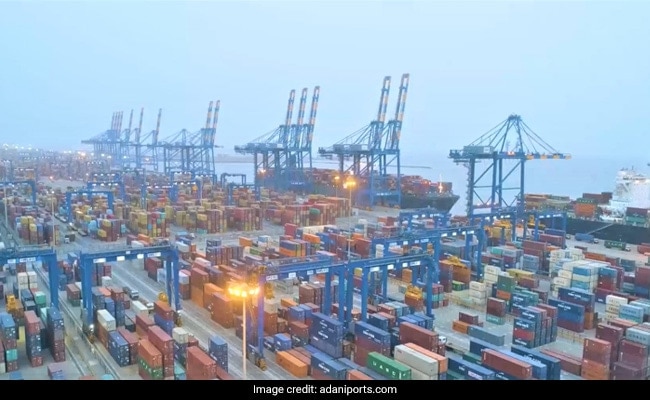
Adani Ports and Special Economic Zone Ltd (APSEZ) handled 32.3 million tonnes of total cargo in April 2023, a yearly growth of 12.8 per cent.
According to the company, the growth in cargo volumes was supported by dry cargo volumes, which increased by 9 per cent (iron ore by 64 per cent, non-coking coal by 22 per cent, and coastal coal by 67 per cent) and container volume increased by 13.6 per cent).
"Growth in cargo volumes across most of our ports reflects that our strategy of improving operational efficiency is delivering results and this will continue to boost the ROCE (return on capital employed) of port assets," said Karan Adani, CEO and Whole Time Director, Adani Ports.
"I am also pleased to announce that Dhamra LNG Terminal berthed its first ship and the natural gas started flowing in the pipeline network connected to the terminal, well in line with our guidance of achieving the LNG terminal commissioning during Q1 FY24."
Four ports recorded significant sequential growth in monthly volumes. These include Krishnapatnam (5.2 MMT, up 22.6 per cent), Dhamra (3.3 MMT, up 36.8 per cent), Tuna (1.15 MMT, up 57.6 per cent), and Katupalli and Ennore combined (1.7 MMT, up 13.3 per cent).
Adani Ports and Special Economic Zone Ltd (APSEZ), a part of the globally diversified Adani Group, has six strategically located ports and terminals on the west coast (Mundra, Dahej, Tuna and Hazira in Gujarat, Mormugao in Goa and Dighi in Maharashtra) and five ports and terminals on the East coast of India (Dhamra in Odisha, Gangavaram, and Krishnapatnam in Andhra Pradesh, and Kattupalli and Ennore in Tamilnadu) representing 24 per cent of the country's total port volumes.
(Except for the headline, this story has not been edited by NDTV staff and is published from a syndicated feed.)

-
Unhedged Position: Can India See An Indonesia-Style Time Correction?

The Nifty is trading below levels it first clocked in 2024. Is there, then, as I have suggested in the headline, potential that the current time correction drags on painfully for the next three-five, even ten years?
-
Navigating Friction And Energy Realities: An Analysis Of Marco Rubio's October Visit To India
Occurring at a critical juncture marked by stalled trade negotiations and escalating geopolitical pressures over global energy supplies, the visit offers a profound window into modern US-India relations.
-
India Exports Capital. Why Not Export Trusteeship?
The big question, then, is whether India can build an institution that global borrowers, investors, banks, and lawyers can trust, even without an Indian connection.
-
France's Economy & Politics Are In Crisis | The Reason Why
Let's look at how the French economy and politics evolved under Nicolas Sarkozy, Franois Hollande and Emmanuel Macron.
-
You May Inherit The Business. You Must Earn Its Credibility.
Succession tests the founder's ability to share authority as much as it tests the next generation's readiness to assume it.
-
Signing Deals Is One Thing; Making Them Work Is Another | The Week In Whys
Sometimes, things don't turn out as planned. Indian companies have lost some bids to rivals, some projects won't produce until 2030.
-
FOMC Wall, PERM Suspension, Hospital Stocks | Talking Points This Week
A PERM suspension would directly affect green-card sponsorship rather than H-1B visas, so the near-term earnings impact could remain relatively limited. The key question is whether this marks a new phase in US scrutiny of Indian IT.
-
Everything, Everywhere, All At Once: Dalal Street's Week To Forget | Joining The Dots
Visa curbs, a Starlink spat and cancer drug caps: what connects this week's shocks for Indian markets
-
India Is Going Abroad For Critical Minerals. But It May Take Years To Pay Off | The Reason Why
Although India's steps are in the right direction, they remain modest compared with India's growing dependence.
-
When Everyone Has AI, What Gives You An Edge?
India's young workforce is entering an uncertain world of work where powerful AI tools are becoming widely accessible. The advantage will belong to those who combine deep expertise with digital fluency, and the distinctly human capabilities that technology cannot manufacture.









