Adani Group To Join 5G Spectrum's Hot Race; Challenge Jio, Airtel: Report
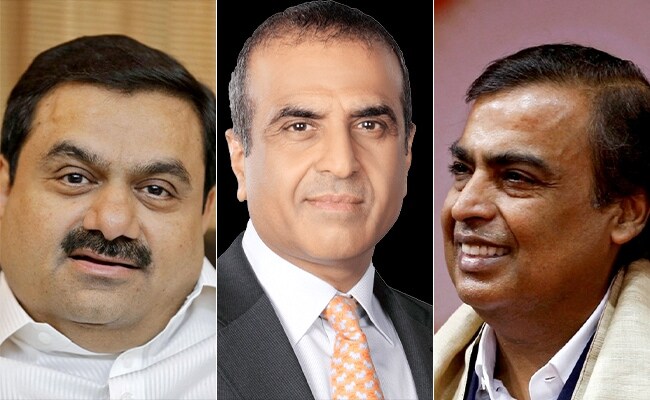
Billionaire Gautam Adani's group is said to be planning a surprise entry into the race to acquire telecom spectrum, which will pitch it directly against Mukesh Ambani's Reliance Jio and telecom czar Sunil Bharti Mittal's Airtel, sources said.
Applications for participating in the July 26 auction of airwaves, including those capable of providing fifth-generation or 5G telecom services such as ultra-high-speed internet connectivity, closed on Friday with at least four applications.
Jio, Airtel and Vodafone Idea -- the three private players in the telecom sector -- applied, three sources with knowledge of the matter said.
The fourth applicant is Adani Group, one of the sources said, adding that the group had recently obtained National Long Distance (NLD) and International Long Distance (ILD) licences.
But this could not be independently confirmed. Email and phone calls made to the Adani Group did not elicit any response.
As per the auction timelines, ownership details of applicants are to be published on July 12 and the bidders should be known then.
A total of 72,097.85 MHz of spectrum worth at least Rs 4.3 lakh crore will be put on the block during the auction, set to commence on July 26, 2022.
The auction will be held for spectrum in various low (600 MHz, 700 MHz, 800 MHz, 900 MHz, 1800 MHz, 2100 MHz, 2300 MHz), mid (3300 MHz) and high (26 GHz) frequency bands.
Ambani and Adani, who hail from Gujarat and went on to build mega business groups, had till recently not had a direct face-off. While the former expanded from the oil and petrochemicals business into telecom and retail, the latter diversified from the ports segment to coal, energy distribution and aviation.
But increasingly, their interests are overlapping, setting what some say is the stage for a clash.
Adani has in the recent months set up a subsidiary for a foray into petrochemicals -- a business that Ambani's father Dhirubhai began with before its downstream and upstream operations.
Ambani too has announced multi-billion-dollar plans for new energy business, including Giga factories for solar panels, batteries, green hydrogen and fuel cells.
Mr Adani, who had previously announced plans to be the world's largest renewable energy producer by 2030, too has unveiled hydrogen ambitions.
And now, if the Adani group participates in the 5G auction on July 26, it will be the first direct competition with Ambani.
The Cabinet, last month, approved 5G auctions at reserve prices recommended by the sector regulator Telecom Regulatory Authority of India (TRAI). The regulator had recommended an about 39 per cent cut in floor price for the sale of 5G spectrum for mobile services.
The validity of the right to use spectrum will be of 20 years.
Overall, the payment terms have been eased for bidders in the upcoming auction.
For the first time ever, there is no mandatory requirement to make upfront payment by the successful bidders.
Payments for spectrum can be made in 20 equal annual installments to be paid in advance at the beginning of each year, a relaxation that is expected to significantly ease cash flow requirements and lower the cost of doing business in this sector.
The bidders would be given an option to surrender the spectrum after 10 years with no future liabilities with respect to balance installments. No SUC (spectrum usage charges) will be levied for the spectrum acquired in this auction.
While the 5G spectrum in nine frequency bands will be auctioned to telecom operators, the Notice Inviting Applications -- the bid-related document issued by the Telecom Department -- said tech firms will be allowed to take the 5G spectrum for their captive non-public network on lease from the telecom companies.
The bid document said direct allocation of spectrum to tech companies will follow a demand study and sector regulator TRAI's recommendation on aspects such as pricing and modalities of such allocation.
The decision on private networks is seen as a dampener for telcos, which had been arguing that if independent entities are allowed to set up private captive networks with direct 5G spectrum allotment by the telecom department, the business case of TSPs (Telecom Service Providers) will get severely degraded.

-
Medicine Pricing: Where Must Profit Stop?

India must confront excessive margins, hidden incentives and regulatory gaps that threaten the integrity of medicine.
-
Why Amazon And Flipkart Are Struggling To Beat Meesho In India's Smaller Cities
With 274 million users and lowest-cost logistics, Meesho is defending its value commerce crown against giants like Amazon and Flipkart.
-
High US Salaries, No Green Card Certainty: The Financial Calculation Facing Indian H-1B Families
The suspension of PERM processing at eight technology employers does not cancel existing H-1B visas. What it does is force a question many Indian families have been avoiding: is the US salary worth tying your career and family plans to one employer?
-
Swiggy vs Eternal: Food Delivery's Two Rivals Are No Longer In The Same Race
Eternal is building a private AI assistant, dark.ai. Swiggy is still working out how to make Instamart pay, with an operating loss of Rs 895 crore in the July-September quarter while Blinkit stayed profitable.
-
Where You Live Shapes How You Get To Work | The Reason Why
Two-wheelers are the most popular way to get to work in India, accounting for nearly 43% of workplace commutes.
-
Unhedged Position: Can India See An Indonesia-Style Time Correction?
The Nifty is trading below levels it first clocked in 2024. Is there, then, as I have suggested in the headline, potential that the current time correction drags on painfully for the next three-five, even ten years?
-
Navigating Friction And Energy Realities: An Analysis Of Marco Rubio's October Visit To India
Occurring at a critical juncture marked by stalled trade negotiations and escalating geopolitical pressures over global energy supplies, the visit offers a profound window into modern US-India relations.
-
India Exports Capital. Why Not Export Trusteeship?
The big question, then, is whether India can build an institution that global borrowers, investors, banks, and lawyers can trust, even without an Indian connection.
-
France's Economy & Politics Are In Crisis | The Reason Why
Let's look at how the French economy and politics evolved under Nicolas Sarkozy, Franois Hollande and Emmanuel Macron.
-
You May Inherit The Business. You Must Earn Its Credibility.
Succession tests the founder's ability to share authority as much as it tests the next generation's readiness to assume it.










