"A Real Loss": Silicon Valley Bank Collapse Leaves Tech Start-Ups Worried
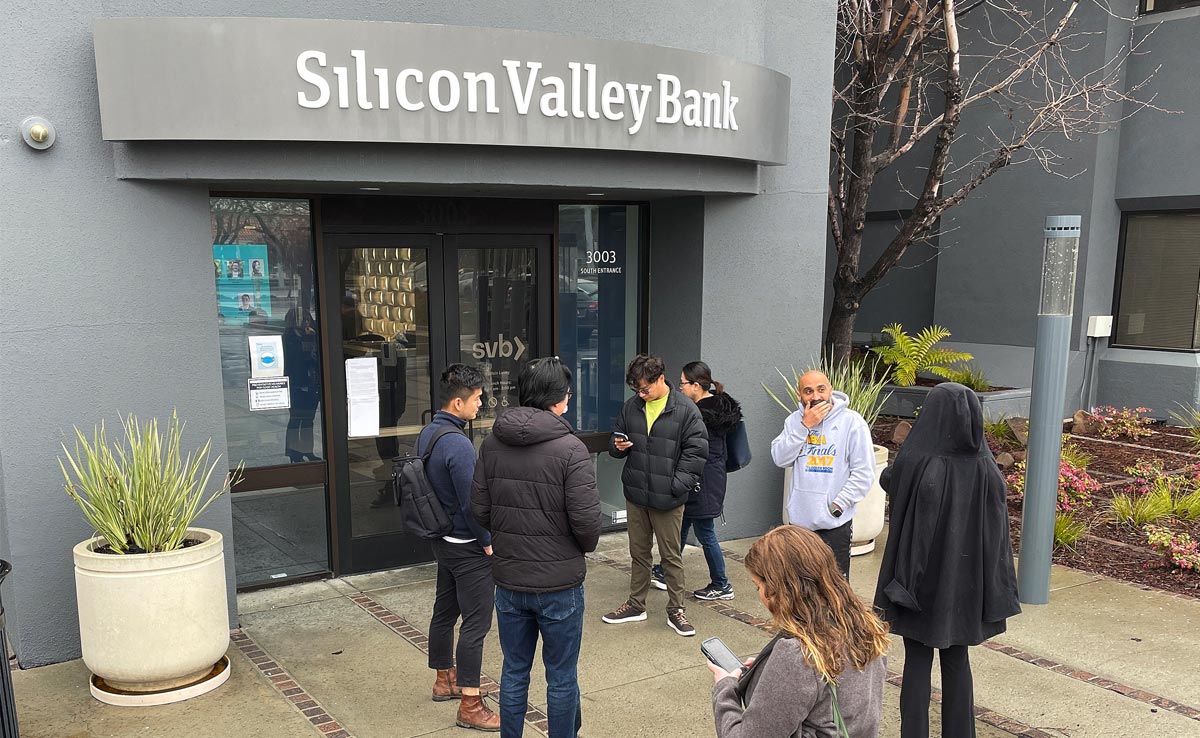
Silicon Valley Bank's stunning collapse has led to the freezing of tens of billions of dollars stored there by startups and their private equity backers, raising fears of a wider tech sector fallout.
The company, whose website says it is "the financial partner of the innovation economy," was taken over Friday by the US Federal Deposit Insurance Corporation (FDIC) to prevent further damage.
"SVB knew the entrepreneurial community," Joseph DeSimone, a professor at Stanford University and founder of several startups, told AFP.
"They helped us recruit people, helped with securing mortgages for transplants, gave financial advice to new executives... So their disappearance is a real loss," he said.
The company previously boasted that "nearly half" of technology and life science companies that had US funding banked with them, leading many to worry about the possible ripple effects of its collapse.
For banks that are FDIC-insured, only $250,000 per account is guaranteed.
But according to SVB's latest annual report, 96 percent of its total $173 billion in deposits was uninsured.
The FDIC said Friday that all accounts would quickly get access to the insured portions of their deposits, but that the rest would depend on how much is recovered from sales of the bank's assets, an often lengthy process.
"The real victims of the SVB fallout are the depositors: startups with 10 to 100 employees, who cannot make payroll, and will have to furlough or shutdown workers as soon as Monday," tweeted Garry Tan, head of the well-known incubator Y Combinator.
He warned that "years of US innovation" are on the line, as an entire "generation of American startups" could be destroyed in a month or two.
'Doesn't look good'
Activist investor Bill Ackman raised a similar alarm on Twitter, saying that SVB's collapse "could destroy an important long-term driver of the economy."
"If private capital can't provide a solution, a highly dilutive gov't (government) preferred bailout should be considered."
According to several US media reports, SVB had discussed on Thursday and Friday a possible buyout with several banks, but could not find a solution quickly enough.
Champ Bennett, cofounder of the video platform Capsule, revealed on Friday that the $5 million raised in mid-February during the company's first seed funding round was housed at SVB and now inaccessible.
"What happens next is anyone's guess, but it doesn't look good," he tweeted.
Bennett added that an intervention should not be viewed as "bailing out 'The 1' or 'Big Tech'," pointing to the "thousands of the most hardworking, talented individuals" at impacted companies who are currently "struggling."
According to the news website Semafor, hedge funds are offering to front cash to SVB's corporate clients, but at a 20 to 40 percent discount.
Beyond that, Adam Arrigo, boss of virtual gig platform Wave, warned his fellow tech entrepreneurs: "Whether or not you had money in SVB, you are not unaffected. This is going to materially impact everyone."
Like others, Bennett says he is also concerned about the fate of other banks favored by the tech industry, including California's First Republic, whose stock price fell 30 percent in two days.
Some see in the back-to-back failure of two banks, SVB and Silvergate Bank, an example of the financial system's precariousness.
"What happened to everyone talking about how banks (SVB, Silvergate) are safe and better than Crypto DEFI?" tweeted US investor Arjun Sethi.
DeFi, or decentralized finance, allows users to theoretically access their funds at any time and without intermediary, but comes without deposit protections or regulations.
(Except for the headline, this story has not been edited by NDTV staff and is published from a syndicated feed.)

-
Opinion | India at 38: From Innovation Overperformer to Innovation Powerhouse

India now has 453 VC-backed deep science startups, 18 of them late-stage, after 117 percent growth since 2020. Laurus Labs, at USD 9.3 billion, is the most valuable deep science company in any middle-income economy outside China.
-
Navigating Energy Crossroads: S Jaishankar's Call For Diversified Supply Chains At G20 Ministerial Meeting
As geopolitical fault lines continue to test maritime trade routes and commodity flows, Jaishankar's message remains pertinent: true economic resilience requires open markets, protected transit lines, and a genuine commitment to multilateral cooperation rather than coercion.
-
Indians Are Travelling, But Not Every Journey Is A Holiday | The Week In Whys
Pilgrims, patients and working women are the real travellers, and the system hasn't quite caught up with them.
-
Getting To Work Costs Women More | The Reason Why
It is not just about women paying more than men. It is about women paying much more in cities than in villages.
-
AI Bias In Investing Cannot Be Eliminated, But It Can Be Governed
Framing is a particularly important example as identical financial information presented in terms of gains rather than losses can lead an LLM to reach a different assessment.
-
Joining The Dots | Dark Skies, Steady Diya: Why Hope Holds This Diwali
With war, a weak rupee and foreign outflows weighing on sentiment, policymakers at the NDTV World Summit and market veterans at NDTV Profit Ignite: Diwali Edition offered the same advice: stay invested and filter out the noise.
-
The Curious Case of Equitas Small Finance Bank And A CEO Who Quit For Stock
PN Vasudevan believes persistent investor concerns over a perceived conflict of interest had become a governance overhang on Equitas Small Finance Bank's stock, even as the lender improved profitability and asset quality.
-
Talking Points This Week: AI Cash Burn, A Tiger Comeback And An India That Still Finds Its Own Path
India is not immune to higher oil or tighter global liquidity, yet its earnings base is broader, its domestic policy levers are still available.
-
Foreign Investors Own Half Of HDFC Bank and ICICI Bank. An LTCG Cut Could Matter Most Here
Foreign portfolio investors have US$115 billion parked in HDFC Bank, ICICI Bank. If the government cuts long-term capital gains tax, Jefferies says returning foreign money could land here first.










