$79 Billion Of Unhedged Debt Is Next Pain Point For Rupee
Indian companies are rushing to hedge their overseas dollar debt against further declines in the rupee, a process that threatens to cascade into additional losses for the battered local currency.
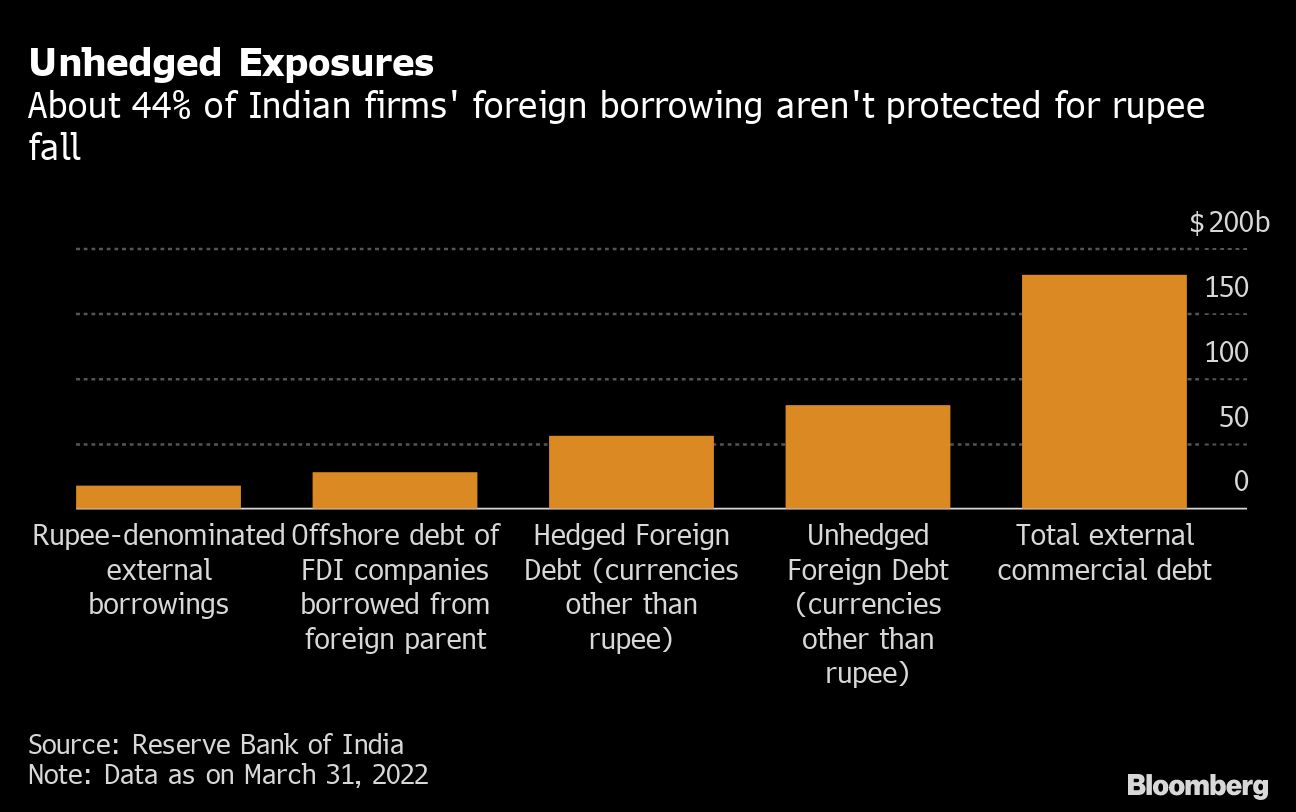
The nation's firms had $79 billion of unhedged offshore loans at the end of March, about 44% of their total overseas borrowings, according to the latest data from the Reserve Bank of India. The cost of repaying that has been soaring as the rupee has tumbled more than 7% this year.
“We have seen increased activity among corporates to hedge their dollar exposure ever since USD/INR broke above 79,” said Parul Mittal Sinha, head of India financial markets at Standard Chartered Plc in Mumbai. “The proportion that is dollar hedged is expected to increase in the current risk-off environment, increasing dollar demand.”
The proportion of unhedged foreign loans has built up as companies were lulled into complacency about their dollar exposure by RBI's intervention, which ensured the rupee was less volatile than its emerging-market peers. In recent months however, stock outflows and broad dollar strength has seen the currency's losses accelerate and sent it to a series of record lows.
While companies are starting to boost hedging levels, the current proportion remains far below the minimum 63% recommended for periods of high foreign-exchange volatility, according to a central-bank study.
The rupee slid to all-time low of 80.06 per dollar on Tuesday, and has lost 2.4% over the past month, the third-worst performing Asian currency over the period. Global funds have offloaded $29.5 billion of Indian shares this year, on course for a record annual outflow, according to data compiled by Bloomberg data starting in 1999.
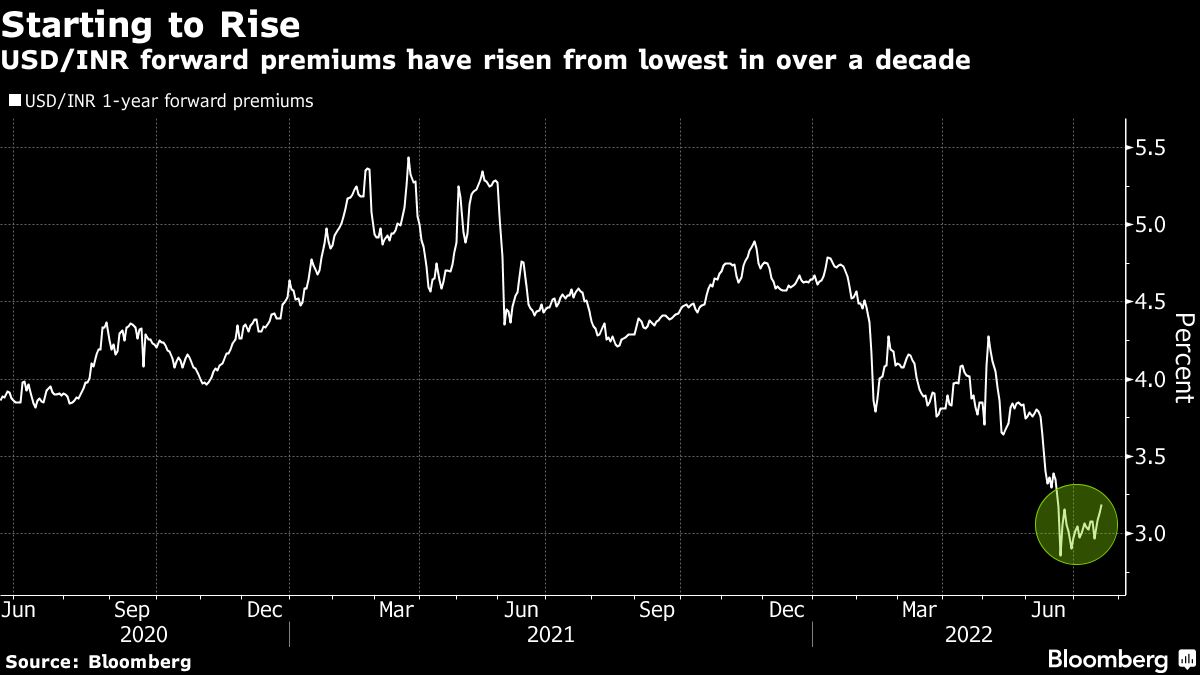
The increased demand for hedging by Indian companies is evident in the rise of dollar-rupee forward premiums, and the process is set to become a key source of depreciation pressure on the rupee, according to Citigroup Inc.
“Holders of external debt are likely to refinance their debt or repay from forex revenue sources,” Citi economists Samiran Chakraborty and Baqar Zaidi wrote in a research note this month. “That said, the increasingly aggressive US Fed tightening could raise the cost of external financing and along with a squeeze in global liquidity could pose some challenges to the large refinancing of external debt due this year.”
Citibank has lowered its 12-month forecast for the rupee to 81 per dollar from an earlier prediction of 79, the economists said.
Cheaper Funding
One alternative to hedging overseas borrowing is to switch away from dollar funding altogether and seek cheaper domestic options.
ReNew Energy Global, one of India's leading green energy companies, recently refinanced $525 million of its dollar-denominated bonds with longer-term funding in rupees.
“The company's broader policy is to hedge the forex exposure as and when the need arises to protect the currency and interest-rate movement risk,” ReNew Power chief financial officer Kedar Upadhye said in an interview last week.

-
Unhedged Position: Can India See An Indonesia-Style Time Correction?

The Nifty is trading below levels it first clocked in 2024. Is there, then, as I have suggested in the headline, potential that the current time correction drags on painfully for the next three-five, even ten years?
-
Navigating Friction And Energy Realities: An Analysis Of Marco Rubio's October Visit To India
Occurring at a critical juncture marked by stalled trade negotiations and escalating geopolitical pressures over global energy supplies, the visit offers a profound window into modern US-India relations.
-
India Exports Capital. Why Not Export Trusteeship?
The big question, then, is whether India can build an institution that global borrowers, investors, banks, and lawyers can trust, even without an Indian connection.
-
France's Economy & Politics Are In Crisis | The Reason Why
Let's look at how the French economy and politics evolved under Nicolas Sarkozy, Franois Hollande and Emmanuel Macron.
-
You May Inherit The Business. You Must Earn Its Credibility.
Succession tests the founder's ability to share authority as much as it tests the next generation's readiness to assume it.
-
Signing Deals Is One Thing; Making Them Work Is Another | The Week In Whys
Sometimes, things don't turn out as planned. Indian companies have lost some bids to rivals, some projects won't produce until 2030.
-
FOMC Wall, PERM Suspension, Hospital Stocks | Talking Points This Week
A PERM suspension would directly affect green-card sponsorship rather than H-1B visas, so the near-term earnings impact could remain relatively limited. The key question is whether this marks a new phase in US scrutiny of Indian IT.
-
Everything, Everywhere, All At Once: Dalal Street's Week To Forget | Joining The Dots
Visa curbs, a Starlink spat and cancer drug caps: what connects this week's shocks for Indian markets
-
India Is Going Abroad For Critical Minerals. But It May Take Years To Pay Off | The Reason Why
Although India's steps are in the right direction, they remain modest compared with India's growing dependence.
-
When Everyone Has AI, What Gives You An Edge?
India's young workforce is entering an uncertain world of work where powerful AI tools are becoming widely accessible. The advantage will belong to those who combine deep expertise with digital fluency, and the distinctly human capabilities that technology cannot manufacture.









