44 European Leaders Gather In Prague. What Could Possibly Go Wrong?
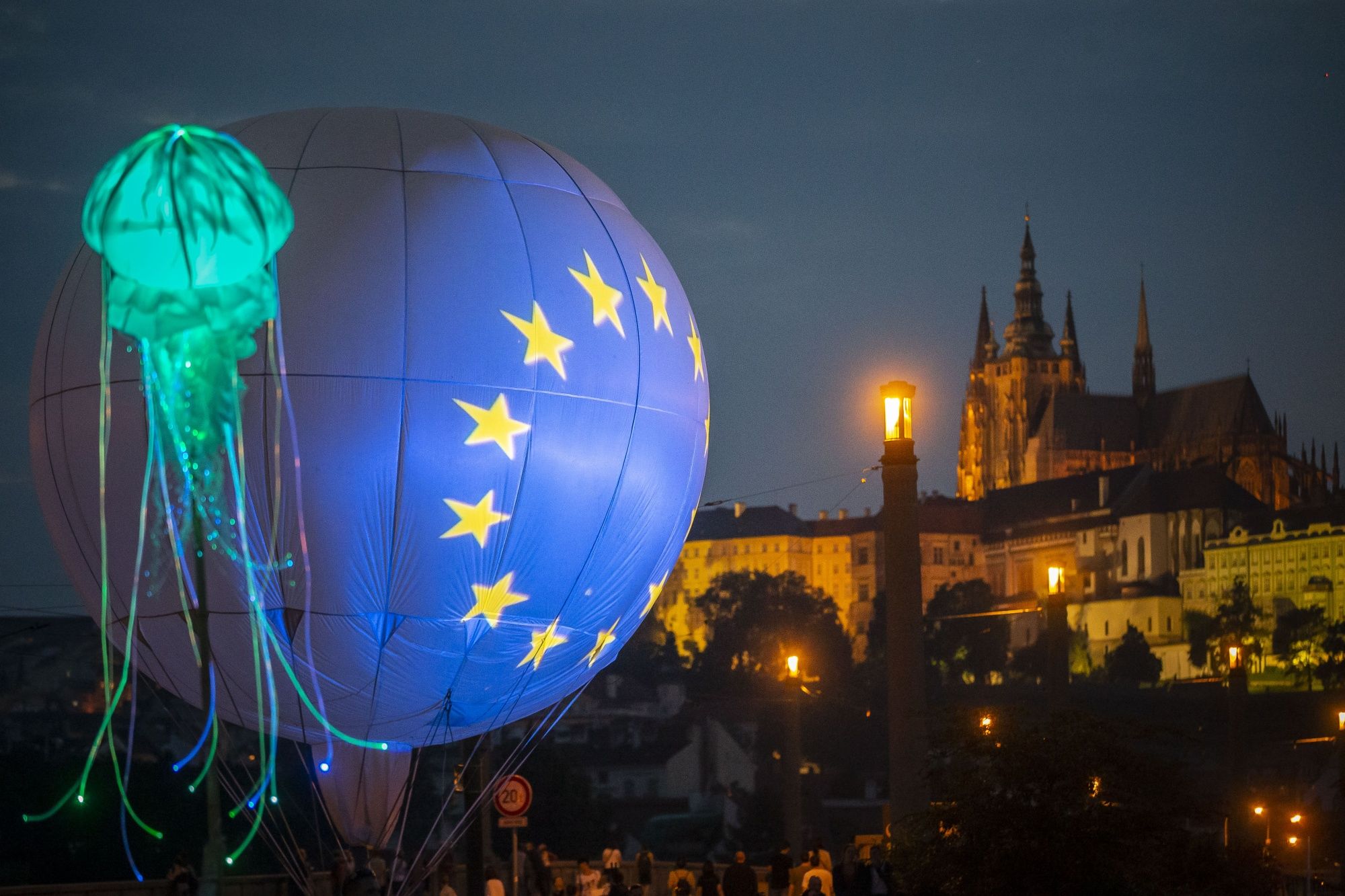
(Bloomberg Opinion) -- Europeans are practiced at the sort of baroque summitry that'll take place this week in Prague, inside the castle grounds where the Thirty Years' War started. Forty-four national leaders — including friends, frenemies and plain old enemies — are showing up for the inaugural meeting of the so-called European Political Community.
Exactly what that institution will become remains to be worked out. But the idea is to remind most Europeans (Russia and Belarus weren't invited) that they share something loftier than a common geography — that is, ideals and a common destiny.
That's the vision, in any case. It was conceived, as such soaring inspirations tend to be, by Emmanuel Macron, the president of France. He came to it in the conviction that all the other European structures are too flawed to help a continent torn by war, border disputes and assorted crises in energy, migration and economics.
In that assessment, Macron is right. Just drawing up a list of those other institutions gets confusing. It starts with such clubs as the Council of Europe (no relation at all to the European Council) and the Organization for Security and Cooperation in Europe (which includes even non-European countries and Russia, the continent's greatest warmonger). Right at the top, there's the European Union. Meant to be history's greatest-ever peace project, it's in theory supposed to gradually integrate its member states — currently 27 — into a United States of Europe.
It doesn't take Macron to realize that none of these groupings is flexible or strong enough to solve Europe's biggest problems. The EU, for example, is so institutionally complex that it's hard just to count how many presidents it has (probably about 10 ). In policy areas such as trade it may be a superpower, but in most others — notably defense — it's a minion.
Its design flaws are legion. The EU can't eject errant members (Hello, Hungary) and is unhelpful when a country wants to leave voluntarily (Bye, Brits). On many important issues, any rogue member can veto all decisions. On others, the EU's treaties are ambiguous — they contain a mutual defense clause that nobody relies on, for instance, which is why all but six EU nations are also in NATO.
Yet another shortcoming of the EU is that it excludes too many European countries. Turkey officially became a candidate for accession to the bloc in 1999; it gave up any hope of joining long ago and may never stop sulking. Several Balkan countries fear that they're in the same holding pattern. Worse, from their point of view, is that Ukraine, Moldova and Georgia — whom the EU wants to support against threats from Russia — may jump ahead of the Balkans in the queue.
Macron apparently hopes that the European Political Community will one day do better. Launched as a “soft-law” institution, it could mature into a club which members can enter as well as leave, but not obstruct or sabotage. It could also provide a continental stage for Brits, Turks, Swiss, Albanians, Georgians and all others who can't or won't join the EU. It's already been decided that the Community's next gathering will take place in Moldova.
As good as Macron's intentions are, of course, Europe won't stop being Europe just because it's getting yet another institution. One country represented in Prague, Ukraine, is fighting for its very existence against a European invader. Two others, Armenia and Azerbaijan, were at war with each other just last month. Two more, Turkey and Greece, could be at any moment, with a third, Cyprus, possibly wedged between them. The North Macedonians, Albanians, Bosnians and other Balkans suspect that the European Political Community is merely Macron's consolation prize because nobody intends to let them into the EU proper. The guests from Serbia, meanwhile, deny that those from Kosovo even have a country to represent.
So yes, it'd be easy to make fun of this continental symposium, of Macron's megalomania in constantly proposing new paperwork monsters and of Europeans being as fractious as they've always been. Too easy.
A more generous view is that Macron and other European leaders are refusing — even at a time when one European, Russian President Vladimir Putin, threatens others with nuclear war — to jettison their dream of continental peace, security and harmony. This week's convention won't be a another Peace of Westphalia or Congress of Vienna. It won't solve the continent's problems, unite the divided or pacify the bellicose. But it deserves attention and support. In times such as ours, gathering in peace is so much better than not gathering at all.
This column does not necessarily reflect the opinion of the editorial board or Bloomberg LP and its owners.
Andreas Kluth is a Bloomberg Opinion columnist covering European politics. A former editor in chief of Handelsblatt Global and a writer for the Economist, he is author of “Hannibal and Me.”
More stories like this are available on bloomberg.com/opinion
©2022 Bloomberg L.P.

-
Love, Sex Aur Dhokha: The Audacious Plot To Spy On Jensen Huang

A Taipei dinner, a Singapore chip buyer and a suspected Chinese asset: inside the alleged spy operation that got close to NVIDIA's Jensen Huang.
-
Ten Things I Learnt This Samvat
Patience can be a trap. Cheap stocks can stay cheap. Leverage can wipe you out. What did Samvat 2082 teach us? Niraj Shah writes on 10 lessons from the year gone by.
-
Talking Points This Week: Tech Nerves, FII Buying, And A Faraway Banking Shock
The global markets are not shining this Diwali. The exception in the large markets is, India.
-
Midterm Rally Lasted A Day. The Hard Reality Of A Divided US May Last Two Years | Opinion
Between a contested AI boom, a debt ceiling that arrives in 2027 and a president with every incentive to act alone, the next two years may prove more volatile than the first day's rally suggests.
-
Blue Wave Will Derail the AI Trade but Won't Dismantle the AI Era | Unhedged Position
The Democrats' sweep of the US Congress will see politics collide with economic forces both over the long and short term.
-
It's Time To Take The GST Council's Bet On Trust Global
Payment records can prove India's services exports, and clear, proportionate rules can bring foreign digital sellers into the tax net.
-
Opinion | India at 38: From Innovation Overperformer to Innovation Powerhouse
India now has 453 VC-backed deep science startups, 18 of them late-stage, after 117 percent growth since 2020. Laurus Labs, at USD 9.3 billion, is the most valuable deep science company in any middle-income economy outside China.
-
Navigating Energy Crossroads: S Jaishankar's Call For Diversified Supply Chains At G20 Ministerial Meeting
As geopolitical fault lines continue to test maritime trade routes and commodity flows, Jaishankar's message remains pertinent: true economic resilience requires open markets, protected transit lines, and a genuine commitment to multilateral cooperation rather than coercion.
-
Indians Are Travelling, But Not Every Journey Is A Holiday | The Week In Whys
Pilgrims, patients and working women are the real travellers, and the system hasn't quite caught up with them.









