2017 Will Be The Year Of A Geopolitical Recession: Eurasia Group
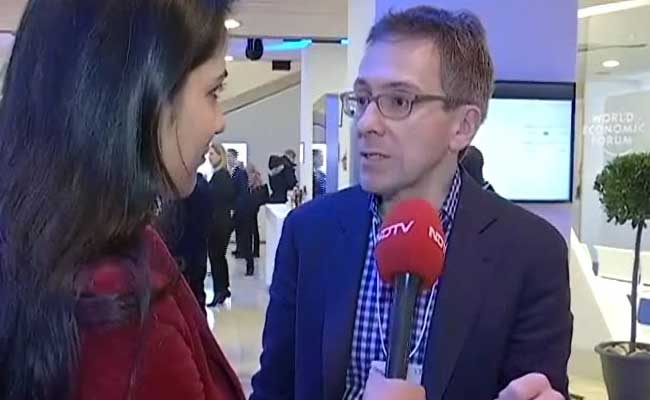
If 2008 was the year of global economic recession, then 2017 can be characterized as a year when the world faces a geopolitical recession. That's the word coming in from Ian Bremmer, founder and president of the Eurasia Group, a leading columnist and political scientist.
Speaking to NDTV's Namrata Brar in Davos, Switzerland, where the global elite have gathered for the annual meeting of the World Economic Forum, Mr Bremmer said the election of Donald Trump to the White House had "decisively repudiated the idea of American exceptionalism", and there was no other country in the world willing to take America's role as a global leader from a military, security and trade standpoint.
"What we see this here is actually a lot of volatility a lot of uncertainty and a geo-political vacuum," said Mr Bremmer. "Xi Jinping only expresses power economically on a global stage, not in terms of the military, certainly not in terms of diplomatic power, not from the technology perspective and not from and energy perspective."
Chinese President Xi Jinping will be the first Chinese leader to make an appearance at the annual meeting in the Alpine town, leading the largest-ever Chinese delegation.
Amid growing protectionist rhetoric from Mr Trump, who will be inaugurated in Washington as the 45th US president on Friday, the Chinese president is expected to make a strong defence of globalisation in a much awaited speech. But while China will make a case for globalisation from a consumerist standpoint, they are not particularly interested in the "globalization of citizenship", or a long-term view that looks at making the idea work for everybody, believes Mr Bremmer, who also dismissed the idea that globalisation was dead.
"Globalisation is not dead," he said. "Americanisation is."
With all eyes on China and the US, the world's interest in India has decisively cooled off at Davos this year, where a slew of disappointing reports, including a growth downgrade by the IMF, has led the country to lose its tag as the fastest growing economy in the world. But Mr Bremmer was a rare optimistic voice about the country's prospects. Lauding Prime Minister Narendra Modi's "strong leadership", he said that while still not a global player of consequence, India had displayed an ability to "develop a longer term economic planning", as evidenced by the reforms undertaken on the Goods and Services Tax (GST).
The government's incremental federal approach to growth also came in for some praise from Mr Bremmer who said that the "the fact that PM Modi is building India with leaders from the BJP state by state, province for province" was a "much more sustainable way to grow an economy even if it takes a lot longer".

-
Midterm Rally Lasted A Day. The Hard Reality Of A Divided US May Last Two Years | Opinion

Between a contested AI boom, a debt ceiling that arrives in 2027 and a president with every incentive to act alone, the next two years may prove more volatile than the first day's rally suggests.
-
Blue Wave Will Derail the AI Trade but Won't Dismantle the AI Era | Unhedged Position
The Democrats' sweep of the US Congress will see politics collide with economic forces both over the long and short term.
-
It's Time To Take The GST Council's Bet On Trust Global
Payment records can prove India's services exports, and clear, proportionate rules can bring foreign digital sellers into the tax net.
-
Opinion | India at 38: From Innovation Overperformer to Innovation Powerhouse
India now has 453 VC-backed deep science startups, 18 of them late-stage, after 117 percent growth since 2020. Laurus Labs, at USD 9.3 billion, is the most valuable deep science company in any middle-income economy outside China.
-
Navigating Energy Crossroads: S Jaishankar's Call For Diversified Supply Chains At G20 Ministerial Meeting
As geopolitical fault lines continue to test maritime trade routes and commodity flows, Jaishankar's message remains pertinent: true economic resilience requires open markets, protected transit lines, and a genuine commitment to multilateral cooperation rather than coercion.
-
Indians Are Travelling, But Not Every Journey Is A Holiday | The Week In Whys
Pilgrims, patients and working women are the real travellers, and the system hasn't quite caught up with them.
-
Getting To Work Costs Women More | The Reason Why
It is not just about women paying more than men. It is about women paying much more in cities than in villages.
-
AI Bias In Investing Cannot Be Eliminated, But It Can Be Governed
Framing is a particularly important example as identical financial information presented in terms of gains rather than losses can lead an LLM to reach a different assessment.
-
Joining The Dots | Dark Skies, Steady Diya: Why Hope Holds This Diwali
With war, a weak rupee and foreign outflows weighing on sentiment, policymakers at the NDTV World Summit and market veterans at NDTV Profit Ignite: Diwali Edition offered the same advice: stay invested and filter out the noise.









