Delivery Wars: Zepto's 10-Minute Food Model Gives It A Chance At The Big Table
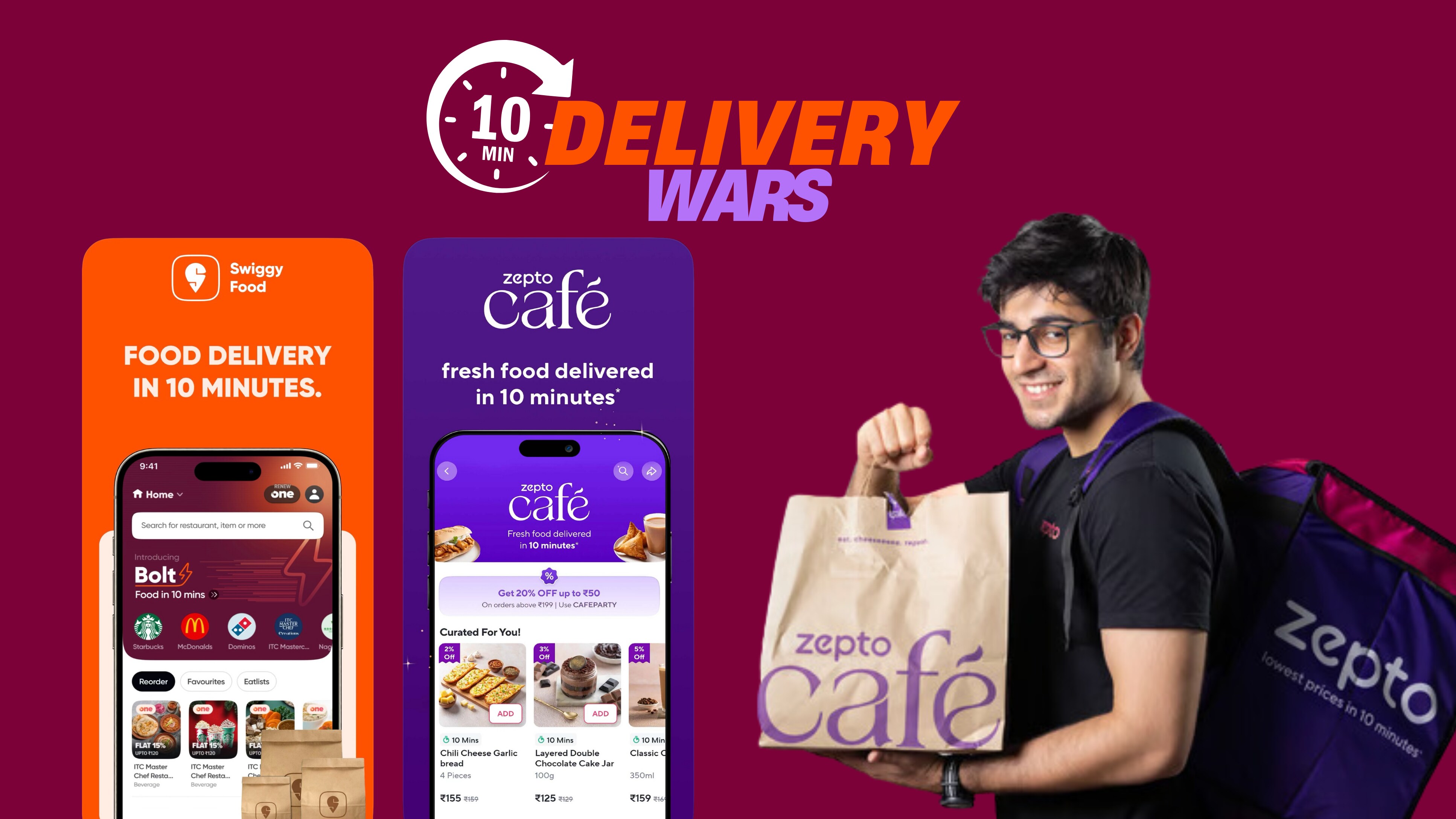
The rise of 10-minute food delivery space in the quick commerce segment has "stirred the market" and presents an opportunity for Zepto Cafe—the instant food delivery arm of Zepto—to become mainstream, according to a note issued by Jefferies on Tuesday.
When Zepto Cafe introduced 10-minute food delivery in 2022, it was a bold experiment in convenience. Fast-forward to today, and the concept has taken off in a big way, with new players and established food aggregators diving into the space, the brokerage pointed out.
What started as a niche offering has now branched into two major business models: the in-house dark store or cloud kitchen setup, where food is prepared and dispatched from a centralised location, and the restaurant partnership model, where platforms collaborate with restaurants to curate quick-prep menus, it explained.
The rise of 10-minute food delivery isn't just about speed—it's reshaping the competitive landscape of food aggregation. According to a recent Jefferies note, this service allows platforms like Zomato and Swiggy to expand their customer base, boost engagement with existing users, and challenge the unorganised sector, including local eateries, street vendors, and food stalls.
"Notwithstanding rise in competition, there is clearly an opportunity for total addressable market expansion," the note said.
Jefferies suggests that by catering to in-between meal snacking and impulse purchases—like coffee or tea, which consumers might otherwise make at home—food aggregators can unlock new revenue streams.
The Players And The Business Models
Zepto Cafe may have pioneered the space, but competition has quickly followed. In the in-house kitchen model, Blinkit's Bistro and Swiggy's SNACC have emerged as key contenders, while startups like Swish and Zing are testing the waters in select cities, Jefferies said.
Zomato's ‘Quick' and Swiggy's ‘Bolt' have additionally introduced restaurant-driven models, delivering pre-prepared or rapidly assembled meals. Other platforms, including Magicpin and Ola Dash, are leveraging the Open Network for Digital Commerce to facilitate rapid food delivery.
The logistics of this business hinge on efficiency. Delivery platforms prioritise dense urban areas with small radii to ensure ultra-fast fulfilment. While the initial menu offerings were limited, platforms have now expanded their selections to over 100 food and beverage items. The entire process is meticulously timed—most of the 10-minute window is dedicated to delivery, leaving only 2-3 minutes for food preparation and packaging, the note stated.
The Challenges: Legal, Health, And Industry Backlash
Despite the enthusiasm, the 10-minute food delivery trend has raised concerns. The National Restaurants Association of India has warned of potential legal action against Zomato and Swiggy, arguing that their dark store models amount to "private labelling", Jefferies pointed out.
The NRAI contends that food aggregators are leveraging restaurant data collected through their main platforms—data that is not shared with the restaurants themselves.
Adding to the debate, the Federation of Hotel & Restaurant Associations of India has urged regulators to intervene, citing concerns about data misuse, unfair competition, and food safety.
On top of this, health experts worry that the rapid-fire model will encourage the consumption of processed and pre-packaged foods, potentially impacting long-term dietary habits, the note stated.

-
High US Salaries, No Green Card Certainty: The Financial Calculation Facing Indian H-1B Families

The suspension of PERM processing at eight technology employers does not cancel existing H-1B visas. What it does is force a question many Indian families have been avoiding: is the US salary worth tying your career and family plans to one employer?
-
Unhedged Position: Can India See An Indonesia-Style Time Correction?
The Nifty is trading below levels it first clocked in 2024. Is there, then, as I have suggested in the headline, potential that the current time correction drags on painfully for the next three-five, even ten years?
-
Navigating Friction And Energy Realities: An Analysis Of Marco Rubio's October Visit To India
Occurring at a critical juncture marked by stalled trade negotiations and escalating geopolitical pressures over global energy supplies, the visit offers a profound window into modern US-India relations.
-
India Exports Capital. Why Not Export Trusteeship?
The big question, then, is whether India can build an institution that global borrowers, investors, banks, and lawyers can trust, even without an Indian connection.
-
France's Economy & Politics Are In Crisis | The Reason Why
Let's look at how the French economy and politics evolved under Nicolas Sarkozy, Franois Hollande and Emmanuel Macron.
-
You May Inherit The Business. You Must Earn Its Credibility.
Succession tests the founder's ability to share authority as much as it tests the next generation's readiness to assume it.
-
Signing Deals Is One Thing; Making Them Work Is Another | The Week In Whys
Sometimes, things don't turn out as planned. Indian companies have lost some bids to rivals, some projects won't produce until 2030.
-
FOMC Wall, PERM Suspension, Hospital Stocks | Talking Points This Week
A PERM suspension would directly affect green-card sponsorship rather than H-1B visas, so the near-term earnings impact could remain relatively limited. The key question is whether this marks a new phase in US scrutiny of Indian IT.
-
Everything, Everywhere, All At Once: Dalal Street's Week To Forget | Joining The Dots
Visa curbs, a Starlink spat and cancer drug caps: what connects this week's shocks for Indian markets
-
India Is Going Abroad For Critical Minerals. But It May Take Years To Pay Off | The Reason Why
Although India's steps are in the right direction, they remain modest compared with India's growing dependence.









