India Opens Flagship EV Policy To Global Carmakers But Tesla Not Coming
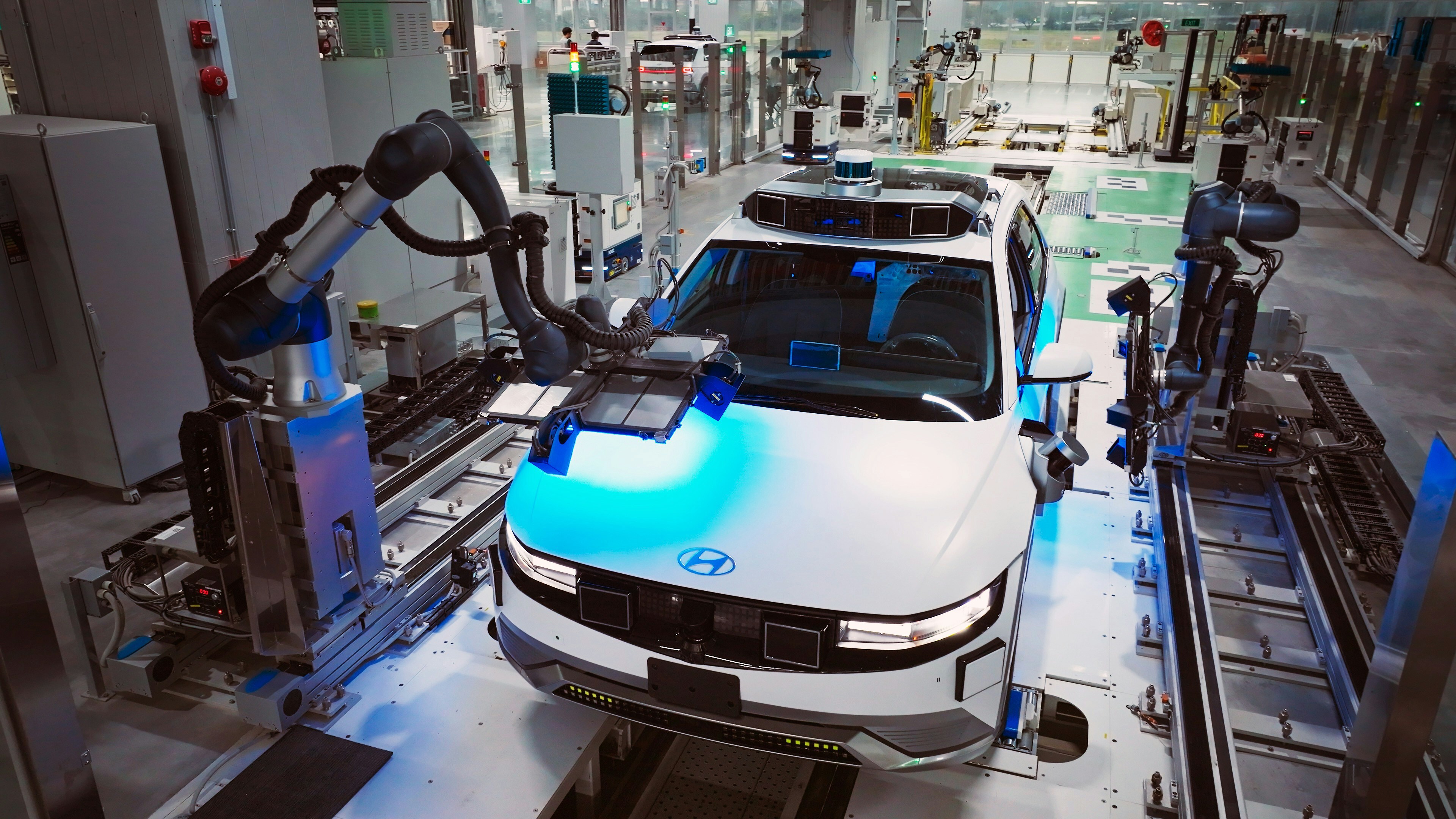
The central government has notified final guidelines of its flagship EV policy to attract global carmakers to make in India for the world, but Tesla Inc. isn't likely to be one of them.
“Mercedes-Benz, Volkswagen-Skoda and Hyundai Motor Co. have already shown interest,” Heavy Industries Minister HD Kumaraswamy said during a press conference on Monday. “Tesla, we are not actually expecting (interest) from them… They are not interested in manufacturing in India,” the minister said. “As from what we know, Tesla plans to open showrooms in India to sell cars.”
Skoda Auto Volkswagen India Pvt. Ltd. said it was closely monitoring developments related to the EV policy in India and was “thoroughly assessing their implications”. “Based on this, we will define the appropriate next steps in line with our long-term strategy,” a company spokesperson said in a statement.
Mercedes-Benz refused to comment on the matter. An email sent to Hyundai Motor India Ltd. remained unanswered.
Announced on 15 March 2024, the ‘Scheme to Promote Manufacturing of Electric Cars in India' offers to slash import duty to 15% on electric cars priced at least $35,000 if their maker invests at least $500 million to set up a local plant within three years. Up to 8,000 cars can be imported annually at this reduced rate for five years.
India EV Policy: Key Guidelines
An approved applicant will be allowed to import completely built-up units of electric cars priced at $35,000 and above at a reduced import duty of 15% for a period of five years.
A total of 8,000 electric cars can be imported annually via this route. Any unsold inventory can be carried over to the next year.
The amount of import duty waived will be limited to Rs 6,484 crore or minimum investment of Rs 4,150 crore ($500 million)
The applicant has to invest $500 million to set up a local plant within three years. An electric car manufactured here has to achieve 25% localisation in three years and 50% in five years.
If the applicant already has manufacturing operations in India, it has to invest a minimum of $500 million to build a new EV assembly line within three years.
The cost incurred towards land acquisition will not be considered as investment. Any construction on this land will be considered as initial investment, provided it doesn't exceed 10% of the total commitment.
Expenditure incurred on setting up charging infrastructure will be considered as initial investment, provided it doesn't exceed 5% of the total commitment.
The applicant's investment to set up shop in India has to be backed by a bank guarantee equivalent to the import duty waived or Rs 4,150 crore ($500 million), whichever is higher.
The applicant needs to have a global annual revenue of Rs 10,000 crore with capex of at least Rs 3,000 crore.
A notice inviting applications will be issued shortly. The window will be open until March 15, 2026.
To be sure, electric cars are still a nascent segment in the world's third largest car market. In the fiscal year ended March 31, 2025, electric car sales rose 17.63% year-on-year to 1,07,645 units. This was the first time the segment crossed the one-lakh mark, in a market that ships 40 lakh cars annually.
Tata Motors Ltd., JSW MG Motor India Pvt. Ltd. and Mahindra & Mahindra Ltd. are the key players in the EV category. Overall market leader, Maruti Suzuki India Ltd., has yet to launch an electric car.

-
High US Salaries, No Green Card Certainty: The Financial Calculation Facing Indian H-1B Families

The suspension of PERM processing at eight technology employers does not cancel existing H-1B visas. What it does is force a question many Indian families have been avoiding: is the US salary worth tying your career and family plans to one employer?
-
Swiggy vs Eternal: Food Delivery's Two Rivals Are No Longer In The Same Race
Eternal is building a private AI assistant, dark.ai. Swiggy is still working out how to make Instamart pay, with an operating loss of Rs 895 crore in the July-September quarter while Blinkit stayed profitable.
-
Where You Live Shapes How You Get To Work | The Reason Why
Two-wheelers are the most popular way to get to work in India, accounting for nearly 43% of workplace commutes.
-
Unhedged Position: Can India See An Indonesia-Style Time Correction?
The Nifty is trading below levels it first clocked in 2024. Is there, then, as I have suggested in the headline, potential that the current time correction drags on painfully for the next three-five, even ten years?
-
Navigating Friction And Energy Realities: An Analysis Of Marco Rubio's October Visit To India
Occurring at a critical juncture marked by stalled trade negotiations and escalating geopolitical pressures over global energy supplies, the visit offers a profound window into modern US-India relations.
-
India Exports Capital. Why Not Export Trusteeship?
The big question, then, is whether India can build an institution that global borrowers, investors, banks, and lawyers can trust, even without an Indian connection.
-
France's Economy & Politics Are In Crisis | The Reason Why
Let's look at how the French economy and politics evolved under Nicolas Sarkozy, Franois Hollande and Emmanuel Macron.
-
You May Inherit The Business. You Must Earn Its Credibility.
Succession tests the founder's ability to share authority as much as it tests the next generation's readiness to assume it.
-
Signing Deals Is One Thing; Making Them Work Is Another | The Week In Whys
Sometimes, things don't turn out as planned. Indian companies have lost some bids to rivals, some projects won't produce until 2030.
-
FOMC Wall, PERM Suspension, Hospital Stocks | Talking Points This Week
A PERM suspension would directly affect green-card sponsorship rather than H-1B visas, so the near-term earnings impact could remain relatively limited. The key question is whether this marks a new phase in US scrutiny of Indian IT.









