US Service Gauge Falls More Than Expected As Demand Moderates

(Bloomberg) -- The US service sector expanded in March at a much slower pace than projected on considerably weaker new orders growth and softer business activity.
The Institute for Supply Management's index fell nearly four points to a three-month low of 51.2, data showed Wednesday. The figure was weaker than all but one forecast in a Bloomberg survey of economists, which had a median projection of 54.4.
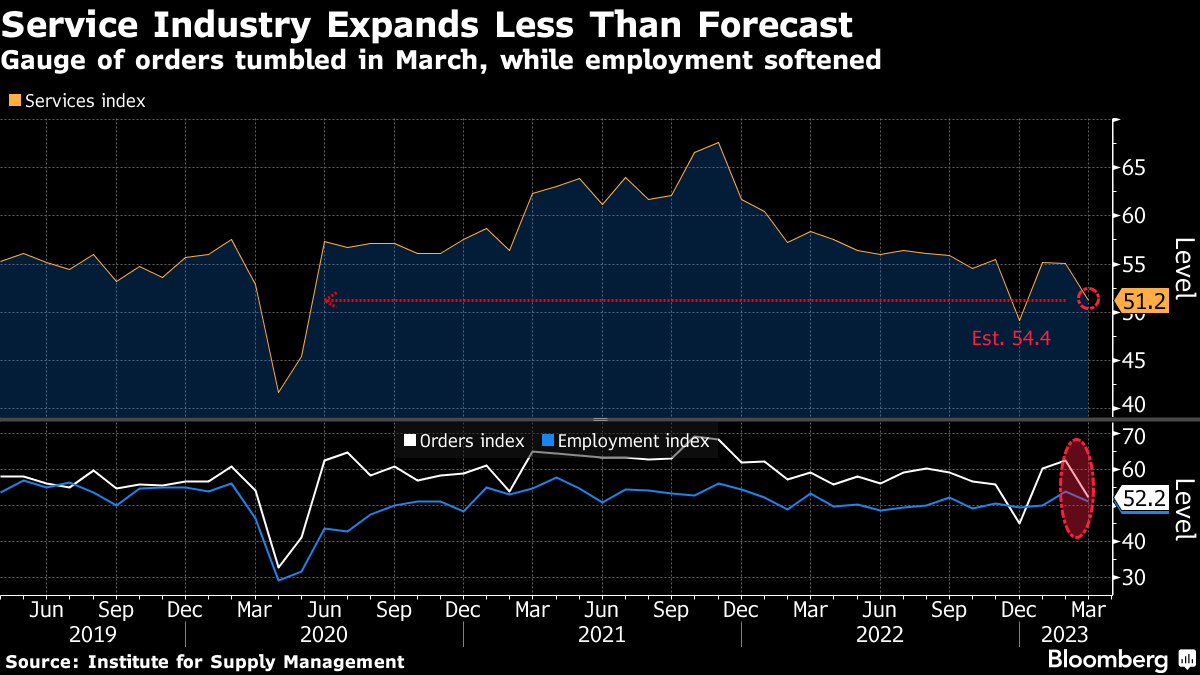
While an index above 50 indicates expansion, the decline suggests companies and consumers are becoming more cautious. When paired with the latest ISM factory survey that showed a further deterioration, the services data may heighten concerns about the economic outlook as credit conditions tighten and interest rates remain high.
The group's index of new orders at service providers dropped more than 10 points to a three-month low of 52.2. While still consistent with expansion, the scale of the drop suggests a significant slowing in the pace of bookings growth. The business activity measure, which mirrors the ISM's factory production index, slipped to 55.4.
“There has been a pullback in the rate of growth for the services sector, attributed mainly to a cooling off in the new orders growth rate, an employment environment that varies by industry and continued improvements in capacity and logistics,” Anthony Nieves, chair of the ISM Services Business Survey Committee, said in a statement.

The S&P 500 declined and Treasury yields fell after the report.
Meantime, inventories grew at the quickest pace in two years and order backlogs shrank at the fastest rate since May 2020, reinforcing concerns of slowing demand.
Export orders also contracted, and the group's gauge of supplier deliveries dropped to its lowest level since 2009. While the export gauge is unadjusted for seasonal variations and can be volatile from month to month, the 18-point slump was the biggest on record.
The index for prices paid for inputs fell by more than 6 points to 59.5, the lowest level since July 2020 and suggesting a slowing in inflationary pressures.
The monthly decline was the steepest since 2017. Service-sector inflation has been a key concern for Federal Reserve officials, who worry a tight labor market risks keeping the rate of price growth elevated for longer.
Select ISM Industry Comments
“Restaurant sales remain favorable compared to pre-pandemic trends. Traffic is recovering and nearly flat.” - Accommodation & Food Services
“Sales continue to increase even as interest rates moderately increase. Most suppliers feel their supply chains are back to normal, with inventories climbing and delivery times improving.” - Construction
“Close of first quarter business conditions are steady. Already projecting out for 2024. Economic uncertainty is still a concern, and interest rates are continuing to be monitored closely.” - Finance & Insurance
“Slowdown in the economy is leading to reduced expenditure amounts.” - Information
“Our company continues to have a cautious approach to the future. Continuing uncertainty regarding inflation and oil and gas regulations.” - Management of Companies and Support Services
“There continues to be uncertainty in the market regarding future investments. Interest rate hikes seem to have done little to slow down consumer spending. The likelihood of a mild slowdown in the second half of 2023 or 2024 is still pretty high. Layoffs will continue.” - Professional, Scientific & Technical Services
“Supply is starting to stabilize. Prices are coming down but in small increments. Food prices remain high, and availability continues to be a challenge.” - Transportation & Warehousing
The pace of hiring appeared to moderate in the month, though the group's employment gauge indicated further increases in headcount. Separate figures Wednesday from ADP Research Institute showed private payrolls increased by a less-than-expected 145,000 in March.
The monthly jobs report, which is produced by the Bureau of Labor Statistics, will be released on Friday. Economists forecast employers added nearly a quarter of a million jobs in March while the unemployment rate held at a historically low 3.6%.
--With assistance from Kristy Scheuble.
(Adds graphic)
More stories like this are available on bloomberg.com
©2023 Bloomberg L.P.

-
The Economic Imperative: Analysing The Material Driving Force Behind India-Canada Strategic Reset

This economic complementarity is further reinforced by deep institutional investment ties and talent mobility, which form the bedrock of the bilateral framework.
-
Medicine Pricing: Where Must Profit Stop?
India must confront excessive margins, hidden incentives and regulatory gaps that threaten the integrity of medicine.
-
Why Amazon And Flipkart Are Struggling To Beat Meesho In India's Smaller Cities
With 274 million users and lowest-cost logistics, Meesho is defending its value commerce crown against giants like Amazon and Flipkart.
-
High US Salaries, No Green Card Certainty: The Financial Calculation Facing Indian H-1B Families
The suspension of PERM processing at eight technology employers does not cancel existing H-1B visas. What it does is force a question many Indian families have been avoiding: is the US salary worth tying your career and family plans to one employer?
-
Swiggy vs Eternal: Food Delivery's Two Rivals Are No Longer In The Same Race
Eternal is building a private AI assistant, dark.ai. Swiggy is still working out how to make Instamart pay, with an operating loss of Rs 895 crore in the July-September quarter while Blinkit stayed profitable.
-
Where You Live Shapes How You Get To Work | The Reason Why
Two-wheelers are the most popular way to get to work in India, accounting for nearly 43% of workplace commutes.
-
Unhedged Position: Can India See An Indonesia-Style Time Correction?
The Nifty is trading below levels it first clocked in 2024. Is there, then, as I have suggested in the headline, potential that the current time correction drags on painfully for the next three-five, even ten years?
-
Navigating Friction And Energy Realities: An Analysis Of Marco Rubio's October Visit To India
Occurring at a critical juncture marked by stalled trade negotiations and escalating geopolitical pressures over global energy supplies, the visit offers a profound window into modern US-India relations.
-
India Exports Capital. Why Not Export Trusteeship?
The big question, then, is whether India can build an institution that global borrowers, investors, banks, and lawyers can trust, even without an Indian connection.
-
France's Economy & Politics Are In Crisis | The Reason Why
Let's look at how the French economy and politics evolved under Nicolas Sarkozy, Franois Hollande and Emmanuel Macron.










