US Manufacturing Activity Shrinks for First Time This Year
(Bloomberg) --US factory activity contracted in March for the first time this year and prices accelerated sharply for a second month as the drumbeat of higher tariffs reverberated through the economy.
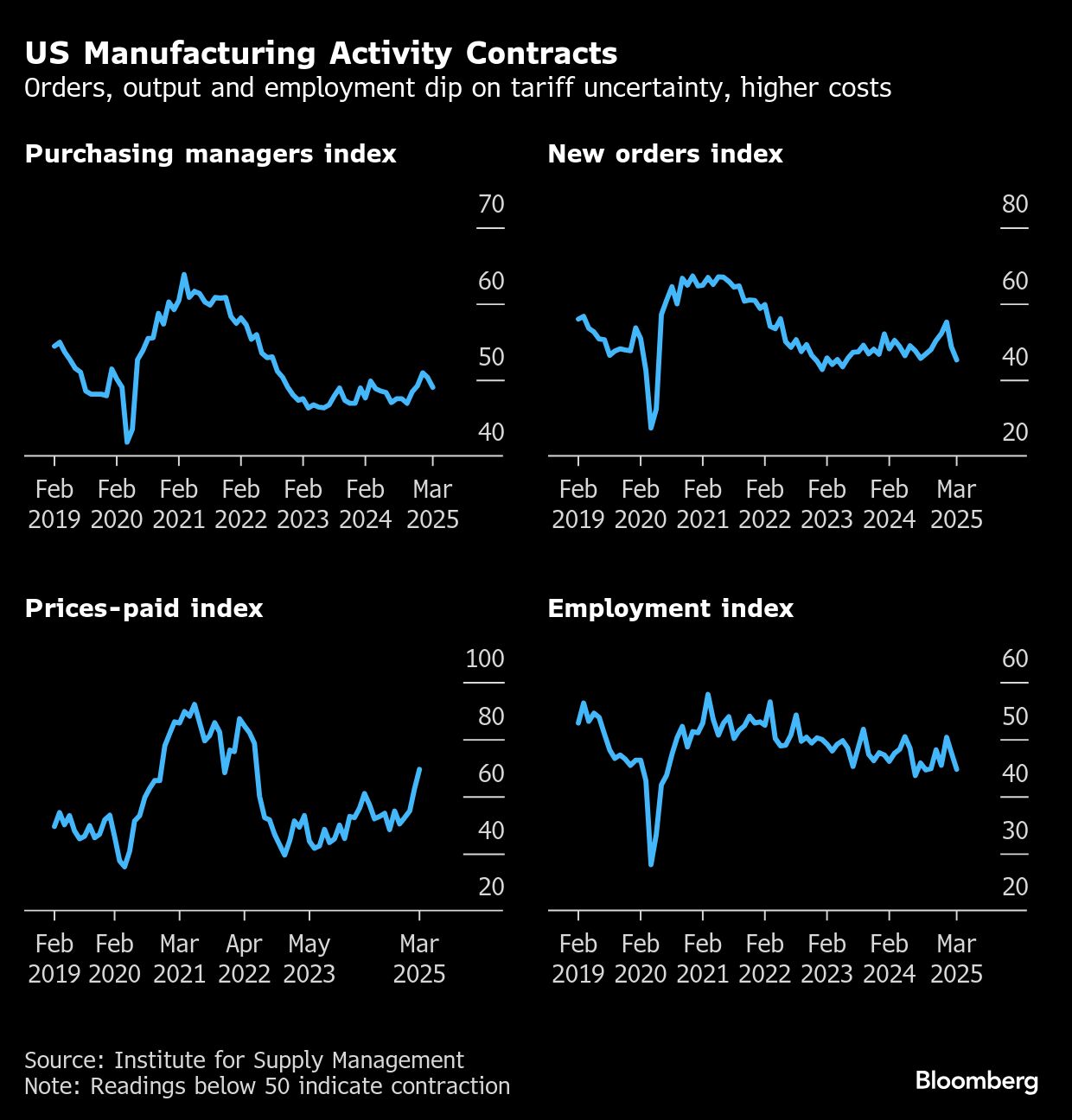
The Institute for Supply Management's manufacturing index declined 1.3 points last month to 49, according to data released Tuesday. Readings below 50 indicate contraction and the figure was slightly weaker than the median projection in a Bloomberg survey of economists.
The group's price measure increased to the highest since June 2022. Over the past two months, the gauge has increased 14.5 points, the most over a comparable period in four years.
The ISM index of factory orders slumped to the lowest level since May 2023. Along with a bigger contraction in order backlogs, the drop in bookings caused production to shrink for the first time this year. Factory employment contracted at the fastest pace since September.
Separate data out Tuesday from the Labor Department showed fewer job openings in February, including a decline at manufacturers.
Some companies are pausing investment plans due to the uncertainty surrounding the details of the implementation of additional tariffs. Meanwhile, a rush by firms to import ahead of the hikes boosted the ISM index of factory inventories to 53.4, the highest since October 2022, helping underpin the overall gauge.
Select ISM Industry Comments
“Complex markets saw a surge in volume buying in anticipation of 2025 being slightly better than 2024. In March, however, all markets saw a slowdown, with fear and inventory stocking to hold through a potential crisis.” — Chemical Products
“Acute shortages continue to impact supply chain continuity. Chinese restrictions on critical minerals such as germanium have caused major shortages, resulting in all supply needed in 2025 already assumed — and, not surprisingly, significant price increases as a result. Tariffs are causing minor ripples at the moment in securing supply, with purchase order terms narrowing due to uncertainties.” — Transportation Equipment
“Customers are pulling in orders due to anxiety about continued tariffs and pricing pressures.” — Computer & Electronic Products
“Business condition is deteriorating at a fast pace. Tariffs and economic uncertainty are making the current business environment challenging.” — Machinery
“New order levels have increased and are better than expected. We suspect that our customers are trying to build inventory at current prices to get ahead of expected tariff and related cost increases. We expect this surge in demand to be short-lived.” — Fabricated Metals
“No evidence of growing demand. Tariff impacts and mitigation strategies are a daily conversation.” — Electrical Equipment, Appliances & Components
“Worldwide economic instability has really begun to impact our oil and gas business.” — Petroleum & Coal Products
“Bearish market sentiment and tariff applications and costs have dominated discussions over the past month and should continue to dominate markets until a clear path forward is determined. Overall concern is whether or not demand destruction will occur with higher pricing.” — Primary Metals
The scramble to secure goods and materials from outside the country also helped drive materials prices higher. With consumer demand cooling so far this year, producers may find it difficult to pass on higher costs.
Meanwhile, the imports gauge declined 2.5 points to 50.1, indicating producer demand for foreign goods has leveled off.

-
The Curious Case of Equitas Small Finance Bank And A CEO Who Quit For Stock

PN Vasudevan believes persistent investor concerns over a perceived conflict of interest had become a governance overhang on Equitas Small Finance Bank's stock, even as the lender improved profitability and asset quality.
-
Talking Points This Week: AI Cash Burn, A Tiger Comeback And An India That Still Finds Its Own Path
India is not immune to higher oil or tighter global liquidity, yet its earnings base is broader, its domestic policy levers are still available.
-
Foreign Investors Own Half Of HDFC Bank and ICICI Bank. An LTCG Cut Could Matter Most Here
Foreign portfolio investors have US$115 billion parked in HDFC Bank, ICICI Bank. If the government cuts long-term capital gains tax, Jefferies says returning foreign money could land here first.
-
'Never Seen This Level Of Negativity': Sandeep Tandon Says The Next Rally May Be Closer Than You Think
Veteran investor Sandeep Tandon says foreign selling is easing, large-caps are due a comeback and mid-caps are crowded, while he turns positive on gold, power and pharma this Diwali.
-
Indians Stay With Family, Not In Hotels | The Reason Why
India still lacks enough clean, reliable and affordable hotels for budget-conscious travellers.
-
The Economic Imperative: Analysing The Material Driving Force Behind India-Canada Strategic Reset
This economic complementarity is further reinforced by deep institutional investment ties and talent mobility, which form the bedrock of the bilateral framework.
-
Medicine Pricing: Where Must Profit Stop?
India must confront excessive margins, hidden incentives and regulatory gaps that threaten the integrity of medicine.
-
Why Amazon And Flipkart Are Struggling To Beat Meesho In India's Smaller Cities
With 274 million users and lowest-cost logistics, Meesho is defending its value commerce crown against giants like Amazon and Flipkart.
-
High US Salaries, No Green Card Certainty: The Financial Calculation Facing Indian H-1B Families
The suspension of PERM processing at eight technology employers does not cancel existing H-1B visas. What it does is force a question many Indian families have been avoiding: is the US salary worth tying your career and family plans to one employer?
-
Swiggy vs Eternal: Food Delivery's Two Rivals Are No Longer In The Same Race
Eternal is building a private AI assistant, dark.ai. Swiggy is still working out how to make Instamart pay, with an operating loss of Rs 895 crore in the July-September quarter while Blinkit stayed profitable.










