US Jobless Claims Get Bumped Up By Revisions For Seasonal Swings

(Bloomberg) -- Applications for US unemployment benefits have been much higher than previously reported this year after the government updated its method of adjusting the data for seasonal swings.
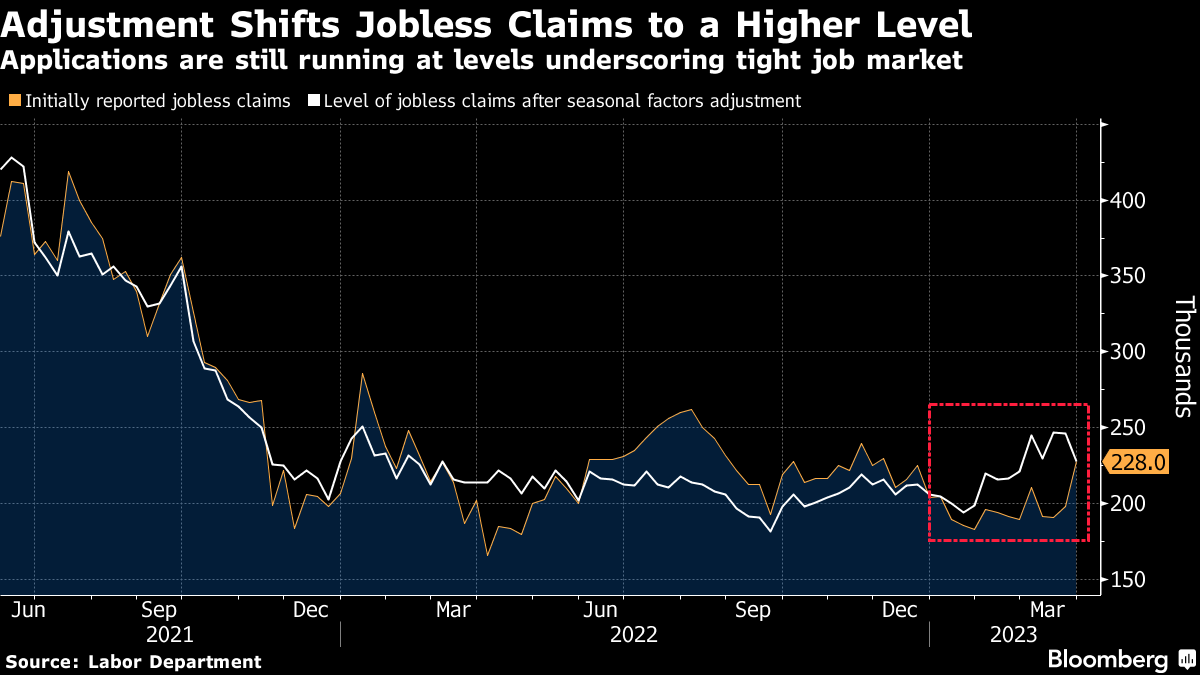
Initial unemployment claims were 228,000 in the week ended April 1 and the prior week was revised up by 48,000 to 246,000, Labor Department data showed Thursday. The report included updated seasonal factors going back to 2018.
The level indicates a softer, but still strong labor market. The median forecast in a Bloomberg survey of economists called for 200,000 applications.
Continuing claims, which include people who have received unemployment benefits for a week or more and are a good indicator of how hard it is for people to find work after losing their job, was little changed at 1.82 million in the week ended March 25. The previous week was revised up.
The Labor Department had to switch the way it adjusts for seasonal factors during the pandemic given that the distortions were so large. Today's report maintains that method for the first year of the pandemic but uses the traditional way when looking at data before March 2020 and after June 2021.
That means that claims have been largely above 200,000 this year, whereas they were previously reported well below that.
Economists have been puzzled as to why claims were so low, especially given large waves of layoffs and other signs of softening in the labor market. Even with the adjustments, applications are still relatively low and indicative of strong demand for workers.
A separate report Thursday showed job-cut announcements from US-based employers rose 15% in March from the prior month, marking the highest first-quarter total since 2020, according to Challenger, Gray & Christmas, Inc.
What Bloomberg Economics Says...
“We have long suspected claims numbers were artificially low, stemming from pandemic-distorted problems in seasonally adjusting the data. With job-cut announcements up 15% in March amid weaker market and economic conditions, more Americans are likely to apply for unemployment benefits ahead.”
— Eliza Winger, economist
However, the higher level of claims shouldn't be interpreted as a sign that layoffs have suddenly surged, according to Stephen Stanley, chief US economist at Santander US Capital Markets LLC.
“I think we are going to have to give it a few weeks to see how this plays out,” Stanley said in a note. “Having said that, it is true that the trend in seasonally adjusted initial claims is noticeably higher than previously estimated, which does suggest that the flurry of layoff announcements so far this year has begun to show up in these data.”
The four-week moving average in initial claims, which smooths out week-to-week volatility, fell to 237,750 from an upwardly revised 242,000 in the prior period.
On an unadjusted basis, claims fell by around 17,000 to 206,931, with California, Kentucky and Michigan posting the biggest decreases. Indiana posted the largest increase.
The data precede Friday's employment report, which is expected to show another strong month of hiring in March and the unemployment rate holding near a historic low.
--With assistance from Jordan Yadoo and Augusta Saraiva.
More stories like this are available on bloomberg.com
©2023 Bloomberg L.P.

-
The Economic Imperative: Analysing The Material Driving Force Behind India-Canada Strategic Reset

This economic complementarity is further reinforced by deep institutional investment ties and talent mobility, which form the bedrock of the bilateral framework.
-
Medicine Pricing: Where Must Profit Stop?
India must confront excessive margins, hidden incentives and regulatory gaps that threaten the integrity of medicine.
-
Why Amazon And Flipkart Are Struggling To Beat Meesho In India's Smaller Cities
With 274 million users and lowest-cost logistics, Meesho is defending its value commerce crown against giants like Amazon and Flipkart.
-
High US Salaries, No Green Card Certainty: The Financial Calculation Facing Indian H-1B Families
The suspension of PERM processing at eight technology employers does not cancel existing H-1B visas. What it does is force a question many Indian families have been avoiding: is the US salary worth tying your career and family plans to one employer?
-
Swiggy vs Eternal: Food Delivery's Two Rivals Are No Longer In The Same Race
Eternal is building a private AI assistant, dark.ai. Swiggy is still working out how to make Instamart pay, with an operating loss of Rs 895 crore in the July-September quarter while Blinkit stayed profitable.
-
Where You Live Shapes How You Get To Work | The Reason Why
Two-wheelers are the most popular way to get to work in India, accounting for nearly 43% of workplace commutes.
-
Unhedged Position: Can India See An Indonesia-Style Time Correction?
The Nifty is trading below levels it first clocked in 2024. Is there, then, as I have suggested in the headline, potential that the current time correction drags on painfully for the next three-five, even ten years?
-
Navigating Friction And Energy Realities: An Analysis Of Marco Rubio's October Visit To India
Occurring at a critical juncture marked by stalled trade negotiations and escalating geopolitical pressures over global energy supplies, the visit offers a profound window into modern US-India relations.
-
India Exports Capital. Why Not Export Trusteeship?
The big question, then, is whether India can build an institution that global borrowers, investors, banks, and lawyers can trust, even without an Indian connection.
-
France's Economy & Politics Are In Crisis | The Reason Why
Let's look at how the French economy and politics evolved under Nicolas Sarkozy, Franois Hollande and Emmanuel Macron.










