US Job Openings Fall to Lowest Level Since 2021, Layoffs Ease
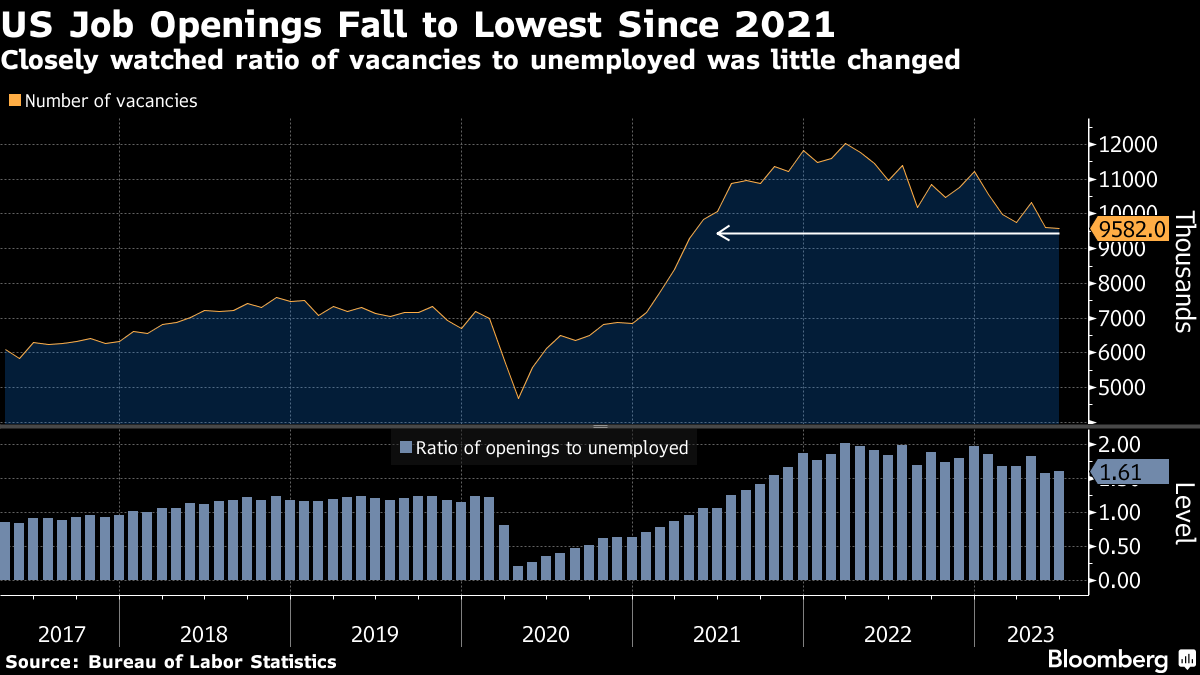
(Bloomberg) -- US job openings fell in June to the lowest level since April 2021, suggesting some softening in demand for workers in an otherwise resilient labor market.
The number of available positions eased to 9.6 million in June, the Labor Department's Job Openings and Labor Turnover Survey showed Tuesday, in line with the median estimate in a Bloomberg survey.
Hiring fell to the lowest level since February 2021. But layoffs also declined to the lowest since the end of last year, suggesting employers are reticent to let go of staff. That bolsters the message from weekly filings for jobless claims, which have moderated in recent months, and an unemployment rate that remains historically low.
“The data on layoffs show just how resilient employer demand for workers remains,” Nick Bunker, the head of economic research at Indeed Hiring Lab, said in a note. “Layoff data, a loud emergency siren during economic downturns, are instead signaling a muted ‘all's well' for current employees.”
Tuesday's data precede the government's jobs report, which is projected to show Friday that employers added some 200,000 positions in July. That would mark the lowest reading since the end of 2020.
The decline in openings was led by goods-producing sectors such as manufacturing, while several service industries, including health care and arts and entertainment, registered increases.
A separate report out Tuesday showed US factory activity contracted in July for a ninth-straight month, reflecting tepid demand for American merchandise at home and abroad.
What Bloomberg Economics Says...
“We have doubts that these data capture the real temperature of the labor market. We believe the labor market is looser than the headline figure suggests, and aren't yet convinced by the soft-landing narrative.”
— Anna Wong, economist
To read the full note, click here
The so-called quits rate, which measures how many workers voluntarily left their jobs as a share of total employment, fell to 2.4%, matching the lowest since February 2021. That figure is often interpreted as a proxy for perceptions about job security.
Record job openings have been an important driver of the Federal Reserve's aggressive tightening campaign over the last 16 months. Investors expect the central bank to hold its benchmark interest rate steady at its next policy meeting in September after raising it last week to the highest level in 22 years.
The ratio of openings to unemployed people was little changed at 1.6 in June. Prior to the pandemic, it was about 1.2.
Some economists have questioned the reliability of the JOLTS statistics given the survey's low response rate. By the end of 2022, it had fallen to about 31%, roughly half the rate just three years earlier.
--With assistance from Jordan Yadoo and Reade Pickert.
(Adds Bloomberg Economics comment)
More stories like this are available on bloomberg.com
©2023 Bloomberg L.P.

-
Signature Play: The Classic Cocktail Is Dead. Or Is It?

Classic cocktails are disappearing from India's cocktail menus. But they're still being ordered, taught to bartenders and borrowed from. So, who's really having the last drink?
-
A New Samvat Wishlist: Inclusive Prosperity And Human Development
India has strengthened its economic foundations through infrastructure, digital access and enterprise. Its next growth chapter must deepen productivity, create better livelihoods and widen participation in prosperity.
-
Love, Sex Aur Dhokha: The Audacious Plot To Spy On Jensen Huang
A Taipei dinner, a Singapore chip buyer and a suspected Chinese asset: inside the alleged spy operation that got close to NVIDIA's Jensen Huang.
-
Ten Things I Learnt This Samvat
Patience can be a trap. Cheap stocks can stay cheap. Leverage can wipe you out. What did Samvat 2082 teach us? Niraj Shah writes on 10 lessons from the year gone by.
-
Talking Points This Week: Tech Nerves, FII Buying, And A Faraway Banking Shock
The global markets are not shining this Diwali. The exception in the large markets is, India.
-
Midterm Rally Lasted A Day. The Hard Reality Of A Divided US May Last Two Years | Opinion
Between a contested AI boom, a debt ceiling that arrives in 2027 and a president with every incentive to act alone, the next two years may prove more volatile than the first day's rally suggests.
-
Blue Wave Will Derail the AI Trade but Won't Dismantle the AI Era | Unhedged Position
The Democrats' sweep of the US Congress will see politics collide with economic forces both over the long and short term.
-
It's Time To Take The GST Council's Bet On Trust Global
Payment records can prove India's services exports, and clear, proportionate rules can bring foreign digital sellers into the tax net.
-
Opinion | India at 38: From Innovation Overperformer to Innovation Powerhouse
India now has 453 VC-backed deep science startups, 18 of them late-stage, after 117 percent growth since 2020. Laurus Labs, at USD 9.3 billion, is the most valuable deep science company in any middle-income economy outside China.









