US Inflation Data To Bolster Case For Fed Interest-Rate Cut In September

(Bloomberg) -- Forecasters expect a monthly report on US consumer prices to show the smallest back-to-back increases in underlying inflation since last summer, adding to the case for a Federal Reserve interest-rate cut in September.
The figures, to be published Thursday by the Bureau of Labor Statistics, will probably show a key gauge of prices excluding food and energy advanced just 0.2% in June for the second month in a row, according to the median estimate in a Bloomberg survey. The broader consumer price index is seen posting a smaller 0.1% increase, thanks in part to lower gas prices.
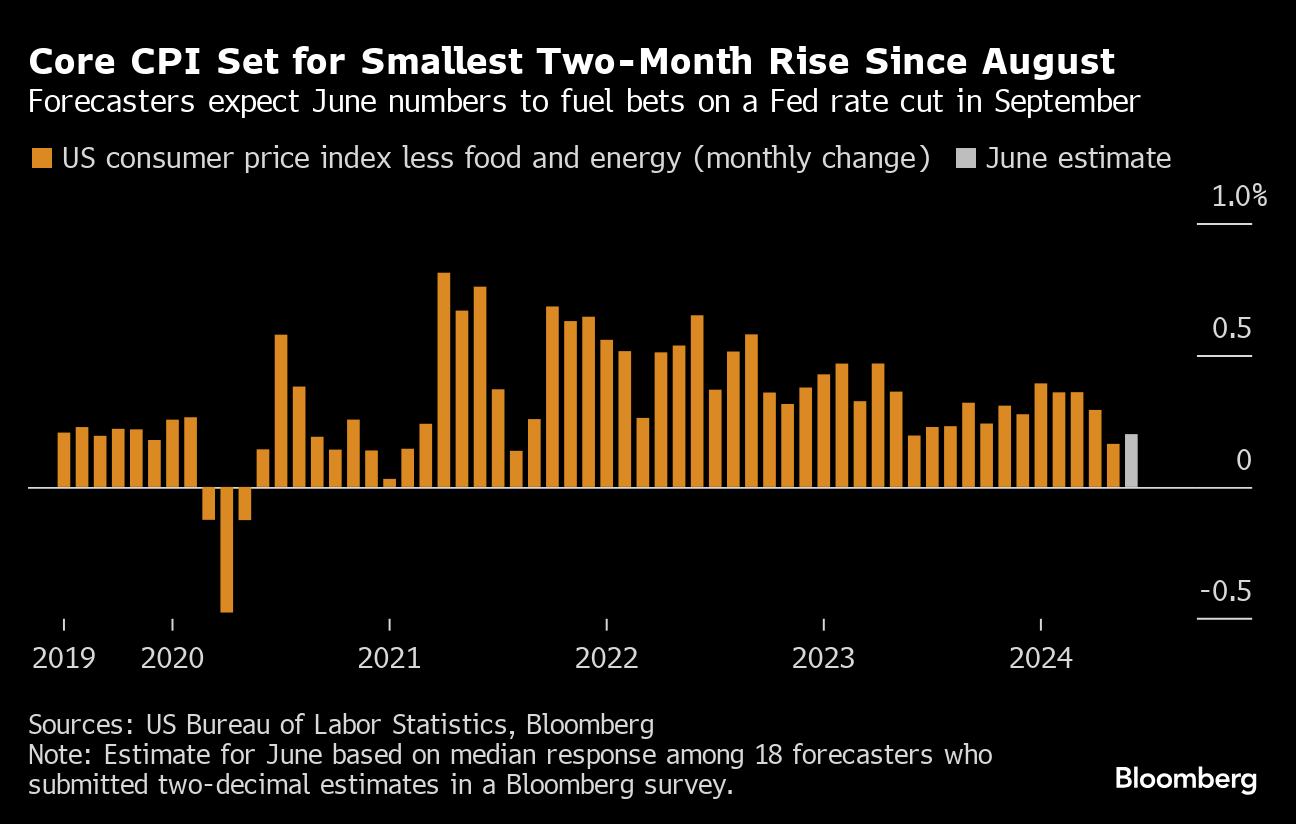
Such an outcome would help solidify expectations in financial markets that the Fed will begin cutting rates at its September policy meeting, marking the first step in unwinding its most aggressive tightening campaign since the early 1980s.
“Bloomberg Economics expects June's CPI report to be a ‘really good' reading, to borrow Fed Chair Jerome Powell's characterization of recent inflation prints,” Bloomberg economists Anna Wong, Chris Collins and Stuart Paul said Wednesday in a preview of the numbers. “That should set the stage for the Fed to start cutting rates in September.”
Here are the key components to watch in the report:
NYC Rents
June probably marked the beginning of an overdue moderation in rent increases, which have been keeping overall monthly inflation readings elevated in 2024. A measure known as owners' equivalent rent, which has a 26.6% weight in the CPI, has risen 0.41% per month so far this year on average, versus 0.27% per month in 2019.
That deceleration would already have turned up in the May data if not for an unusual surge in the New York City metro area, which saw a 1.8% jump in OER — the biggest in 30 years. And because NYC is the largest metro area in the country, that move alone boosted the national OER reading in May by about eight basis points, according to Omair Sharif, president of Inflation Insights.
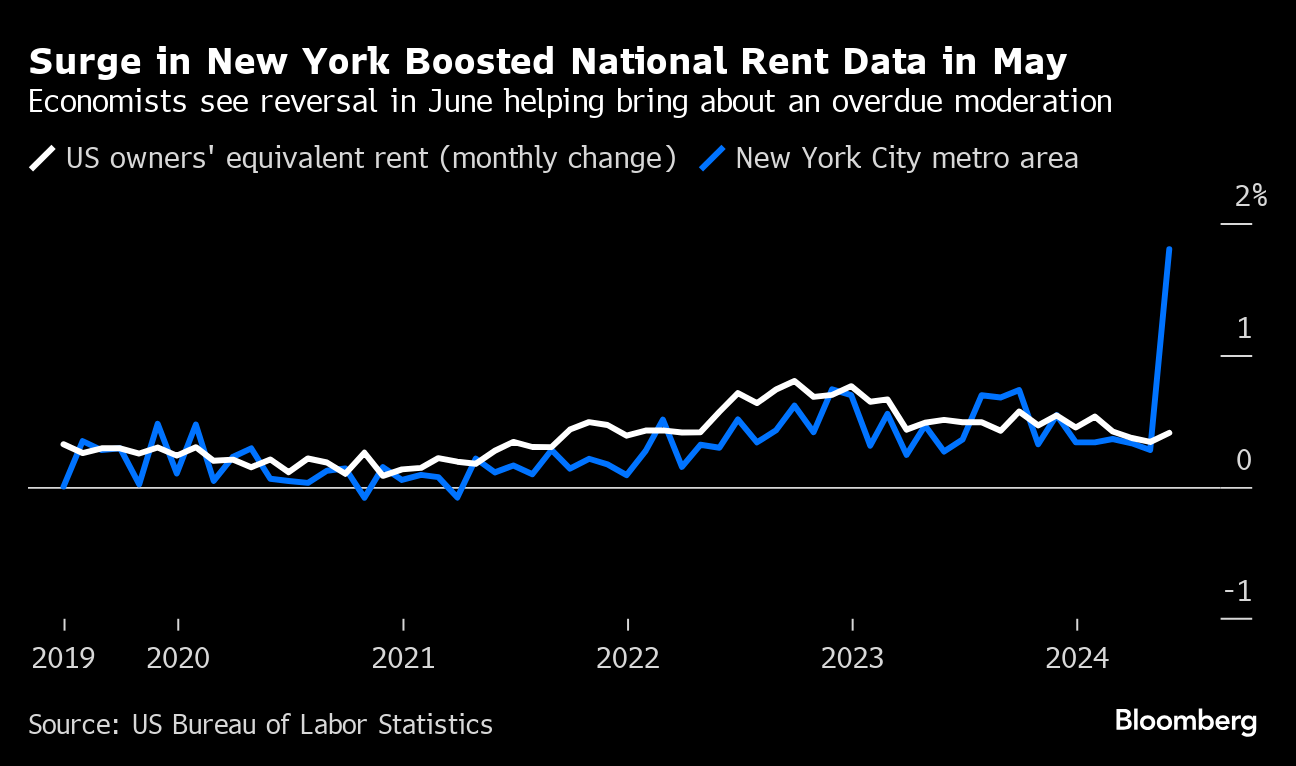
Steve Reed, an economist at the BLS who works on the CPI numbers, attributed the outsize reading to problems they had collecting quotes. He also pointed out that the June data will draw on a different sample of units, which rotates every six months.
“A small number of quotes that we did collect in certain areas wound up sort of having magnified importance, because there were quite a few quotes that we didn't collect,” Reed said. “Essentially it represents noise.”
Used Cars
Following a 16.2% increase between February 2020 and May 2023, core goods prices have posted declines in 11 of the past 12 months. Many forecasters expect them to edge lower again in June, led by used cars—one of the biggest items in the core goods basket.
While most measures of wholesale used car prices that economists use as leading indicators fell in June, a cyberattack affecting dealerships across the country has raised uncertainty about what the CPI numbers may show. Any outsize move would probably be seen as likely to reverse in July.
“If the attack led sales to shift from new car dealerships to used alternatives, this could keep upward pressure on used car prices temporarily despite falling wholesale values,” Citi economists Veronica Clark and Andrew Hollenhorst said in a July 8 note.
“On the other hand, car prices (for both new and used) typically rise in June, with negative seasonal factors offsetting this increase,” they said. “If the attack made dealers unable to update prices (not raise them in line with seasonal patterns), this may result in downside risks to seasonally adjusted prices.”
Auto Insurance
Services prices excluding food, energy and rents—a grouping Fed officials watch closely—fell in May for the first time since 2021, thanks in part to a drop in motor vehicle insurance costs.
Auto insurance has been one of the hottest components of the CPI this year, and many forecasters expect it resumed its upward trajectory in June.
“We think it would be a mistake to make a trend from the last print,” Morgan Stanley economists led by Diego Anzoategui said in a July 5 note.
“Even though we expect disinflation ahead as insurance companies normalize profits, we haven't seen a meaningful slowdown in companies' rate filings. Companies are still asking regulators to increase premiums meaningfully.”
More stories like this are available on bloomberg.com
©2024 Bloomberg L.P.

-
Your iPhone Costs 12 Grams Of Gold, A Car About 100. What Does Your Life Weigh?

Measured in rupees, almost everything looks more expensive than it did a generation ago. Measured in grams of gold, a lot of it has become cheaper.
-
Gold Is Rs 22,000 Cheaper Than A Month Ago. Should You Buy Amid The Wedding Season?
Gold's potential slide to $3,500 could save around Rs 4,700 per 10 grams, but a soft inflation print could just as easily push prices back up. One way to split the risk is to buy in parts, some now and the rest after the Fed's Dec. 9 decision.
-
AI Agents Are Gaining Power. Who Governs Them?
Artificial intelligence agents promise to transform productivity by moving machines from assisting decisions to executing them. But as organisations delegate greater authority to these AI-agents, they must first establish who controls that authority and who remains accountable when things go wrong.
-
Why Swapping Your Old Gold Can Trigger A Rs 5 Lakh Tax Bill, And How You Can Avoid It Legally
Swapping old gold for new is taxed as a sale and a fresh purchase. Getting your own gold remade can cut most of that bill, though it has its own costs.
-
The AI Trade is Done. The Real Opportunity for Investors Starts in 2027 | Unhedged Position
As pureplay AI stocks plunge and circular, capex-led financing unwinds, 2027 is set to be a year of reckoning for AI companies. Yet the bust clears the way for a better opportunity for investors in 2027 -- shifting the spotlight from AI builders to the companies using AI.
-
Leadership As Mission: Why The Age Of AI Demands More Human Leadership
Debjani Ghosh examines how AI is changing leadership, arguing that its success must be measured by its impact on people and the accountability of those guiding its use.
-
We May Need Another Tukaram Mundhe To Fight Air Pollution | The Reason Why
Developers may install basic measures such as sprinklers and green nets, resume work, and continue violating rules when this equipment stops working.
-
Extracting Value From Battery Scrap Could Be Challenging For India | The Reason Why
A discarded lithium-ion battery still contains valuable materials such as lithium, nickel and cobalt. These can be recovered and reused. When such batteries are crushed and shredded, they produce a dark powder called black mass.
-
One El Nino, India Can Handle. Two Could Break The Granary
India's grain stocks can absorb one bad year, but a second El Nino could drain the buffer in two to three years, economists say.
-
India's Troika Of Good Luck | Joining The Dots
As Jensen Huang's exit drags Nvidia down, a cooling AI trade and resilient earnings have revived investor interest in India. A likely RBI rate hike looms.









