US Inflation Tops Forecasts in Blow to Fed Rate-Cut Hopes
(Bloomberg) -- US consumer prices jumped at the start of the year, stalling recent disinflation progress and likely delaying any Federal Reserve interest-rate cuts.
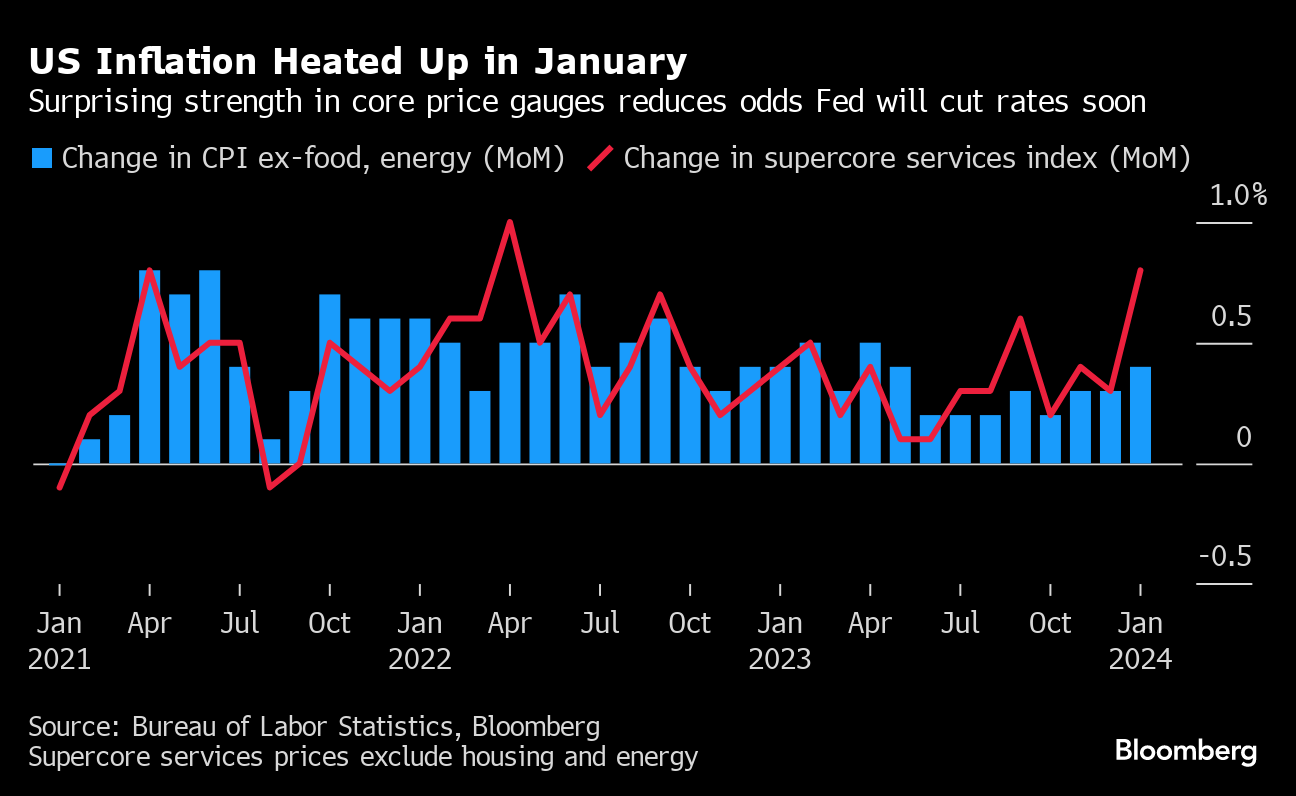
The consumer price index rose by more than forecast across the board in January — on a monthly and annual basis — as did the core measures, which strip out food and energy costs. A key subset of services prices advanced by the most in nearly two years, and shelter costs heated up, government data showed Tuesday.
The figures further reduced already-slim chances that Fed officials will start lowering interest rates soon, and any additional reacceleration risks reigniting talks that they will resume hikes. Some policymakers have said they want to see a broader easing of price pressures before cutting rates.
The S&P 500 fell and Treasury yields jumped after the release from the Bureau of Labor Statistics. Traders pushed out bets of when the Fed will start cutting rates and marked down March odds to almost zero.
Economists have long contended that the path to 2% inflation — which the Fed targets, based on a separate index — would be arduous, and the CPI release suggests it may be longer and bumpier.
Many forecasters still maintain that inflation is broadly on a downward trend, and that the January inflation surprise likely won't translate to the Fed's preferred measure, known as the personal consumption expenditures price index.
Read More: Inflation Jump Seen as Less Pronounced in Fed's Preferred Gauge
“The Fed will view this as another reason to wait until May or June, but the direction of trend is still lower,” said Kathy Jones, Charles Schwab's chief fixed-income strategist. “With much of the increase due to housing, it's a waiting game to see when those costs will come down.”
The figures reflected increases in the price of food, car insurance and medical care, while shelter costs contributed to more than two-thirds of the overall increase. Outpatient hospital services and pet services both posted record monthly advances.
There was, however, some favorable news for American consumers. Prices of used cars dropped on a monthly basis by the most since 1969 after the methodology was updated. Broader goods prices and energy also continued to fall, underscoring policymakers' concerns that the recent disinflation has been concentrated in a few categories.
Last week, the BLS's annual revisions confirmed inflation receded as fast as initially reported at the end of 2023. But new weightings — which are effective as of the latest figures — will place a greater emphasis on services and less on goods, which economists say will slightly boost the outlook for the CPI this year.
Shelter prices, which is the largest category within services, advanced 0.6%, matching the steepest gain since early 2023. Economists see a sustained moderation in this area as key to bringing core inflation down to the Fed's target.
What Bloomberg Economics Says...
“The January CPI report shows it won't be a smooth road to get inflation back to 2%... Our base case is for the Fed to begin cutting rates in May — though if the troubling signs in this report persist, the risk of a later cut rises.”
— Anna Wong and Stuart Paul. To read the full note, click here
Excluding housing and energy, services prices climbed 0.8% from December, the most since April 2022, according to Bloomberg calculations of the measure known as supercore. While policymakers have stressed the importance of looking at such a metric when assessing the nation's inflation trajectory, they compute it based on the PCE index.
The PCE doesn't put as much weight on shelter as the CPI does. That's one reason why it's trending much closer to the Fed's 2% target.
Friday's release of the producer price index will provide more clues, as several categories within that report feed directly into the PCE price calculation. The PCE figures will be released later this month.

Unlike services, a sustained decline in the price of goods over most of the past year has been providing some relief to consumers. So-called core goods prices, which exclude food and energy commodities, fell by the most since July.
Recent comments from large consumer companies suggest price pressures will ease this year.
Coca-Cola Co. said Tuesday that it raised prices 9% in the fourth quarter, more than analysts expected. Much of the increase was driven by what Chief Executive Officer James Quincey called “hyperinflation” in certain regions of the world. He expects prices to moderate this year in most countries. In North America, lower-income shoppers are starting to push back on price hikes and are buying fewer of the company's products.
Burger King owner Restaurant Brands International Inc. also said it expects “a pretty decent step back in the level of pricing across the industry.”
At the same time, cereal maker WK Kellogg Co. is betting that some Americans will continue to shell out for some higher-end products. The company recently launched several new premium brands. In an interview Tuesday, CEO Gary Pilnick said the premium cereal category is performing well because “it's incredibly affordable” as far as meals go.
Fed officials will have access to multiple inflation reports — including one more CPI print — before their next policy meeting on March 19-20. Though Wall Street has been pushing for the central bank to start easing rates, policymakers have indicated they're likely to stay on hold for a fifth straight meeting.
That's in part due to the strength of the US jobs market. A separate report Tuesday showed real earnings advanced by the most since July on an annual basis, extending a months-long streak in which wage growth has modestly outpaced inflation.
--With assistance from Kristy Scheuble, Matthew Boesler, Steve Matthews, Brett Pulley, Deena Shanker and Daniela Sirtori-Cortina.
(Updates with company comments on prices.)
More stories like this are available on bloomberg.com
©2024 Bloomberg L.P.

-
Signature Play: The Classic Cocktail Is Dead. Or Is It?

Classic cocktails are disappearing from India's cocktail menus. But they're still being ordered, taught to bartenders and borrowed from. So, who's really having the last drink?
-
A New Samvat Wishlist: Inclusive Prosperity And Human Development
India has strengthened its economic foundations through infrastructure, digital access and enterprise. Its next growth chapter must deepen productivity, create better livelihoods and widen participation in prosperity.
-
Love, Sex Aur Dhokha: The Audacious Plot To Spy On Jensen Huang
A Taipei dinner, a Singapore chip buyer and a suspected Chinese asset: inside the alleged spy operation that got close to NVIDIA's Jensen Huang.
-
Ten Things I Learnt This Samvat
Patience can be a trap. Cheap stocks can stay cheap. Leverage can wipe you out. What did Samvat 2082 teach us? Niraj Shah writes on 10 lessons from the year gone by.
-
Talking Points This Week: Tech Nerves, FII Buying, And A Faraway Banking Shock
The global markets are not shining this Diwali. The exception in the large markets is, India.
-
Midterm Rally Lasted A Day. The Hard Reality Of A Divided US May Last Two Years | Opinion
Between a contested AI boom, a debt ceiling that arrives in 2027 and a president with every incentive to act alone, the next two years may prove more volatile than the first day's rally suggests.
-
Blue Wave Will Derail the AI Trade but Won't Dismantle the AI Era | Unhedged Position
The Democrats' sweep of the US Congress will see politics collide with economic forces both over the long and short term.
-
It's Time To Take The GST Council's Bet On Trust Global
Payment records can prove India's services exports, and clear, proportionate rules can bring foreign digital sellers into the tax net.
-
Opinion | India at 38: From Innovation Overperformer to Innovation Powerhouse
India now has 453 VC-backed deep science startups, 18 of them late-stage, after 117 percent growth since 2020. Laurus Labs, at USD 9.3 billion, is the most valuable deep science company in any middle-income economy outside China.









