U.S. And India To Co-Produce Armoured Vehicles To Counter China
(Bloomberg) --
The US and India will co-produce Stryker armored vehicles, as the two countries push to counter China's rising military might in Asia.
The announcement, made by a senior US defense official, came during the annual 2+2 ministerial consultations being held between the countries' foreign and defense ministers in New Delhi. Joint development and production of defense equipment especially “ground mobility systems” was prominently mentioned in the joint statement issued after the meeting in New Delhi. The two countries will pursue more such projects in “priority areas,” it said.
The initiative “will strengthen the shared security of our countries by diversifying supply chains and supporting interoperability between our militaries,” US Secretary of Defense Lloyd Austin said Friday in Indian capital.
The vehicles will help India push back against China along their disputed border, while also reducing New Delhi's long-term dependence on Russian weapons. The announcement comes as part of a multi-year effort to strengthen US-India ties through intelligence sharing, technology transfer and bolstered diplomatic ties. It also helps Prime Minister Narendra Modi's bid to expand India's industrial base.
An Indian official, speaking on condition of anonymity, said the majority of the vehicles will be deployed along India's border with China, where tensions have remained high after a clash in 2020 that killed soldiers on both sides. Some of the vehicles will also be deployed along India's border with Pakistan.
New Delhi is seeking thousands of co-produced vehicles, most of which will be armed with anti-tank missile systems. The rest will be used for battlefield surveillance or as command vehicles, the official said.
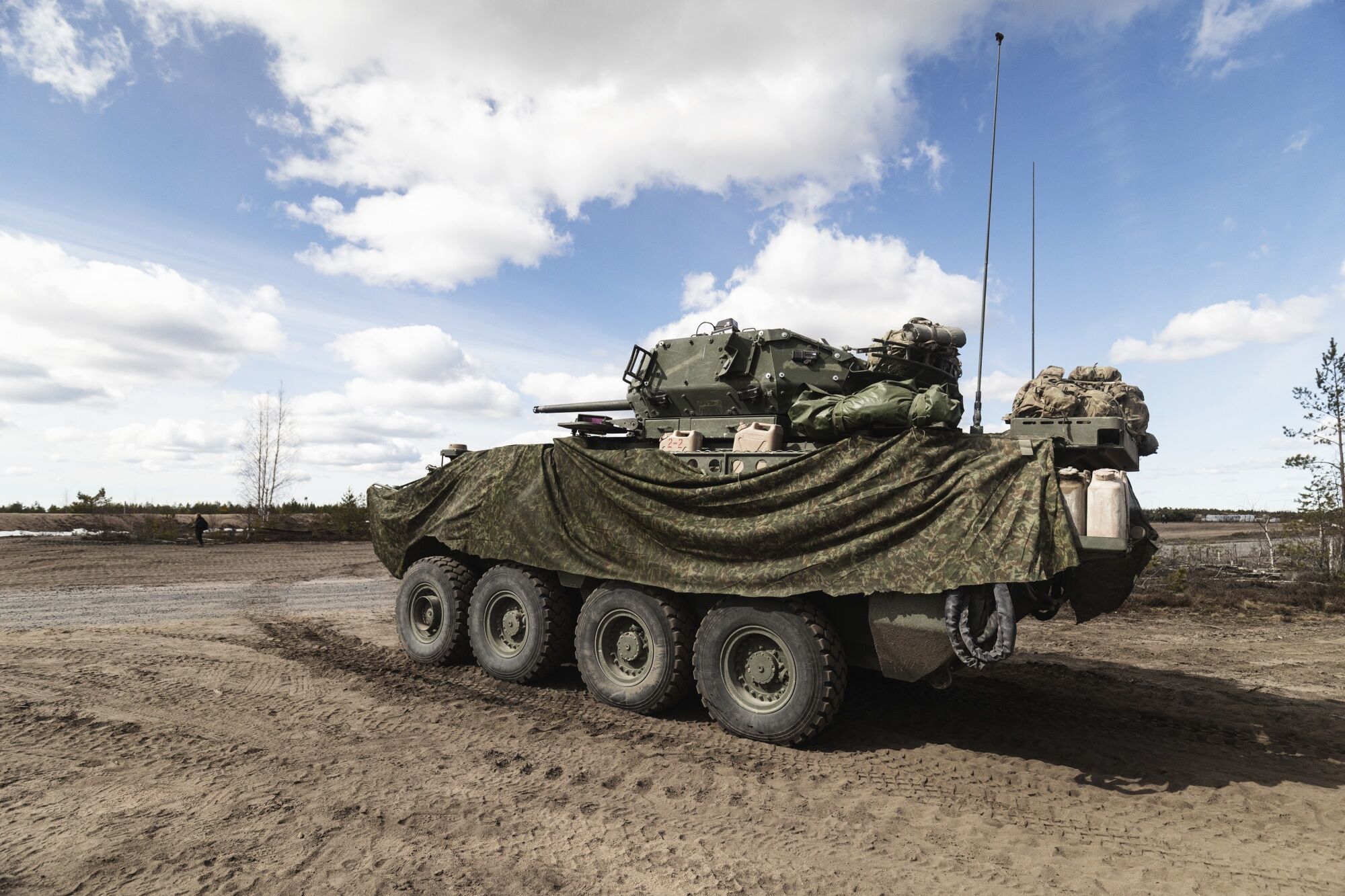
The Stryker, a wheeled combat vehicle produced by General Dynamics Land Systems Inc., is prized by the US Army for its versatility. There are more than two dozen variants, which serve as infantry carriers, reconnaissance platforms, medical and engineering support, among other missions.
The US Army, in recent years, has added a 30mm cannon to the vehicle and worked to integrate directed energy weapons on the Strykers for short-range air defense.
The Biden administration has sent Strykers to Ukraine to aid its defense against Russia, in addition to Bradley fighting vehicles and Abrams tanks.
The US-India partnership has “never been closer,” Eric Garcetti, the US Ambassador to India, told Bloomberg News Friday. “We think this growing partnership can be a force for good as well as a powerful deterrent to bad action.”
In June, during a state visit by Modi to Washington, the two countries pledged to deepen defense-industry ties, including technologies for intelligence, reconnaissance and surveillance, as well as aircraft engines and munitions. As part of that push, the countries are working to streamline regulations, licensing and export controls, and to deepen ties between defense companies.
The US and India also plan to conduct more joint exercises across combatant commands and regions, according to a senior US defense official.
(Adds more detail from joint statement in second paragraph.)
More stories like this are available on bloomberg.com
©2023 Bloomberg L.P.

-
Signature Play: The Classic Cocktail Is Dead. Or Is It?

Classic cocktails are disappearing from India's cocktail menus. But they're still being ordered, taught to bartenders and borrowed from. So, who's really having the last drink?
-
A New Samvat Wishlist: Inclusive Prosperity And Human Development
India has strengthened its economic foundations through infrastructure, digital access and enterprise. Its next growth chapter must deepen productivity, create better livelihoods and widen participation in prosperity.
-
Love, Sex Aur Dhokha: The Audacious Plot To Spy On Jensen Huang
A Taipei dinner, a Singapore chip buyer and a suspected Chinese asset: inside the alleged spy operation that got close to NVIDIA's Jensen Huang.
-
Ten Things I Learnt This Samvat
Patience can be a trap. Cheap stocks can stay cheap. Leverage can wipe you out. What did Samvat 2082 teach us? Niraj Shah writes on 10 lessons from the year gone by.
-
Talking Points This Week: Tech Nerves, FII Buying, And A Faraway Banking Shock
The global markets are not shining this Diwali. The exception in the large markets is, India.
-
Midterm Rally Lasted A Day. The Hard Reality Of A Divided US May Last Two Years | Opinion
Between a contested AI boom, a debt ceiling that arrives in 2027 and a president with every incentive to act alone, the next two years may prove more volatile than the first day's rally suggests.
-
Blue Wave Will Derail the AI Trade but Won't Dismantle the AI Era | Unhedged Position
The Democrats' sweep of the US Congress will see politics collide with economic forces both over the long and short term.
-
It's Time To Take The GST Council's Bet On Trust Global
Payment records can prove India's services exports, and clear, proportionate rules can bring foreign digital sellers into the tax net.
-
Opinion | India at 38: From Innovation Overperformer to Innovation Powerhouse
India now has 453 VC-backed deep science startups, 18 of them late-stage, after 117 percent growth since 2020. Laurus Labs, at USD 9.3 billion, is the most valuable deep science company in any middle-income economy outside China.









