Russian Drones Hit Danube Port Key to Ukraine Grain Exports

(Bloomberg) -- Russian drones struck a Ukrainian port on the Danube River, driving global wheat and corn prices higher as Moscow continues its campaign to cripple Kyiv's ability to export food.
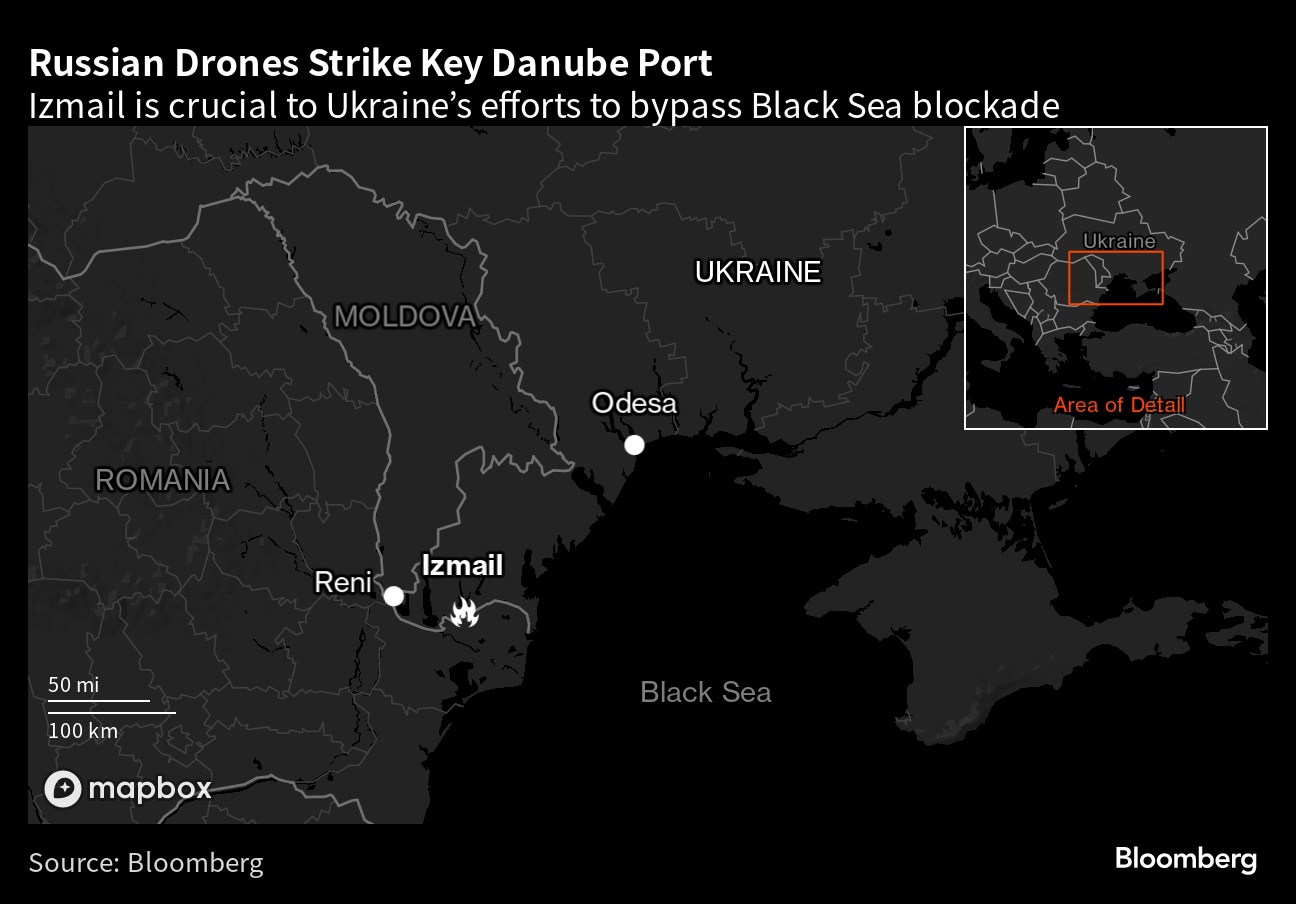
The attack damaged grain storage facilities, a fuel tank and administrative buildings in the Odesa region in southwestern Ukraine, the country's prosecutor's office said Wednesday. Government and industry officials with knowledge of the situation said it hit Izmail, one of Ukraine's biggest river terminals near the border with Romania, although the head of the port said it was still operating.
“Russian terrorists again were attacking ports, grain, global food security,” Ukrainian President Volodymyr Zelenskiy said on Telegram. “The world has to react. When civilian ports are targets, when terrorists deliberately destroy even silos — this is a threat to everyone on all continents.”
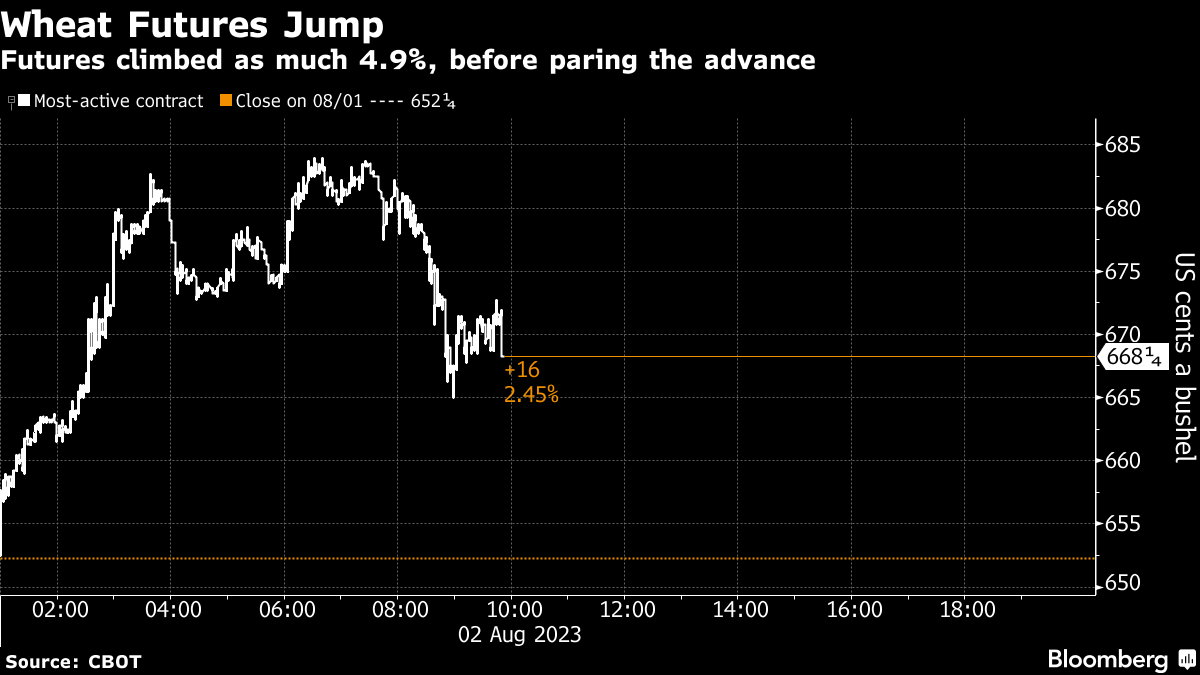
The price of wheat futures trading in Chicago jumped as much as 4.9%, the biggest intraday gain in a week, before retreating. Corn futures also rose.
Russian President Vladimir Putin is coming under intensifying international pressure to return to negotiations to resume a deal that allowed Ukraine to export grain through a safe corridor on the Black Sea.
Instead, he has stepped up attacks on Danube ports. Last month his forces hit Reni, which along with Izmail and Ust-Dunaisk are increasingly important to Ukraine's attempt to circumvent the Russian blockade by sending grain via the Danube to be shipped from Romanian territorial waters.
Izmail port manager Serhiy Tkachenko said the port was still operating. According to Bilal Muftuoglu at shipbroker Howe Robinson, charterers were still looking for vessels from Izmail and Reni Wednesday morning to carry grains to European countries including Spain and Italy, and ships were still arriving and leaving from those ports during the morning.
The strikes, nevertheless, appear to be having a deterrent effect with only three large ships reaching Ukrainian ports Tuesday, even as smaller vessels and barges continue to make their way up the Danube river, according to a transport industry official.
Dozens of ships are now waiting in Romanian waters and only smaller vessels and barges are approaching the ports to load grains and fuel through the Romanian Danube channels, the person said. Ukraine's Infrastructure Ministry and Romania's Defense Ministry declined to comment.
Romanian President Klaus Iohannis condemned the attacks as a “war crime,” saying they undercut the supply of food to the world's most needy.
Putin has defended Russia's withdrawal from the Black Sea deal, blaming Western countries for the global food “crisis” and accusing them of “obstructing” Russia's agricultural exports even as it's shipping record volumes of wheat and fertilizer deliveries are recovering to pre-war levels.
The was has had repercussions in the so-called Global South, where developing nations that depend on grain shipped via the Black Sea have suffered from a spike in food prices.
Turkish President Recep Tayyip Erdogan underscored the importance of the Black Sea deal in a phone call with Putin on Wednesday, calling it a “bridge of peace.” He said the long-term shutdown of the arrangement didn't benefit anyone, according to a statement from his office.
South African Foreign Minister Naledi Pandor said Tuesday that his country was trying to persuade Russia to return to talks on the deal. Her Japanese counterpart, Yoshimasa Hayashi, said Japan “deplores” Russia's halting the initiative and hopes to work for its resumption.
--With assistance from Áine Quinn, Andra Timu, Greg Sullivan, Ugur Yilmaz and Slav Okov.
(Updates with port manager in seventh paragraph, Erdogan in 13th.)
More stories like this are available on bloomberg.com
©2023 Bloomberg L.P.

-
Signature Play: The Classic Cocktail Is Dead. Or Is It?

Classic cocktails are disappearing from India's cocktail menus. But they're still being ordered, taught to bartenders and borrowed from. So, who's really having the last drink?
-
A New Samvat Wishlist: Inclusive Prosperity And Human Development
India has strengthened its economic foundations through infrastructure, digital access and enterprise. Its next growth chapter must deepen productivity, create better livelihoods and widen participation in prosperity.
-
Love, Sex Aur Dhokha: The Audacious Plot To Spy On Jensen Huang
A Taipei dinner, a Singapore chip buyer and a suspected Chinese asset: inside the alleged spy operation that got close to NVIDIA's Jensen Huang.
-
Ten Things I Learnt This Samvat
Patience can be a trap. Cheap stocks can stay cheap. Leverage can wipe you out. What did Samvat 2082 teach us? Niraj Shah writes on 10 lessons from the year gone by.
-
Talking Points This Week: Tech Nerves, FII Buying, And A Faraway Banking Shock
The global markets are not shining this Diwali. The exception in the large markets is, India.
-
Midterm Rally Lasted A Day. The Hard Reality Of A Divided US May Last Two Years | Opinion
Between a contested AI boom, a debt ceiling that arrives in 2027 and a president with every incentive to act alone, the next two years may prove more volatile than the first day's rally suggests.
-
Blue Wave Will Derail the AI Trade but Won't Dismantle the AI Era | Unhedged Position
The Democrats' sweep of the US Congress will see politics collide with economic forces both over the long and short term.
-
It's Time To Take The GST Council's Bet On Trust Global
Payment records can prove India's services exports, and clear, proportionate rules can bring foreign digital sellers into the tax net.
-
Opinion | India at 38: From Innovation Overperformer to Innovation Powerhouse
India now has 453 VC-backed deep science startups, 18 of them late-stage, after 117 percent growth since 2020. Laurus Labs, at USD 9.3 billion, is the most valuable deep science company in any middle-income economy outside China.









