UK Seeks To Scare Off Migrants With Plan To House Them On Barge
(Bloomberg) -- The UK government contracted its first accommodation vessel to house asylum-seekers as Prime Minister Rishi Sunak pursues plans to cut the number of people crossing the English Channel illegally.
The Bibby Stockholm barge can house 500 migrants and will be “significantly” cheaper than current arrangements using hotels, the Home Office said on Wednesday in an emailed statement. It will be moored in Portland, southwest England, it said, adding that officials are looking to hire more vessels for the same purpose.
Facing a backlog of tens of thousands of asylum-seekers who need to be processed, the government is trying to bear down on the cost to taxpayers of housing them in hotels, which it puts at about £7 million ($8.7 million) a day.
Nevertheless, the main rationale for housing migrants on vessels is to deter people from crossing the channel in the first place rather than speed up the processing of backlogged asylum applications, current and former Home Office officials said.
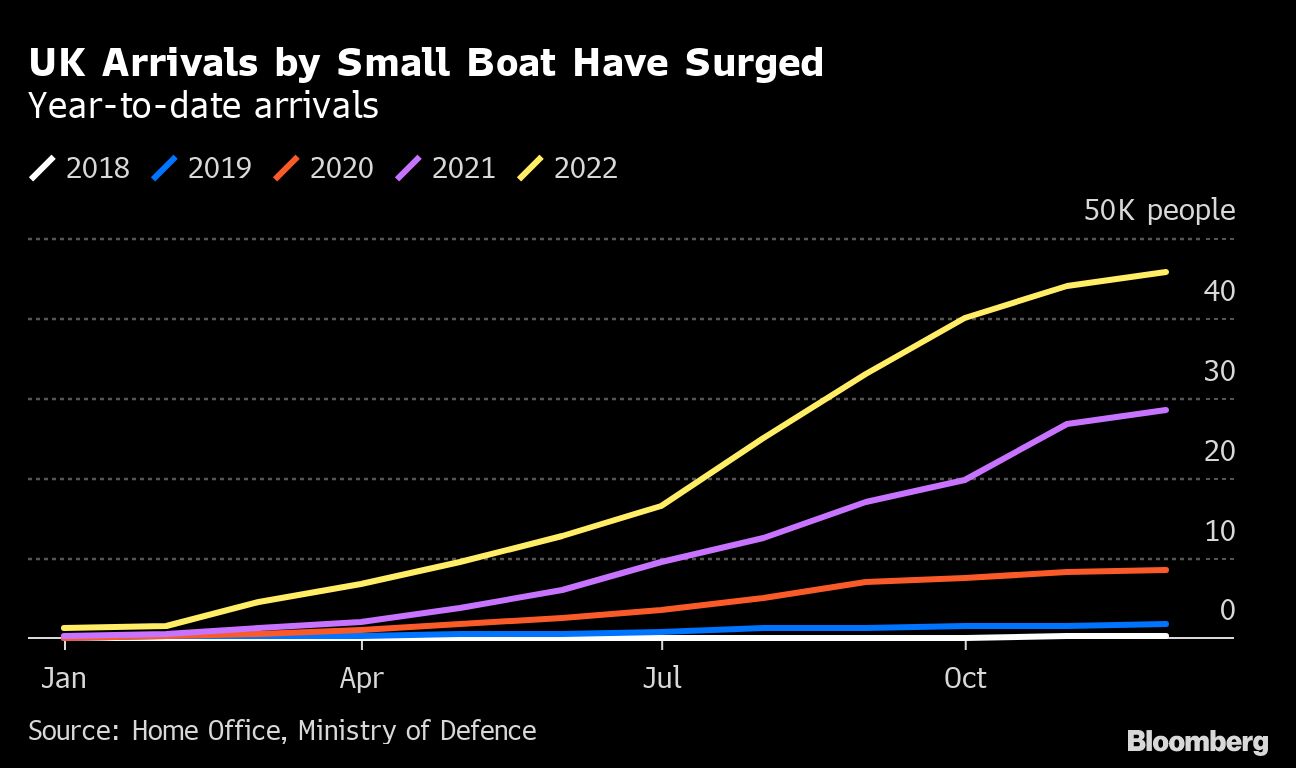
Prime Minister Rishi Sunak has bet that a hard-line approach to illegal immigration will see a significant fall in the number of people crossing the English Channel this year. That includes sending people to Rwanda who arrive in the UK illegally and banning them from ever claiming asylum or citizenship in Britain.
Asylum Backlog
Sunak and Braverman's strategy is that political controversy generated will create news stories that have the effect of deterring people from crossing the Channel in the first place, according to people familiar with the matter. For the gamble to succeed, it can't be seen as an empty threat, according to the officials, who requested anonymity discussing internal government thinking.
The barge will provide “basic and functional” accommodation, as well as health care, catering, and all-day security, the Home Office said.
“All accommodation will meet our legal obligations and we will work closely with the local community to address their concerns, including through financial support,” Immigration Minister Robert Jenrick said in the statement. “The use of expensive hotels to house those making unnecessary and dangerous journeys must stop. We will not elevate the interests of illegal migrants over the British people we are elected to serve.”
But there is no prospect that the barge plan in itself will significantly reduce either the number of asylum seekers residing in the UK or the price of housing them, the officials said. Home Office figures figures published last month showed 160,919 people were waiting for decisions on their asylum claims at the end of 2022, an increase of 60% on 2021.

Some 45,755 people crossed the English Channel in small boats last year, leading Sunak to make a vow to “stop the boats” one of his key pledges to British voters.
Unworkable
A similar proposal had previously been rejected by former Prime Minister Boris Johnson's government as unworkable due to exorbitant costs, safety and security concerns, and the impracticality of procuring enough vessels to house migrants in significant numbers.
A concern was that asylum seekers kept on the vessels for long periods would jump overboard in an attempt to make it to the shore, one of the people said.
It is therefore similar to the plan to put Channel migrants on planes to Rwanda, one of the people said. Even if only one Rwanda flight takes place or just one barge is procured, the possibility of ending up in that situation will convince many not to attempt the journey to England, they suggested.
Government officials pointed to statistics suggesting the number of Albanians trying to cross the Channel had fallen in the first three months of 2023. That followed a deal struck in December with the Albanian government to facilitate returns.
Tory Opponents
The strategy also invites the Labour opposition to argue against the government, allowing the Conservatives to make the case to voters that their opponents would take a softer approach.
However, some current and former officials are skeptical the plan will work, saying large numbers of people will still risk the journey as the likelihood of being put on a barge or a plane to Rwanda currently remained slim.
The policy is also garnering opposition from some local lawmakers on the right of Sunak's Tory party, who Downing Street may have assumed would support their tough approach.
Richard Drax, Member of Parliament for the South Dorset constituency that would accommodate the barge, told Sky News he had consulted lawyers in a bid to block the plan, adding he hoped to see it “consigned to the dustbin.”
--With assistance from Joe Mayes.
More stories like this are available on bloomberg.com
©2023 Bloomberg L.P.

-
The Economic Imperative: Analysing The Material Driving Force Behind India-Canada Strategic Reset

This economic complementarity is further reinforced by deep institutional investment ties and talent mobility, which form the bedrock of the bilateral framework.
-
Medicine Pricing: Where Must Profit Stop?
India must confront excessive margins, hidden incentives and regulatory gaps that threaten the integrity of medicine.
-
Why Amazon And Flipkart Are Struggling To Beat Meesho In India's Smaller Cities
With 274 million users and lowest-cost logistics, Meesho is defending its value commerce crown against giants like Amazon and Flipkart.
-
High US Salaries, No Green Card Certainty: The Financial Calculation Facing Indian H-1B Families
The suspension of PERM processing at eight technology employers does not cancel existing H-1B visas. What it does is force a question many Indian families have been avoiding: is the US salary worth tying your career and family plans to one employer?
-
Swiggy vs Eternal: Food Delivery's Two Rivals Are No Longer In The Same Race
Eternal is building a private AI assistant, dark.ai. Swiggy is still working out how to make Instamart pay, with an operating loss of Rs 895 crore in the July-September quarter while Blinkit stayed profitable.
-
Where You Live Shapes How You Get To Work | The Reason Why
Two-wheelers are the most popular way to get to work in India, accounting for nearly 43% of workplace commutes.
-
Unhedged Position: Can India See An Indonesia-Style Time Correction?
The Nifty is trading below levels it first clocked in 2024. Is there, then, as I have suggested in the headline, potential that the current time correction drags on painfully for the next three-five, even ten years?
-
Navigating Friction And Energy Realities: An Analysis Of Marco Rubio's October Visit To India
Occurring at a critical juncture marked by stalled trade negotiations and escalating geopolitical pressures over global energy supplies, the visit offers a profound window into modern US-India relations.
-
India Exports Capital. Why Not Export Trusteeship?
The big question, then, is whether India can build an institution that global borrowers, investors, banks, and lawyers can trust, even without an Indian connection.
-
France's Economy & Politics Are In Crisis | The Reason Why
Let's look at how the French economy and politics evolved under Nicolas Sarkozy, Franois Hollande and Emmanuel Macron.










