Trump Warns Of Tariff ‘Disturbance’ As He Defends Economic Plans
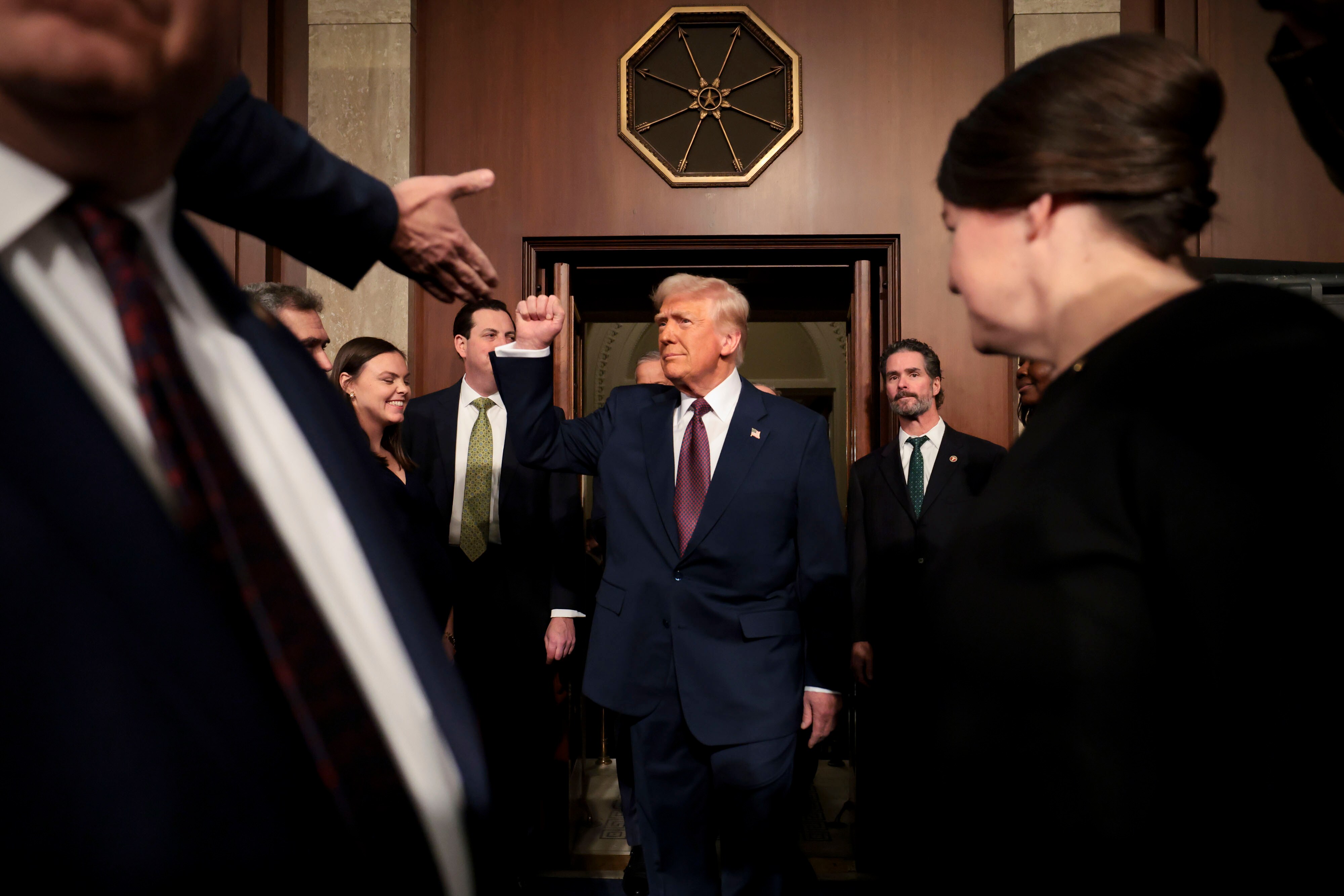
President Donald Trump acknowledged that there may be an “adjustment period” as his sweeping tariffs take effect but sought to defend his push to remake the US economy in a primetime address to a joint session of Congress on Tuesday night, arguing that despite economic headwinds the nation's “momentum is back.”
“Tariffs are about making America rich again and making America great again. And it's happening, and it will happen rather quickly,” Trump said. “There'll be a little disturbance, but we're okay with that. It won't be much.”
Trump's speech comes at a pivotal moment, with data showing new strains on the economy as factory activity stagnates, inflation simmers, consumer confidence ebbs, and stocks lag behind equity markets in other countries.
Stocks swung wildly Tuesday following Trump's most recent tariff actions against the US's largest trading partners, with the S&P 500 Index closing at its lowest level since before the president's election last year. Commerce Secretary Howard Lutnick hinted the administration might announce a pathway for tariff relief for goods from Mexico and Canada — two of the countries hit — that are covered by a free trade agreement as soon as tomorrow.
But Trump used the address to defend his use of tariffs and unveil new projects, including a new natural gas pipeline and efforts to ramp up production of critical minerals and rare earths, that he argues will bolster domestic industries. Trump touted the pipeline as “among the largest in the world,” and said countries including Japan and South Korea would partner on the initiative “with investments of trillions of dollars each.”
Similarly, Trump argued he's taking steps to address persistent consumer concerns — from egg prices to energy costs — while expanding critical industries. He argued that his administration inherited what he cast as “an inflation nightmare” from his predecessor Joe Biden and that his policies were already helping the economy rebound.

(Photographer: Win McNamee/Bloomberg)
Still, Trump's speech was dominated by both red meat for the social conservatives who bolstered his comeback political bid and protests from Democratic lawmakers seeking to highlight the consequences of Trump's swift executive actions.
Early in his remarks, the president was repeatedly interrupted by Democratic Representative Al Green of Texas. Speaker Mike Johnson called for Green, who has already called for impeaching Trump, to show decorum and sit down. When the Democrat refused, Johnson had the House Sergeant at Arms remove him from the chamber.
“I look at the Democrats in front of me, and I realise there is absolutely nothing I can say to make them happy, or to make them stand or smile,” Trump said.
Even as Trump highlighted his economic agenda, he touted many of his moves on the cultural issues that have animated his base. Those included his efforts to restrict diversity, equity and inclusion initiatives, a directive for the government to recognise only two genders, a ban on men playing in women's sports targeted at transgender athletes, as well as his move to rename the Gulf of Mexico as the Gulf of America. First lady Melania Trump's guests included a former high school volleyball player injured in a game with a transgender athlete, and family of Laken Riley, a student killed by an undocumented migrant.
Georgia Representative Marjorie Taylor Greene, one of Trump's staunchest allies, wore a red hat which read “Trump was right about everything,” and the president took the stage to chants of “USA.” Democrats remained seated during the rest of Trump's remarks, with some holding signs that read “Musk Steals” — a reference to billionaire Trump adviser Elon Musk — and “False.”

(Photographer: Alexander Drago/Bloomberg)
The pivotal question is which will resonate more for voters, and the lawmakers who represent them. The president spoke just hours after hitting top trading partners Canada and Mexico with 25% tariffs, and doubling levies on the world's second largest economy China to 20% — moves which risk exacerbating economic pressures.
Trump reiterated his threat to impose 25% tariffs on aluminum and steel and to put in place reciprocal tariffs on all countries with barriers to American imports, saying that the US had been “ripped off for decades by nearly every country on Earth, and we will not let that happen any longer.”
“Whatever they tariff us, we tariff them,” Trump said. “Whatever they tax us, we tax them. If they do non-monetary tariffs to keep us out of their market, then we do non-monetary barriers to keep them out of our market.”
Trump touted his tariff moves as more effective at bringing jobs to the US than Biden's efforts, which included the Chips and Science Act and its billions in subsidies and incentives to spur domestic semiconductor manufacturing. Trump urged lawmakers to eliminate the Chips Act and said he would not give chipmakers any more funds from the law.
He said he had spoken to the heads of the three largest US automakers Tuesday before his speech. Car companies are particularly concerned that the tariffs on Mexican and Canadian goods could ratchet up prices even on vehicles assembled in the US.

(Photographer: Alexander Drago/Bloomberg)
In his second term, Trump has moved rapidly to implement his policies with a slew of executive actions that are reshaping the US government and its economic and security ties with the world.
The president is poised to lay out plans to end the war in Ukraine days after a public bust-up with Ukrainian counterpart Volodymyr Zelenskyy that stunned allies. Trump is pressuring the war-ravaged country to agree to a peace deal with Russia.
Zelenskyy was in Washington last week to sign a deal allowing the US to benefit from developing Ukraine's natural resources, which Trump has cast as necessary to repay US taxpayers for their support and to lay the groundwork for ending the conflict. US officials were rushing to revive the deal, with the goal of Trump announcing an agreement as soon Tuesday's speech, people familiar with the matter said.
Musk's DOGE Cuts
Musk, who is overseeing an effort to slash the federal government's workforce and spending through the Department of Government Efficiency, was in the chamber and received a standing ovation from Republicans.
Those moves have sparked consternation throughout Washington and concerns even from some Republicans over its scope. Democrats will also highlight the effort, with some lawmakers inviting former government workers who lost their jobs.
Trump gave a lengthy list of government programs and grants he cast as examples of waste, and reiterated previous claims - since walked back by other government officials - suggesting that Social Security was providing benefits to those hundreds of years old. Democrats frequently interjected to jeer the claims.
Trump's appearance before Congress also presents a crucial opportunity to press Republicans on legislative action. Republicans are grappling with how to extend expiring tax cuts from Trump's first term, approve additional benefits he promised during the campaign, and his calls to balance the budget.
“I'm calling for no tax on tips, no tax on overtime and no tax on Social Security benefits for our great seniors,” Trump said.
Trump will say that he's transmitting a “detailed funding request” seeking additional resources to carry out his ramped up deportations of undocumented migrants and to complete his signature border wall that he wants lawmakers to immediately approve.

(Photographer: Alexander Drago/Bloomberg)
Trump is also expected to discuss the Israel-Hamas War after a six-week truce ended with both sides still divided over how to move toward an open-ended halt to the fighting. Trump's role as a broker, though, has been hampered by his proposal for the US to redevelop Gaza into a Middle Eastern “Riviera.”

-
Foreign Investors Own Half Of HDFC Bank and ICICI Bank. An LTCG Cut Could Matter Most Here

Foreign portfolio investors have US$115 billion parked in HDFC Bank, ICICI Bank. If the government cuts long-term capital gains tax, Jefferies says returning foreign money could land here first.
-
'Never Seen This Level Of Negativity': Sandeep Tandon Says The Next Rally May Be Closer Than You Think
Veteran investor Sandeep Tandon says foreign selling is easing, large-caps are due a comeback and mid-caps are crowded, while he turns positive on gold, power and pharma this Diwali.
-
Indians Stay With Family, Not In Hotels | The Reason Why
India still lacks enough clean, reliable and affordable hotels for budget-conscious travellers.
-
The Economic Imperative: Analysing The Material Driving Force Behind India-Canada Strategic Reset
This economic complementarity is further reinforced by deep institutional investment ties and talent mobility, which form the bedrock of the bilateral framework.
-
Medicine Pricing: Where Must Profit Stop?
India must confront excessive margins, hidden incentives and regulatory gaps that threaten the integrity of medicine.
-
Why Amazon And Flipkart Are Struggling To Beat Meesho In India's Smaller Cities
With 274 million users and lowest-cost logistics, Meesho is defending its value commerce crown against giants like Amazon and Flipkart.
-
High US Salaries, No Green Card Certainty: The Financial Calculation Facing Indian H-1B Families
The suspension of PERM processing at eight technology employers does not cancel existing H-1B visas. What it does is force a question many Indian families have been avoiding: is the US salary worth tying your career and family plans to one employer?
-
Swiggy vs Eternal: Food Delivery's Two Rivals Are No Longer In The Same Race
Eternal is building a private AI assistant, dark.ai. Swiggy is still working out how to make Instamart pay, with an operating loss of Rs 895 crore in the July-September quarter while Blinkit stayed profitable.
-
Where You Live Shapes How You Get To Work | The Reason Why
Two-wheelers are the most popular way to get to work in India, accounting for nearly 43% of workplace commutes.
-
Unhedged Position: Can India See An Indonesia-Style Time Correction?
The Nifty is trading below levels it first clocked in 2024. Is there, then, as I have suggested in the headline, potential that the current time correction drags on painfully for the next three-five, even ten years?










