The Economy Under Modi: Gains, Self-Inflicted Pains, And A Dash Of Luck
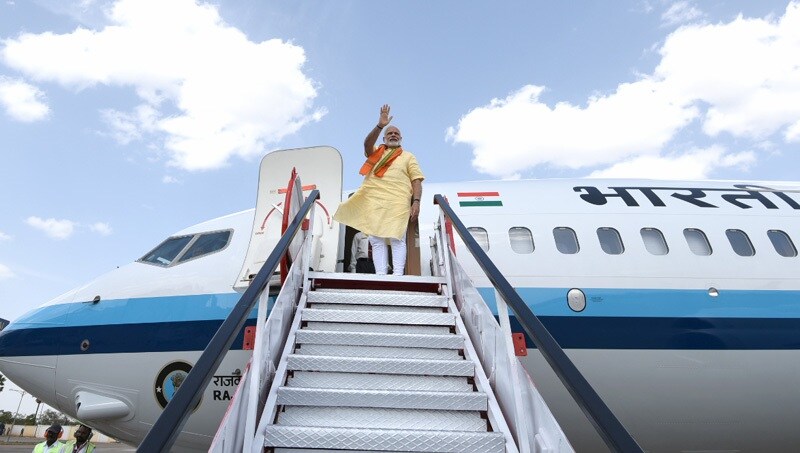
The Narendra Modi led government completes four years in power this week. The four years have brought good economic luck, some prudent policies but also a few instances of self-inflicted pain. As it enters the final year of the current term, the government finds itself facing some tough economic and policy choices. How it manages this final year may determine the Modi government's economic scorecard.
Growth: Self-Inflicted Pain
Growth in the Indian economy saw a peak of 9 percent and a trough of 5.7 percent during the four Modi years.
Over the last four years, growth has been supported by strong private consumption in the economy and heavy government spending. Private investment, however, has remained weak.
While this is primarily due to the prevailing excess capacity, it is also true that the government's attempts to kick-start the investment cycle through schemes like ‘Make In India' have not yet shown significant results. Attempts to revive stalled projects, too, have been partially successful at best.
The last eighteen months have seen the economy deal with the twin shocks of demonetisation and the Goods and Services Tax. Demonetisation led to a shortage of cash between November 2016 and March 2017, impacting transactions. GST, too, has led to volatility in growth. With the effect of both those disruptive policies waning, growth in the economy is seen reviving to near 7.5 percent in the current financial year.

Also Read: Here's How India's Economy Is Faring After Four Years Under Modi
Inflation: Some Real Gains
The Indian economy has seen a period of declining and stable inflation over the four years that the Modi government has been in power. A significant part of this good run on inflation is attributable to the low oil prices that have persisted for the most part of this government's tenure. However, the government has also followed prudent policies on minimum support price increases, which has helped keep food inflation in check.
The Modi government's tenure has also seen India adopt inflation targeting and move to a monetary policy committee driven framework. Both those changes have raised India's credibility in the eyes of foreign investors, particularly fixed income investors.
The new framework is facing its first test in the current year, as inflation rises due to a surge in oil prices and stronger domestic demand.

Fiscal Management: Prudent...Till Now.
The BJP government has followed prudent fiscal policies for the most part. The government has stayed away from any large handouts to boost the economy when it appeared that growth was faltering.
It has reduced the fiscal deficit to below 4 percent and was originally targeting a deficit of 3.2 percent for FY18. However, volatility in GST revenues and significant revenue spending meant that the government breached its fiscal deficit target in FY18. The fiscal deficit settled at 3.5 percent of GDP last year.
That target is already facing pressure from higher oil prices, which could increase the subsidy burden and also force the government to pare down the excise duties it has been collecting on oil products.
Importantly, the government has also pushed back the target of bringing down the fiscal deficit to 3 percent of GDP to 2020-21.

External Sector: Missing The Export Bus
India has failed to make any significant progress on pushing exports as a lever of growth. With export growth remaining moderate and import growth volatile on account of items like oil, India's trade deficit has gyrated over the past four years.
India's exports grew 9.8 percent in the 12 months ended March 2018, after a growth of 5.2 percent in the 2016-17. This, is at a time when global demand has been strong. According to the World Trade Organization, global trade grew at its strongest pace in six years in 2017 at 4.7 percent.
Export growth has remained in single digits and well below the growth seen in FY11 and FY12.
It is also worth mentioning that the dollar value of exports remains at close to $300 billion. Indian exports have been oscillating close to that mark since FY12 now.
As the government enters its final year, the specter of a wide current account deficit, which is not adequately covered by capital flows has re-emerged. This, in turn, is pushing the Indian currency back towards record lows.

Manufacturing And Jobs: No Real Answers
One of the promises of the Modi government was that it would help create 100 million jobs through a focus on manufacturing. It hoped to increase the share of manufacturing to 25 percent of GDP.
The debate over whether job creation has been strong in the four years of the Modi government has been a polarised one. India has no single indicator of employment and the available metrics throw up different outcomes. Recently, the Indian government released provident fund data, which, it said, showed that 31 lakh jobs were created in the six months between September 2017 and February 2018 alone. The data, according to NITI Aayog chief Rajiv Kumar, dispels concerns that the Indian economy is witnessing jobless growth.
The government's contention met with some skepticism from those who believe that the Employee Provident Fund Organisation data is more a reflection of the extent of formal jobs in the economy rather than new jobs created.
The question of adequate and appropriate job creation, hence, remains an open one. However, what is clear is that the attempt to push up the share of manufacturing in the economy has failed to see much traction. At last count, the share of manufacturing remained largely unchanged over the four year period at under 18 percent.


-
We May Need Another Tukaram Mundhe To Fight Air Pollution | The Reason Why

Developers may install basic measures such as sprinklers and green nets, resume work, and continue violating rules when this equipment stops working.
-
Extracting Value From Battery Scrap Could Be Challenging For India | The Reason Why
A discarded lithium-ion battery still contains valuable materials such as lithium, nickel and cobalt. These can be recovered and reused. When such batteries are crushed and shredded, they produce a dark powder called black mass.
-
One El Nino, India Can Handle. Two Could Break The Granary
India's grain stocks can absorb one bad year, but a second El Nino could drain the buffer in two to three years, economists say.
-
India's Troika Of Good Luck | Joining The Dots
As Jensen Huang's exit drags Nvidia down, a cooling AI trade and resilient earnings have revived investor interest in India. A likely RBI rate hike looms.
-
Talking Points This Week: Leadership Shock At Nvidia, Earnings Strength, And The Fog Over Hormuz
The Anthropic IPO pricing and first trading day, Nvidia's upcoming earnings, and any fresh signals from Iran will set the tone for the following week.
-
Signature Play: The Classic Cocktail Is Dead. Or Is It?
Classic cocktails are disappearing from India's cocktail menus. But they're still being ordered, taught to bartenders and borrowed from. So, who's really having the last drink?
-
A New Samvat Wishlist: Inclusive Prosperity And Human Development
India has strengthened its economic foundations through infrastructure, digital access and enterprise. Its next growth chapter must deepen productivity, create better livelihoods and widen participation in prosperity.
-
Love, Sex Aur Dhokha: The Audacious Plot To Spy On Jensen Huang
A Taipei dinner, a Singapore chip buyer and a suspected Chinese asset: inside the alleged spy operation that got close to NVIDIA's Jensen Huang.
-
Ten Things I Learnt This Samvat
Patience can be a trap. Cheap stocks can stay cheap. Leverage can wipe you out. What did Samvat 2082 teach us? Niraj Shah writes on 10 lessons from the year gone by.
-
Talking Points This Week: Tech Nerves, FII Buying, And A Faraway Banking Shock
The global markets are not shining this Diwali. The exception in the large markets is, India.









