How Do You End Sri Lanka’s Crisis? Ask The Bond Market

(Bloomberg Opinion) -- Sri Lanka is only about a quarter of the way to meeting its commitments to the International Monetary Fund, but the results of reform are already beginning to show in the bond market. The big missing piece is restructuring of domestic liabilities.
Delaying the inevitable haircuts for local banks any further will prolong the uncertainty about their capital adequacy and make depositors worry about the safety of their money. The time to take the pain is now, provided external creditors also agree to do the same. And for that, Beijing, the largest bilateral lender, must be willing to come to the negotiating table. India, Japan and the Paris Club kicked off the debt-recast process in April with the IMF in Washington. China is yet to officially join the discussions.
The vicious economic cycle that led last year to Sri Lanka's first-ever sovereign default is reversing. Bailout funds are coming in. A strengthening currency, the world's best performing this year, is setting the stage for scrapping import controls on as many as 400 goods. That should further ease shortages of machines and materials required for local production. Consumer prices are rising at only half the 50% pace seen earlier this year, and the central bank is feeling confident enough about its end-2023 goal of single-digit inflation to start slashing interest rates.
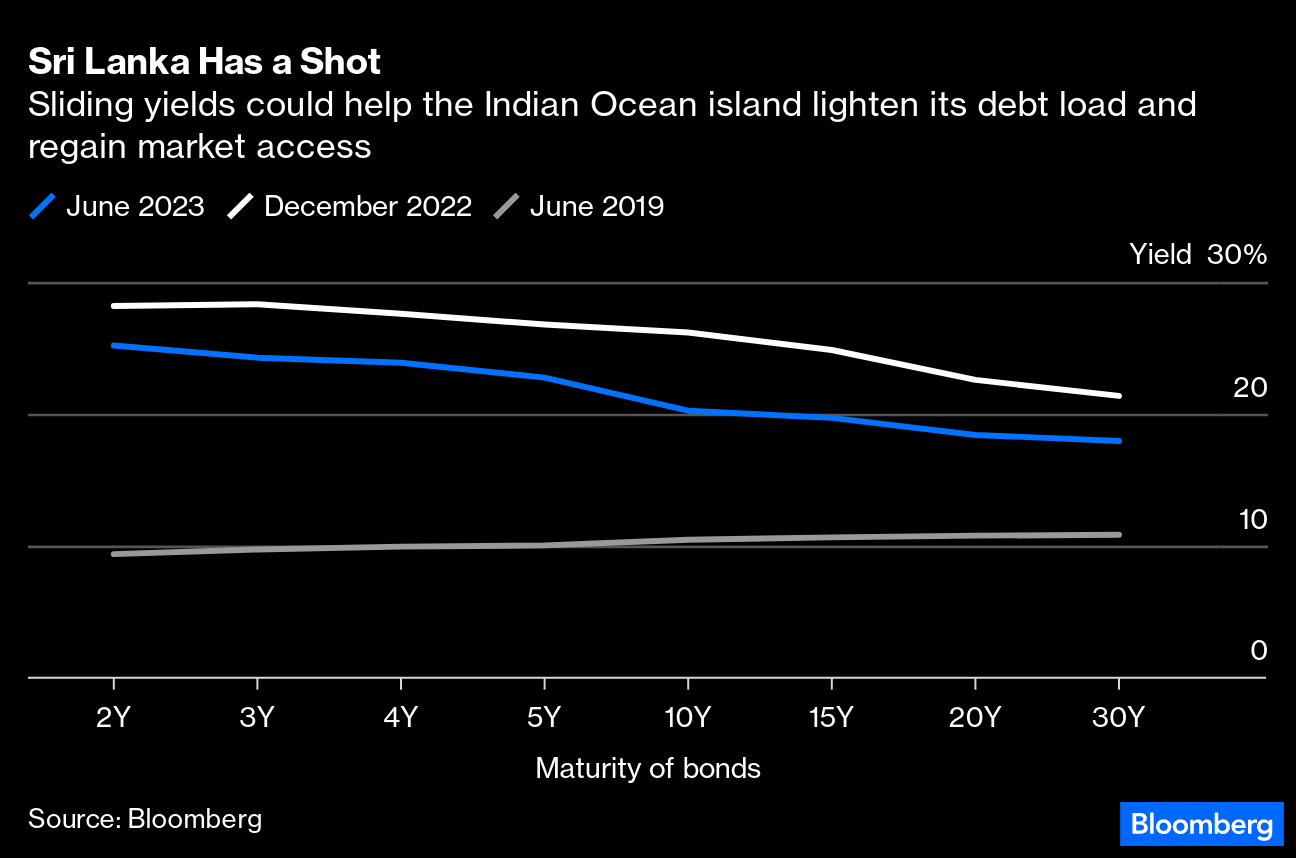
Yields on local government bonds were falling even before this month's unexpected 250 basis-point rate cut. If the slide continues, the bloated public debt — a legacy of severe mismanagement under previous President Gotabaya Rajapaksa — may become sustainable.
Domestic lenders will also make a lot of money in a falling interest-rate environment. Since bond prices move in the opposite direction of rates, the IOUs they buy now will become more valuable in the future. Revival of growth will fix the currently inverted shape of the yield curve at some stage. Lenders will have more opportunities to profit from maturity transformation: Borrowing short-term money and lending long-term funds.
Which is why banks and other domestic institutions should strike a bargain with authorities, and agree to write off a part of what they have lent to the government in the past. The bigger the sacrifice, the greater the reward for everyone. After all, international investors will be more likely to accept a restructuring in which the pain is spread fairly among the three main affected groups: local banks, official lenders, and foreign bondholders. There will be less reason to worry about prolonged legal action by holdout creditors.
A bank recapitalization plan, costing up to 6% of last year's gross domestic product, is baked into the $3 billion IMF loan as a contingency. It will be best to conclude the ongoing asset-quality review and meet any capital shortages right away so that savers are assured of the safety of their account balances. It isn't just the bond investments that must be written down. Depository institutions have to make provisions against soured loans to the private sector, too. Waiting for tax revenue to build before recapitalization may be counterproductive. That will take time — and more reform.
Even as the government goes about meeting the remaining three-quarters of its commitments to the Fund, the financial sector has to work with the monetary authority to achieve the required interest-rate reduction. The 10-year yield, which was 26% in December, has fallen to 20%. For last year's public debt of 128% of GDP to start coming down, the benchmark needs to decline to about 17% this year.
That will at least mark a partial return to the 10% yield on the 10-year bond four years ago, before Rajapaksa and his brothers ruined the economy with a disastrous revenue plan, a harebrained ban on chemical fertilizers, a reckless dependence on China, and a mindless pursuit of trophy projects like a tax-free playground for the rich.
Ranil Wickremesinghe, Sri Lanka's current president, had promised a debt restructuring framework by May. That was optimistic because of Beijing's recalcitrance. If the lender is hoping to privately negotiate a sweeter outcome for itself with Wickremesinghe, then that's a nonstarter. No such deal may be acceptable to New Delhi or Tokyo. And as long as large bilateral creditors are stuck in a stalemate, the private-sector investors can't move forward, either.
Sri Lanka's bond market is showing glimpses of a better future to 23 million people. It will be a shame if the Indian Ocean island can't make a quick, clean break with the past to grab that chance.
More from Bloomberg Opinion:
- Sri Lanka Is a Preview of a Global Default Crisis: Ruth Pollard
- Why Sri Lanka's Suffering May Not End Soon: Andy Mukherjee
- China's Debt Noose Might Just Strangle Pakistan: Mihir Sharma
This column does not necessarily reflect the opinion of the editorial board or Bloomberg LP and its owners.
Andy Mukherjee is a Bloomberg Opinion columnist covering industrial companies and financial services in Asia. Previously, he worked for Reuters, the Straits Times and Bloomberg News.
More stories like this are available on bloomberg.com/opinion
©2023 Bloomberg L.P.

-
Getting To Work Costs Women More | The Reason Why

It is not just about women paying more than men. It is about women paying much more in cities than in villages.
-
AI Bias In Investing Cannot Be Eliminated, But It Can Be Governed
Framing is a particularly important example as identical financial information presented in terms of gains rather than losses can lead an LLM to reach a different assessment.
-
Joining The Dots | Dark Skies, Steady Diya: Why Hope Holds This Diwali
With war, a weak rupee and foreign outflows weighing on sentiment, policymakers at the NDTV World Summit and market veterans at NDTV Profit Ignite: Diwali Edition offered the same advice: stay invested and filter out the noise.
-
The Curious Case of Equitas Small Finance Bank And A CEO Who Quit For Stock
PN Vasudevan believes persistent investor concerns over a perceived conflict of interest had become a governance overhang on Equitas Small Finance Bank's stock, even as the lender improved profitability and asset quality.
-
Talking Points This Week: AI Cash Burn, A Tiger Comeback And An India That Still Finds Its Own Path
India is not immune to higher oil or tighter global liquidity, yet its earnings base is broader, its domestic policy levers are still available.
-
Foreign Investors Own Half Of HDFC Bank and ICICI Bank. An LTCG Cut Could Matter Most Here
Foreign portfolio investors have US$115 billion parked in HDFC Bank, ICICI Bank. If the government cuts long-term capital gains tax, Jefferies says returning foreign money could land here first.
-
'Never Seen This Level Of Negativity': Sandeep Tandon Says The Next Rally May Be Closer Than You Think
Veteran investor Sandeep Tandon says foreign selling is easing, large-caps are due a comeback and mid-caps are crowded, while he turns positive on gold, power and pharma this Diwali.
-
Indians Stay With Family, Not In Hotels | The Reason Why
India still lacks enough clean, reliable and affordable hotels for budget-conscious travellers.
-
The Economic Imperative: Analysing The Material Driving Force Behind India-Canada Strategic Reset
This economic complementarity is further reinforced by deep institutional investment ties and talent mobility, which form the bedrock of the bilateral framework.
-
Medicine Pricing: Where Must Profit Stop?
India must confront excessive margins, hidden incentives and regulatory gaps that threaten the integrity of medicine.










