Russian Explosive Makers Use Fertilizer Firms to Blunt Sanctions
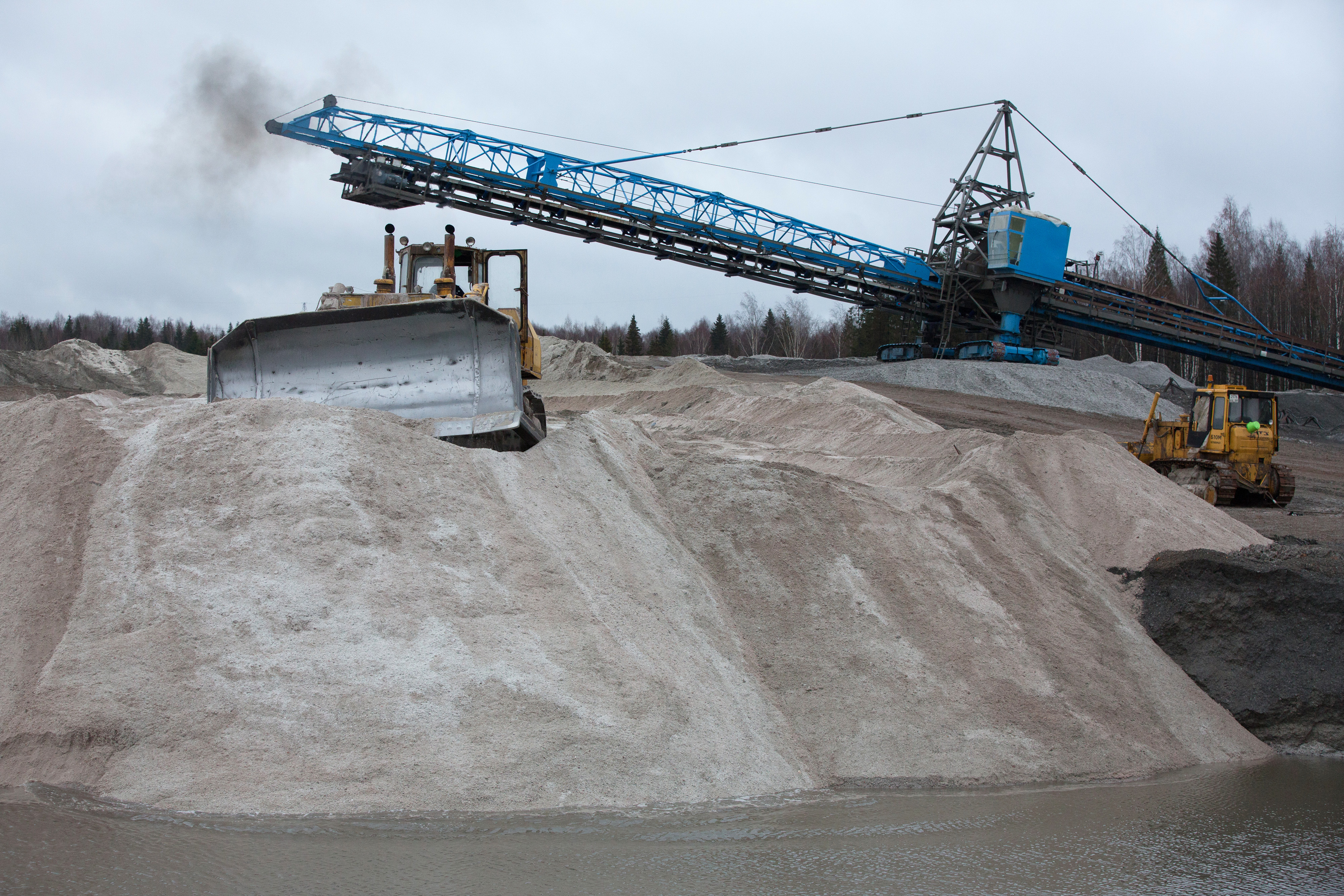
(Bloomberg) --Russia is scheduled to receive deliveries of chemical ingredients critical to the manufacture of explosives, ordered from fertilizer companies that have largely escaped international sanctions, according to documents seen by Bloomberg.
Tens of thousands of tons of nitric acid and a nitric-sulphuric-acid mix have been ordered for entities and plants controlled by JSC Spetskhimiya, one of Russia's biggest makers of explosives, the documents show. The contracts are one way in which the country maintains its military strength despite rigorous economic restrictions.
The orders for the Spetskhimiya-controlled facilities were placed with subsidiaries of fertilizer producers EuroChem Group AG and UralChem JSC, the documents show. The acid types are key components of TNT, gunpowder and other propellants vital to Russia's war against Ukraine. Yet EuroChem and UralChem have so far avoided the toughest of US and European sanctions aimed at hampering the country's military effort, as the fertilizers they sell are critical to farming and global food supplies.
Many of the 11 factories named in the documents as due to receive the acids this year have been sanctioned by Ukraine's allies for contributing to Russia's war efforts. The plants also provide explosives for civilian use and Bloomberg is unable to verify how much of their current operations focus on non-military purposes.
The planning documents, which include order-reference numbers, suggest the acid supplies have been confirmed and will be delivered over the course of the year.
EuroChem “is an important part of global food security,” the firm said in emailed comments. “Our products are intended for use in agriculture and civil industry. The company is not part of the defense sector of the Russian economy.”
UralChem didn't respond to requests for comment. Rostec State Corp, the sanctioned government-owned conglomerate that controls Spetskhimiya, also didn't reply to a request for comment. Spetskhimiya was sanctioned by the EU last June.
Russia supplies about a quarter of Europe's fertilizer, a business that's been worth more than 5 billion euros ($5.4 billion) since Moscow's war against Ukraine began in February 2022, according to data published by the European Commission. The bloc is working to introduce punitive tariffs on some fertilizers from Russia and Belarus, though its ability to further restrict the trade is limited by a need to ensure food supplies are not disrupted.

The US said on Tuesday that Russia and Ukraine agreed to a ceasefire in the Black Sea, though the Kremlin said this would be dependent on sanctions relief for banks and other services involved in agricultural exports including fertilizer shipments.
Nitric acid is a central ingredient in plastic explosive RDX and nitrocellulose, a key component in gunpowder. Nitrocellulose, or guncotton, is the most important ingredient in propellants for modern shells. As the name suggests, it is made from high-grade cotton, which is then soaked in a mix of acids. Just one round of artillery ammunition requires about 12kg (26lb) of gunpowder.
Based on the volumes of nitric acid the schedules show flowing into Rostec subsidiaries this year, Russia would have the material to manufacture at least 6,500 152 mm artillery shells a day this year, according to Bloomberg calculations. Russia has the capacity to produce or refurbish some 3-4 million artillery shells per year, according to estimates published in 2024.
“Nitrocellulose can be used for gunpowder as well as other non-military applications,” said Bradley Martin, a retired Navy captain who studies military supply chains at US research firm Rand Corp. “Most munition supply chains involve precursor material that are going to be moving all over the world.”
The mixture of nitric and sulphuric acid is used to make trinitrotoluene, commonly known as TNT. Historically, Russia's military has also used it as a rocket propellant.
The findings raise question marks over EU supply chains, which continue to include large volumes of Russian fertilizer, according to Mark Bromley at the Stockholm International Peace Research Institute. “Sanctions imposed on Russia can and should be able to prevent economic actors from conducting business with Rostec and its subsidiaries,” he said.
EuroChem, which is registered in Zug, Switzerland, is scheduled to supply through its Russian subsidiary about 40,000 tons of nitric acid to plants linked to Rostec, a company sanctioned by Swiss authorities.
The documents indicate that UralChem and EuroChem have the capacity to meet a significant portion of the Russian demands for nitric acid and the nitric-sulphuric mix this year.

Andrey Melnichenko (Photo Source: Bloomberg)
UralChem is controlled by the family of Dmitry Mazepin, a tycoon sanctioned by the European Union. Russian President Vladimir Putin awarded Mazepin with the Order of Alexander Nevsky, one of the oldest Russian state awards, in 2023.
EuroChem is linked to the family of billionaire Andrey Melnichenko. He withdrew as a beneficiary of a trust that owns EuroChem shares through a holding company after getting hit with sanctions from the US, the EU and UK.
Both companies are significant suppliers of nitrogen-based fertilizers. Nitric acid is primarily used to produce ammonium nitrate, a key component in the production of chemicals used by farmers.
EuroChem and UralChem are so hard to sanction due to their significant role in the global agricultural industry, according to Nick Reynolds, a defence researcher at London's Royal United Services Institute.
“These are bulk-material commodities that would be very hard to control,” he said. “Broader sanctions on these materials would be unlikely to constrain Russia. They would just set up new front companies in places where others are willing to fill the gap.”
Scheduling Plans
The scheduling plans seen by Bloomberg show factories including the Sverdlov facility in Dzerzhinsk and the Biysk Oleum plant are expecting deliveries this year. Many of the facilities named have been sanctioned by Ukraine's allies for supplying Russia's military industry, including the Solikamsk Plant Ural, the Tambov gunpowder plant, the Perm powder plant and the Kazan state gunpowder plant.
Rostec is sanctioned by the US and the EU. The state company is headed by long-term Putin ally Sergey Chemezov, who in the 1980s served with the now Russian president in the KGB in East Germany.

-
Getting To Work Costs Women More | The Reason Why

It is not just about women paying more than men. It is about women paying much more in cities than in villages.
-
AI Bias In Investing Cannot Be Eliminated, But It Can Be Governed
Framing is a particularly important example as identical financial information presented in terms of gains rather than losses can lead an LLM to reach a different assessment.
-
Joining The Dots | Dark Skies, Steady Diya: Why Hope Holds This Diwali
With war, a weak rupee and foreign outflows weighing on sentiment, policymakers at the NDTV World Summit and market veterans at NDTV Profit Ignite: Diwali Edition offered the same advice: stay invested and filter out the noise.
-
The Curious Case of Equitas Small Finance Bank And A CEO Who Quit For Stock
PN Vasudevan believes persistent investor concerns over a perceived conflict of interest had become a governance overhang on Equitas Small Finance Bank's stock, even as the lender improved profitability and asset quality.
-
Talking Points This Week: AI Cash Burn, A Tiger Comeback And An India That Still Finds Its Own Path
India is not immune to higher oil or tighter global liquidity, yet its earnings base is broader, its domestic policy levers are still available.
-
Foreign Investors Own Half Of HDFC Bank and ICICI Bank. An LTCG Cut Could Matter Most Here
Foreign portfolio investors have US$115 billion parked in HDFC Bank, ICICI Bank. If the government cuts long-term capital gains tax, Jefferies says returning foreign money could land here first.
-
'Never Seen This Level Of Negativity': Sandeep Tandon Says The Next Rally May Be Closer Than You Think
Veteran investor Sandeep Tandon says foreign selling is easing, large-caps are due a comeback and mid-caps are crowded, while he turns positive on gold, power and pharma this Diwali.
-
Indians Stay With Family, Not In Hotels | The Reason Why
India still lacks enough clean, reliable and affordable hotels for budget-conscious travellers.
-
The Economic Imperative: Analysing The Material Driving Force Behind India-Canada Strategic Reset
This economic complementarity is further reinforced by deep institutional investment ties and talent mobility, which form the bedrock of the bilateral framework.
-
Medicine Pricing: Where Must Profit Stop?
India must confront excessive margins, hidden incentives and regulatory gaps that threaten the integrity of medicine.










